The founding claims
The CES Letter
A long list of doubts, and the table of which of its points the Church’s own pages now confirm.
The point in one sentence
The CES Letter is a one-sided document built to persuade, and some of its claims fail, but on most of its main topics a page the Church itself publishes confirms the facts the letter relies on and disputes only what they mean.
If you have heard of the CES Letter, it was probably described to you as a list of attacks on the Church. CES stands for Church Educational System, the Church’s seminary and institute program, and the letter was written to one of its directors. This page does not ask you to trust the letter. It asks a simpler question: do the Church’s own pages, which you can open yourself, say the same things? (Gospel Topics essays are the short articles the Church began publishing in 2013 on hard questions in its history and teaching.)
Twelve topics from the letter, checked against the Church’s own pages
Twelve topics from the letter, chosen for this page and checked against Church-published pages (table below). Lit means a Church page confirms a fact the letter relies on.
11 of 12 topics have a Church page. Seven are Gospel Topics essays, four are Church History Topics pages. Only the seven italicized words have no Church page found for this page. On the Hofmann and priesthood rows the page confirms less than the letter claims; the table says exactly how much.
Each row below links to the Church page and quotes it
The world the letter came from
Jeremy Runnells was a member who, by his own account on cesletter.org, began to have doubts in 2012. His grandfather asked a Church Educational System institute director to talk with him, and in March 2013 the director asked him to write down his questions and concerns. He wrote the letter over about three weeks. It was posted on the internet in April 2013, which Wikipedia puts at 84 pages. By Runnells’s account the director said he would reply and never did, and Wikipedia reports no official response from the Church was released.
He called it “Letter to a CES Director”. The current version carries the subtitle “My Search for Answers to my Mormon Doubts”. It is organized by topic: the Book of Mormon and its translation, the First Vision, the Book of Abraham, polygamy and polyandry, prophets, the Kinderhook plates, testimony, priesthood restoration, the witnesses, temples and Freemasonry, science, other concerns, a conclusion and an epilogue. The author published a revised version in October 2017.
The timing matters for what follows. The Church began publishing its Gospel Topics essays seven months after the letter went online. According to a secondary list of release dates (the Church’s own pages show only a 2016 revision year), the first, “First Vision Accounts”, appeared on 20 November 2013, and the essays on several of the letter’s subjects followed. This page does not claim the letter caused them; the Church has not said so. It only means a reader can now put the letter next to what the Church itself publishes on each topic, which is what the table below does.
What defenders and the Church have said
Three statements bear on how to read the letter. Two answer it directly or by name; the third is the Church’s general position on evidence.
FAIR (a volunteer-run, independent organization of Latter-day Saint defenders), Sarah Allen, “CES Rebuttal, Part 1 (extended version)”, 25 August 2021
a rapid series of many specious arguments, half-truths, and misrepresentations in a short space of time, which makes it impossible
FAIR’s Sarah Allen presents this as a passage from Wikipedia’s article on the “Gish gallop” (the current Wikipedia text is worded differently) and says the letter uses the technique. FAIR also prints, under the same Wikipedia heading: “In practice, each point raised by the ‘Gish galloper’ takes considerably more time to refute or fact-check than it did to state in the first place.” This page does not attribute that sentence to a named author. This is the strongest general objection: a long list overwhelms, and the effect is not evidence.
FAIR, Part 1Tad R. Callister, then general president of the Sunday School, A Case for the Book of Mormon (Deseret Book, 2019), as reported on Wikipedia
“rash” … “partial truths” … “a classic case of ‘presentism’”
Wikipedia reports that Callister, calling Runnells an unnamed “critic”, described his assertions as “rash”, “partial truths” and “a classic case of ‘presentism’”. These are Wikipedia’s words for a 2019 book not read for this page, so neither the context nor which claims Callister meant is checked here.
Wikipedia, CES LetterThe Church of Jesus Christ of Latter-day Saints, Gospel Topics essay “Book of Mormon and DNA Studies”
It is our position that secular evidence can neither prove nor disprove the authenticity of the Book of Mormon.
The Church’s position in this essay. It does not say the letter is wrong about the facts. It says the facts cannot settle the question.
The essay on churchofjesuschrist.orgRunnells resigned his membership in April 2016 during a disciplinary council held over the letter. Wikipedia reports he told supporters outside: “What errors or mistakes are there in the ‘CES Letter’ or on my website that I can publicly correct? If there are no errors or mistakes, why am I being punished for seeking and sharing the truth?” The first question is a fair one, and much of this page tries to answer it.
A method can be unfair and the documents still be real.
The Gish gallop charge is about how the letter is built. It says nothing about whether any one page of it is accurate. That has to be checked item by item.
From the letter to the Church’s pages
Essay dates are release dates as listed in press and blog coverage; the Church’s own pages show only a 2016 revision year. No cause is claimed between any two lines.
Sources: cesletter.org; Wikipedia; essay release dates from press and blog coverage (the Church’s essay pages show only a 2016 revision year)
The exhibits
Seven Church-published sources first, then B. H. Roberts as an outside check. Quotes are as printed on the page linked unless the card says otherwise.
Gospel Topics essay, “Translation and Historicity of the Book of Abraham”
first published 2014
What it establishes: The letter’s Abraham chapter rests on this. The essay’s next sentence: “Latter-day Saint and non-Latter-day Saint Egyptologists agree that the characters on the fragments do not match the translation given in the book of Abraham, though there is not unanimity, even among non-Latter-day Saint scholars, about the proper interpretation of the vignettes on these fragments.” The essay then answers with believing readings: Joseph’s study of the papyri “may have led to a revelation about key events and teachings in the life of Abraham”; the fragments “do not have to be as old as Abraham” for the book to be authentic; and “much of the papyri accessible to Joseph … is not among these fragments.” The facts about the fragments are not disputed; what they show is. The full case is on the Abraham page.
Read the essayGospel Topics essay, “Book of Mormon and DNA Studies”
first published 2014
What it establishes: Both halves of the letter’s DNA point are in the Church’s own words. The essay’s next sentences say “Nothing is known about the extent of intermarriage and genetic mixing” and offer the limited-geography reading. See the historicity page.
Read the essayGospel Topics essay, “Book of Mormon Translation”
first published 2013
What it establishes: The essay also quotes Emma: the plates “often lay on the table without any attempt at concealment, wrapped in a small linen table cloth.” Asked whether Joseph had dictated from the Bible or a prepared manuscript, Emma, in the essay, answered: “He had neither manuscript nor book to read from.” All of this is in the Church’s account, and it bears on what “translation” meant. See the translation page.
Read the essayGospel Topics essay, “Plural Marriage in Kirtland and Nauvoo”
first published 2014
What it establishes: Two of the letter’s polygamy claims, in the essay’s own sentences. The essay presents the practice as commanded: an angel “with a drawn sword” threatened Joseph unless he obeyed. It rejects the letter’s label “polyandry” in a footnote: “There is no evidence that Joseph Smith’s sealings functioned in this way, and much evidence works against that view.” See the polygamy page.
Read the essayGospel Topics essay, “First Vision Accounts”
first published 2013
What it establishes: The letter says the accounts contradict. The Church says they are consistent in substance and different in detail. Both agree there are four and that they differ. See the First Vision page.
Read the essayGospel Topics essay, “Peace and Violence among 19th-Century Latter-day Saints”
first published 2014
What it establishes: This is the letter’s blood atonement material; the letter says the Church “now confirms” that Brigham Young taught blood atonement, and that it was later declared false by subsequent leaders. The essay adds that “it is likely that in at least one instance, a few Latter-day Saints acted on this rhetoric” and that most “seem to have recognized” the sermons as, in historian Paul Peterson’s words, “hyperbole or incendiary talk.” The essay also covers the Mountain Meadows Massacre, which the letter does not raise: leaders’ “intemperate preaching” contributed to “a climate of hostility,” but “President Young did not order the massacre.” See When Prophets Were Wrong.
Read the essayChurch History Topics, “Masonry”
no year shown
What it establishes: The Church places the Nauvoo endowment after Joseph’s initiation as a Mason (15 March 1842) and says the first endowments, on 4 May 1842, were given to nine men, all of whom were Masons. The page also stresses “significant differences in their substance” between the two. See Doctrines That Changed.
Read the pageB. H. Roberts, Studies of the Book of Mormon (written in the early 1920s; first published as a book in 1985), as quoted on Wikipedia
first published as a book in 1985
What it establishes: The framing matters. Wikipedia reports that Roberts, a General Authority, wrote the study after questions put to the Church (accounts differ on whether the First Presidency asked him to develop an apologetic), and that he told Church leaders he was “taking the position that our faith is not only unshaken but unshakable in the Book of Mormon, and therefore we can look without fear upon all that can be said against it.” It also reports he continued to affirm his faith until his death in 1933, though a lively debate exists over whether his private conviction survived. So it is a real study of the strongest objections, not a confession of unbelief. The quotes are from Wikipedia’s account, not the book. See also Wikipedia, B. H. Roberts.
Wikipedia, Studies of the Book of MormonThe visual breakdown: the letter against the Church’s own pages
This is the check to run yourself. Left: the topic as the letter raises it. Then the Church page that addresses it, what that page confirms in its own words, and what the Church still disputes. Twelve rows, in the letter’s order.
| The letter’s topic | Where the Church addresses it | What the Church’s page confirms | What it still disputes |
|---|---|---|---|
| Book of Mormon translation (page) | Gospel Topics essay, “Book of Mormon Translation” (first published 2013) | Joseph “placed either the interpreters or the seer stone in a hat” and read the words aloud. | That the method undercuts the claim: the essay reads the stone as an instrument of translation. |
| DNA and the Lamanites (page) | Gospel Topics essay, “Book of Mormon and DNA Studies” (first published 2014) | “the majority of Native Americans carry largely Asian DNA”; the 2006 introduction says “among the ancestors.” | That DNA bears on authenticity: “secular evidence can neither prove nor disprove.” |
| The First Vision (page) | Gospel Topics essay, “First Vision Accounts” (first published 2013) | Four accounts, which “differ in emphasis and detail.” | That they contradict: “a basic consistency remains.” |
| The Book of Abraham (page) | Gospel Topics essay, “Translation and Historicity of the Book of Abraham” (first published 2014) | “None of the characters… mentioned Abraham’s name”; the fragments date “long after Abraham lived.” | That the Book of Abraham is therefore not authentic: the essay says the fragments “do not have to be as old as Abraham” for the book to be authentic, that much of the papyri Joseph had is “not among these fragments”, and that his study of the papyri “may have led to a revelation”. |
| Polygamy and polyandry (page) | Gospel Topics essay, “Plural Marriage in Kirtland and Nauvoo” (first published 2014) | Helen Mar Kimball sealed “several months before her 15th birthday”; sealings to women “already married.” | That this was polyandry or wrong: a footnote says “There is no evidence that Joseph Smith’s sealings functioned in this way, and much evidence works against that view”; the essay presents the practice as commanded, under angelic threat. |
| The priesthood and race (page) | Gospel Topics essay, “Race and the Priesthood” (first published 2013) | In 1852 Brigham Young announced that men of black African descent “could no longer be ordained”. | That the theories were doctrine: “Today, the Church disavows the theories advanced in the past that black skin is a sign of divine disfavor or curse…”; the essay calls the ban a “policy” that ended with a revelation in June 1978. |
| Blood atonement (page) | Gospel Topics essay, “Peace and Violence among 19th-Century Latter-day Saints” (first published 2014) | Leaders taught the perpetrator’s “blood would have to be shed”; “it is likely that in at least one instance, a few Latter-day Saints acted on this rhetoric.” | That the sermons were meant literally: most “seem to have recognized” the sermons as “hyperbole or incendiary talk.” On Mountain Meadows (not raised in the letter) the essay says “President Young did not order the massacre.” |
| Kinderhook plates (page) | Church History Topics, “Kinderhook Plates” (no year shown) | Clayton wrote that Joseph said the plates contained the history of a descendant of Ham. | That Joseph translated: he “evidently did not attempt a revelatory translation.” |
| Mark Hofmann’s forgeries | Church History Topics, “Hofmann forgeries” (no year shown) | Hofmann forged documents including the Salamander letter and the Joseph Smith III blessing; “The Church acquired several documents from him.” | Not addressed: the page does not say what the Church paid or whether leaders were deceived, and the letter’s charges of purchase, suppression and dishonesty are not answered here. |
| Temples and Freemasonry (page) | Church History Topics, “Masonry” (no year shown) | Joseph was initiated as a Mason on 15 March 1842; the first endowments, on 4 May, went to nine men, all Masons. | That the endowment is Masonic: the page names “significant differences in their substance”, while calling Masonry a “catalyst for revelation.” |
| Priesthood restoration records (page, edited revelations) | Church History Topics, “Restoration of the Aaronic Priesthood” (no year shown); see also Saints, vol. 1, ch. 7 | Calls Cowdery’s 1834 letters “the earliest detailed account” of John the Baptist’s appearance, and notes that Joseph’s 1832 history, in an outline of what it would cover, promised to narrate “the reception of ‘the holy Priesthood’ by the ministering of angels.” | Not treated as a problem: the page gives the reticence of Joseph and Oliver “owing to a spirit of persecution” as the reason details came later. See the restoration page for the dates. |
| Seven italicized 1611 words in 3 Nephi 24:10 (page) | No Church page found for this page. FAIR answers it. | None. | FAIR’s answer is in the rebuttals below. |
Eleven of twelve topics have a Church page. That is not the same as the Church agreeing with the letter. In most rows the last column is a position held by believers, and several of them (the believing readings of Abraham, the limited-geography reading of DNA, the Church’s reading of the First Vision accounts) are serious answers, not dodges. What the table shows is narrower: on these topics the Church’s own pages now state many of the facts the letter relies on. Where the Church’s page disagrees with the letter’s wording (polyandry, Hofmann), the last column says so.
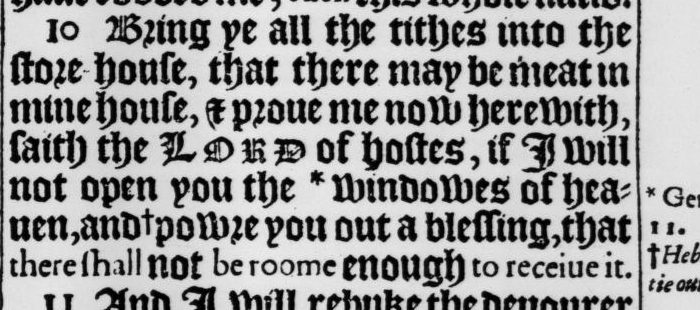
One row you can check without a Church page at all. Here is Malachi 3:10 as the 1611 King James Bible printed it:
What is true on the other side
Take the strongest case at full strength first. FAIR’s point is that a list of many items is a persuasion technique, not an investigation, and that the format hides how many items are weak. That is correct in kind, and it is why some items below fail. A second point is the believer’s own: the Church does not say the facts the table lists are wrong. It says the facts, once known, still fit a faith that rests on a spiritual witness rather than on any one document. That position is coherent, and honest people hold it.
FAIR also makes a specific point on priesthood restoration that the letter does not give weight to. The letter quotes David Whitmer, from a 14 January 1885 interview (Early Mormon Documents 5:137): “I never heard that an Angel had ordained Joseph and Oliver to the Aaronic Priesthood until the year 1834[,] [183]5, or [183]6 – in Ohio,” and, in the letter’s longer version, that he does not believe John the Baptist ever ordained them. FAIR notes that in the same interview Whitmer says Oliver told him in Joseph’s presence in 1829 that they had baptized each other, and that in June 1829 “Joseph ordained Oliver Cowdery to be an Elder, and Oliver ordained Joseph to be an Elder in the Church of Christ.” FAIR argues that “ordain” in 1828 usage meant conferring priesthood power, so Whitmer’s own account has priesthood authority conferred before 1834, and that he gave the interview long after leaving the Church. On FAIR’s reading, then, Whitmer did not deny early ordinations; what he rejected was an angelic ordination.
The Church’s own History Topics page, “Restoration of the Aaronic Priesthood”, calls Cowdery’s 1834 letters “the earliest detailed account” of John the Baptist’s appearance, about five years after the event. It also notes that Joseph’s 1832 history, in an outline of what it would cover, promised to narrate the reception of “the holy Priesthood” by the ministering of angels (the narrative itself stops before it gets there; see the restoration page). The page explains the delay by Joseph’s and Oliver’s reticence “owing to a spirit of persecution.”
The Late War parallels. FAIR’s response to the letter calls the list a “Texas Sharpshooter” pattern, finding matches without showing a connection. This page has not independently tested the parallels.
The list of town and city names Joseph supposedly took for the Book of Mormon. FAIR calls it “debunked many, many times” and reports that Runnells asked the Exmormon subreddit whether to remove it, qualify it, or leave it, and kept it “basically as is, with a few of the most egregiously bad arguments removed.” The Church has no page on it, and this page has not tested the list itself.
How literally to take the blood atonement sermons. The letter quotes Journal of Discourses 4:53-54 and says the Church now confirms Brigham Young taught it. The essay does confirm leaders taught it, and adds that most Latter-day Saints seem to have recognized the sermons as “hyperbole or incendiary talk” (while allowing that a few acted on it in at least one instance). This page has not sourced a Church statement that the teaching was later declared false, or one on Adam-God, so it makes no claim about either.
B. H. Roberts as a suppressed confession. The letter says Roberts’ study was meant for Church leaders and not the public, and it was first published as a book in 1985. Wikipedia reports that Church authorities “proved uninterested” in examining it, which is not the same as proof it was hidden. Wikipedia also reports that Roberts continued to affirm his faith in the Book of Mormon until his death in 1933, while noting a lively debate over whether his private conviction survived. What can be said is narrower: a General Authority wrote a detailed study of the strongest objections he knew, and it was not published until 1985.
Whitmer as a witness that no priesthood was conferred in 1829. The letter quotes Whitmer accurately on not hearing of an angel’s ordination until the mid-1830s. In the same 1885 interview Whitmer says Joseph and Oliver ordained each other elders in June 1829 (FAIR). His interview does not deny early ordinations; it denies, or does not recall, the angel.
The common rebuttals
“It’s a Gish gallop. Eighty-four pages of half-truths. Answering it point by point just proves the point.”
Half of this is right, and the page says so: some items are weak (the flag box above), and FAIR argues the format is built to overwhelm. Eleven of the twelve topics have a Church page, in sentences you can open and read. A charge about format does not answer an item; the item has to be checked on its own.
“Runnells had already left. He wrote it to take people out of the Church. You can’t trust a document with that motive.”
FAIR’s Sarah Allen reports, citing secondary accounts of a 15 November 2012 post on the Exmormon subreddit, that Runnells wrote he had already left the Church a few months before, and wanted “the most effective way to save” his children “from Mormonism.” The post was not read for this page, so that is a report of a report. If it is accurate, a motive is a reason to read with care, not a reason to stop. FAIR argues that the letter sets up a “genetic fallacy” by treating any answer from FAIR or the Maxwell Institute as “unofficial”, which would be the same mistake from the other side. The row for Abraham quotes a sentence the Church published; whatever the author wanted, that sentence says what it says.
“The Church published all of this itself. That shows it has nothing to hide.”
It does show openness, and credit is due for the essays. It also means the question has moved from whether the facts are real to what they mean. Many of the facts in the table are conceded; what is left is whether the believing readings (the Church’s readings of the Book of Abraham, the limited-geography reading of DNA) carry the weight of the original claims. Take Abraham. The book’s printed heading says it was “written by his own hand, upon papyrus”, and the essay dates the surviving fragments to between the third century B.C.E. and the first century C.E. The essay answers that the fragments “do not have to be as old as Abraham” for the book to be authentic, that much of what Joseph had “is not among these fragments”, and that the heading “can be understood to mean that Abraham is the author and not the literal copyist.” Those are the Church’s readings, and they are coherent. The Abraham page weighs them on their own terms: the length of a lost portion does not show what was on it; the facsimiles Joseph published himself, with his own explanations, survive and can be read directly; and Joseph described the roll as containing the writings of Abraham, which is the claim the heading makes. Whether those readings carry the weight the heading and the original claims put on them is a question about the claims, not about openness.
“The seven italic words are just the King James wording. Joseph used the Bible he knew as the base text.”
FAIR’s answer has two parts. First, FAIR reports that 38% of the italicized words in the King James Bible are changed in some way in the Book of Mormon, and argues that where the Book of Mormon keeps the italicized words it does so because they make the text read clearly. Second, FAIR cites Royal Skousen’s study of the manuscripts: “none of the King James language contained in the Book of Mormon could have been copied directly from the Bible,” and the original manuscript “shows no signs of visual copying.” On that view the English is a borrowed wording, so the match tells nothing about whether an ancient source lies beneath it. What the answer leaves open is why a speaker around 34 AD would be given, in English, words the 1611 translators had to supply. The reader can hold both. The full exchange is on the historicity page.
On most of the letter’s main topics, the Church’s own pages confirm the facts. Some of its other claims fail.
Sorting items into those two piles is the work the table does.
What this means
Strip away the format and the author and the length, and these twelve topics are left. On nearly all of them a page published by the Church confirms at least one fact the letter relies on: the seer stone in the hat, the largely Asian DNA, the four accounts, the characters that do not mention Abraham, a girl sealed to Joseph several months before her 15th birthday, the already-married wives, the 1852 restriction, the leaders’ teaching on blood, the Kinderhook entry, the forged documents the Church acquired, and Joseph’s Masonic initiation in 1842. A smaller set needs care: the town names, the Late War parallels, and how Roberts and Whitmer are used.
You do not have to take the letter’s word for most of these facts. The Church’s own website confirms them, usually with a believing reading attached.
That changes the question. It is no longer “is the author fair”; he is not neutral, and the page has said so. It is no longer “did the Church hide it”; it published it. The letter cannot be waved off as invented. What is left for each reader to decide is whether the believing readings can carry the claim that Joseph Smith translated ancient records by the power of God, now that the facts underneath them are on the Church’s own pages.