The institution
Doctrines That Changed
The scriptures say God is “the same unchangeable God.” The Church’s own pages show its teaching about who God is was revised in print in 1837, and the Lectures on Faith, printed as the “doctrine” half of the Doctrine and Covenants, were dropped in 1921. The Word of Wisdom called itself “not by commandment” and became a requirement in 1921.
The point in one sentence
If you grew up in the Church, you learned that God is “the same unchangeable God,” as the Church’s scriptures call him. The Church’s own pages show that what it printed about who God is, and how the Father and the Son relate, did change. The Book of Mormon was reworded on this subject in 1837. The Church taught one thing about the Father in 1835 and another in 1843. And in 1921 the Lectures on Faith, a set of lessons the Church had printed as the “doctrine” half of the Doctrine and Covenants, were dropped. The Church calls this clarification and continuing revelation. This page shows the documents, adds one case from outside the doctrine of God (the Word of Wisdom, which called itself “not by commandment” and became a temple-recommend requirement in 1921), and states what the documents show: the Church’s printed teaching about God changed, while its scripture says God does not.
What the Church says about change, at full strength
Start with the best version of the believing answer, because it is a strong one, and because the verses this page is built on are easy to misread.
Mormon 9:9-10 is not a verse about doctrine standing still. It is part of an argument for ongoing revelation. Two verses earlier, Mormon addresses “you who deny the revelations of God, and say that they are done away,” and says that whoever denies these things “knoweth not the gospel of Christ.” The unchanging God of verse 9 is the reason revelation has not ended. The same is true of D&C 20:11-12: God “does inspire men and call them to his holy work in this age,” “thereby showing that he is the same God yesterday, today, and forever.” On the believing reading, God does not change, and what changes is what people have been given to understand, one piece at a time.
2 Nephi 28:30, Book of Mormon
For behold, thus saith the Lord God: I will give unto the children of men line upon line, precept upon precept, here a little and there a little; and blessed are those who hearken unto my precepts, and lend an ear unto my counsel, for they shall learn wisdom; for unto him that receiveth I will give more.
The scripture itself describes revelation as gradual. A teaching that is incomplete in 1830 and fuller later is, on this reading, what the book says to expect.
2 Nephi 28, on churchofjesuschrist.orgThe Church of Jesus Christ of Latter-day Saints, Newsroom, “Approaching Mormon Doctrine”
In addition, the Church does not preclude future additions or changes to its teachings or practices. This living, dynamic aspect of the Church provides flexibility in meeting those challenges.
The Church’s own statement that change in teaching is possible. The same article draws the line that matters for fairness: “Not every statement made by a Church leader, past or present, necessarily constitutes doctrine. A single statement made by a single leader on a single occasion often represents a personal, though well-considered, opinion, but is not meant to be officially binding for the whole Church.” The article adds that doctrine “resides in the four ‘standard works’ of scripture ..., official declarations and proclamations, and the Articles of Faith.” The Book of Mormon and the Doctrine and Covenants are on that list.
The Newsroom articleElder D. Todd Christofferson, general conference, April 2012, “The Doctrine of Christ”
It is commonly understood in the Church that a statement made by one leader on a single occasion often represents a personal, though well-considered, opinion, not meant to be official or binding for the whole Church.
The same talk says that “establishing the doctrine of Christ or correcting doctrinal deviations is a matter of divine revelation to those the Lord endows with apostolic authority.” Sermons and speculation are one thing; establishing doctrine, or correcting deviations from it, is a matter of revelation to those with apostolic authority. The talk does not say whether the doctrine itself changes.
The talkArticle of Faith 9 says the same: “We believe all that God has revealed, all that He does now reveal, and we believe that He will yet reveal many great and important things pertaining to the Kingdom of God.”
The world these texts came from
The Church was organized on April 6, 1830. D&C 20, which the Joseph Smith Papers title “Articles and Covenants,” dates itself to “the fourth month, and on the sixth day of the month which is called April,” and in the text as it stands today, verse 17 describes God as “infinite and eternal, from everlasting to everlasting the same unchangeable God.” The Joseph Smith Papers date the revelation to circa April 1830 and note that its most substantive revisions were made for the 1835 edition. The first edition of the Book of Mormon was printed the same year, and the page at the top of this article is from it.
Five years later the Church was in Kirtland, Ohio, assembling its first Doctrine and Covenants. According to the Church’s own history page, all seven lectures were published together in 1835 in the first edition of the Doctrine and Covenants, “the lectures constituting the ‘doctrine,’ and Joseph Smith’s revelations, the ‘covenants.’” The Church’s introduction to the Doctrine and Covenants says they had been prepared for a school in Kirtland in 1834 and 1835. In 1837, “Joseph Smith and Oliver Cowdery prepared a second edition.” The preface they wrote states: “Individuals acquainted with book printing, are aware of the numerous typographical errors which always occur in manuscript editions.” Not every change was a typographical one: the Church’s page describes the second edition as “over a thousand minor corrections ... as well as a few important clarifications.” It adds that their approach “resembled how publishers of the Bible at the time improved editions for English readers.”
By April 2, 1843, Joseph Smith was teaching something the 1835 book did not say, and which the Church now prints as scripture: “The Father has a body of flesh and bones as tangible as man’s; the Son also; but the Holy Ghost has not a body of flesh and bones, but is a personage of Spirit.” (D&C 130:22). Hold that sentence next to a page from the 1835 book, below.
What the scriptures say, in the Church’s own words
| Where | What it says |
|---|---|
| Mormon 9:9-10 | “For do we not read that God is the same yesterday, today, and forever, and in him there is no variableness neither shadow of changing? And now, if ye have imagined up unto yourselves a god who doth vary, and in whom there is shadow of changing, then have ye imagined up unto yourselves a god who is not a God of miracles.” |
| Moroni 8:18 | “For I know that God is not a partial God, neither a changeable being; but he is unchangeable from all eternity to all eternity.” |
| D&C 20:12 | “Thereby showing that he is the same God yesterday, today, and forever. Amen.” |
| D&C 20:17 | “By these things we know that there is a God in heaven, who is infinite and eternal, from everlasting to everlasting the same unchangeable God, the framer of heaven and earth, and all things which are in them.” |
| Hebrews 13:8 (KJV) | “Jesus Christ the same yesterday, and to day, and for ever.” |
These verses are about God. So the test is what the Church has taught about who God is.
And on that subject, the documents have a history.
Who God is, as it was printed
The same subject, in the order it was published. Each entry is a document you can open.
Sources: josephsmithpapers.org (1830 and 1837 editions, 1835 Doctrine and Covenants, 1832 history); churchofjesuschrist.org (scriptures, Church history topics)
The exhibits
Church sources first. Every quote is verbatim from the source named, and the sources are linked.
The Church of Jesus Christ of Latter-day Saints, Church history topics, “Changes to the Book of Mormon”
churchofjesuschrist.org
What it establishes: The Church names who made the 1837 changes. They were not made by a later editor or a printer.
The Church pageSame page, on what they changed
churchofjesuschrist.org
What it establishes: The Church confirms the 1830 wording, confirms the manuscripts read the same way, and describes the 1837 changes as including “a few important clarifications.” It also says: “Their approach in updating the Book of Mormon resembled how publishers of the Bible at the time improved editions for English readers.” The page images below show the same kind of change in 1 Nephi 11:18, 11:21 and 13:40.
Same Church pageDoctrine and Covenants, 1835, Lecture Fifth
printed in Kirtland, Ohio, 1835
What it establishes: Later in the same passage the Son is described as “possessing the same mind with the Father, which mind is the Holy Spirit.” The same passage calls the Son “the express image and likeness of the personage of the Father.” Read in full, it describes a Father of spirit, a Son with a tabernacle, and a Holy Spirit that is their shared mind.
The 1835 book, Joseph Smith PapersThe Church of Jesus Christ of Latter-day Saints, Church history topics, “Lectures on Theology (Lectures on Faith)”
churchofjesuschrist.org
What it establishes: One of the Church’s own stated reasons for the 1921 removal. It says “seems to,” and so does this page. The same page says Elder James E. Talmage, who led the 1921 revision committee, felt it would be best to “avoid confusion and contention on this vital point of belief,” and that the committee also argued the lectures “had not been accepted by the Church as anything other than theological lessons.”
The Church pageThe Church of Jesus Christ of Latter-day Saints, Doctrine and Covenants, Introduction
churchofjesuschrist.org
What it establishes: The believing answer, stated by the Church itself, and a fair one. The lectures were never offered as revelation. They were, though, printed for 86 years as the “doctrine” half of the Doctrine and Covenants.
The introductionDoctrine and Covenants 130:22, dated April 2, 1843
printed in your scriptures today
What it establishes: Note the last words. The phrase “personage of Spirit” now describes the Holy Ghost, where in 1835 it was used of the Father.
D&C 130No outside scholar is quoted on this page. The Church’s own pages and the Joseph Smith Papers supply every fact it rests on.
The visual breakdown: the same chapter, 1830 and 1837
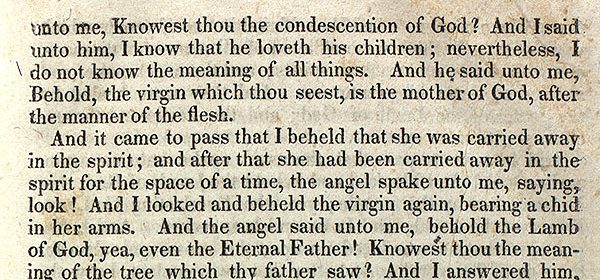
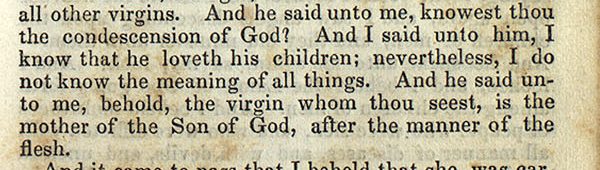
1 Nephi 11 is the vision in which an angel shows Nephi a young woman in Nazareth and a child in her arms and tells him what he is looking at. The first edition is the page at the top of this article (with “mother of God” and “the Eternal Father”). Here is the same passage in the second edition.

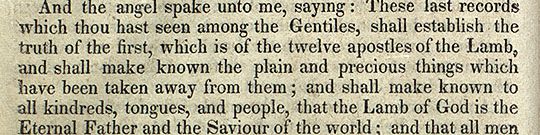
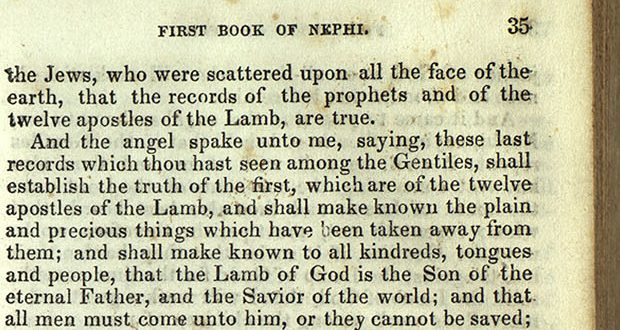
The same edit appears a chapter later, in 1 Nephi 13:40:
| Verse | 1830 first edition | As printed now | When, and by whom |
|---|---|---|---|
| 1 Nephi 11:18 | “the mother of God” | “the mother of the Son of God” | 1837, Joseph Smith and Oliver Cowdery (the Church) |
| 1 Nephi 11:21 | “the Lamb of God, yea, even the Eternal Father” | “the Lamb of God, yea, even the Son of the Eternal Father” | 1837, same |
| 1 Nephi 11:32 | “the Everlasting God, was judged of the world” | “the Son of the everlasting God was judged of the world” | 1837, same |
| 1 Nephi 13:40 | “the Lamb of God is the Eternal Father and the Saviour of the world” | “the Lamb of God is the Son of the Eternal Father, and the Savior of the world” | 1837, same (page images above) |
Each of the four edits puts the Son where the 1830 text had the Father or God. The Church’s history page names the first three phrases and describes the 1837 changes as including “a few important clarifications.” It says the 1830 wording matched the manuscripts for those three, so for them what was clarified was the original text itself. The Church’s page does not name 1 Nephi 13:40; the 1830 and 1837 page images above show that the same kind of edit was made there.
The Father, in 1835 and in 1843
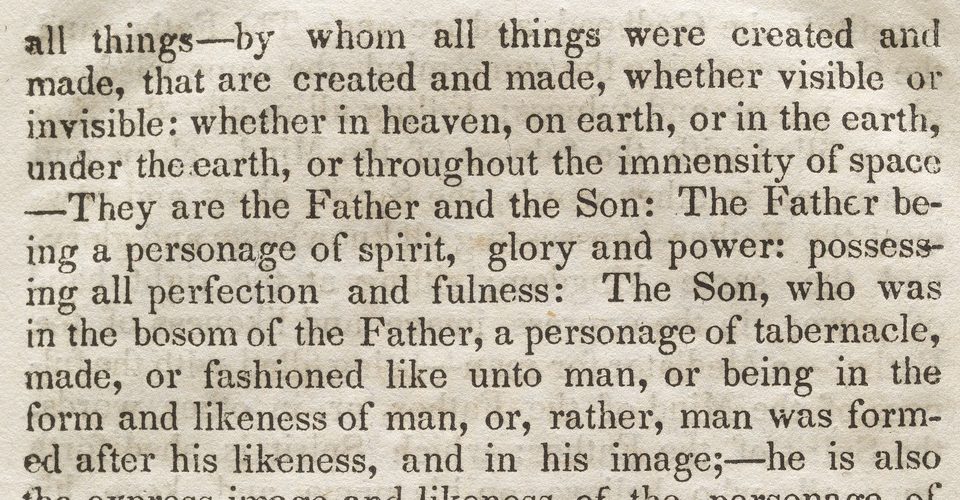
| 1835, Lecture 5 (printed as doctrine) | 1843, D&C 130:22 (printed today) | |
|---|---|---|
| The Father | “a personage of spirit, glory and power” | “a body of flesh and bones as tangible as man’s” |
| The Son | “a personage of tabernacle, made, or fashioned like unto man” | “a body of flesh and bones” (“the Son also”) |
| The Holy Spirit | “the same mind with the Father, which mind is the Holy Spirit” | “the Holy Ghost has not a body of flesh and bones, but is a personage of Spirit” |
| Status today | Removed from the Doctrine and Covenants in 1921 | In the Doctrine and Covenants |
The First Vision, in 1832 and in 1838
The Church’s own essay says “The various accounts of the First Vision tell a consistent story, though naturally they differ in emphasis and detail.” Two of those accounts, side by side, on the one question this page is about:
- “the Lord opened the heavens upon me and I saw the Lord”
- “and he spake unto me saying Joseph [my son, inserted above the line] thy sins are forgiven thee”
- The speaker continues, after “go thy way walk in my statutes and keep my commandments”: “behold I am the Lord of glory I was crucifyed for the world”
- “When the light rested upon me I saw two Personages, whose brightness and glory defy all description, standing above me in the air.”
- One speaks and introduces the other as “My Beloved Son” (the Church’s essay quotes it so)
A revelation that said it was not a commandment
One standard members live by today began as a text that described itself differently. The Word of Wisdom, given February 27, 1833, says in its introduction that it is sent “not by commandment or constraint.” The rule that decides who may hold a temple recommend came 88 years later. The printed page shows the line, and the Church’s own history page dates the rule.
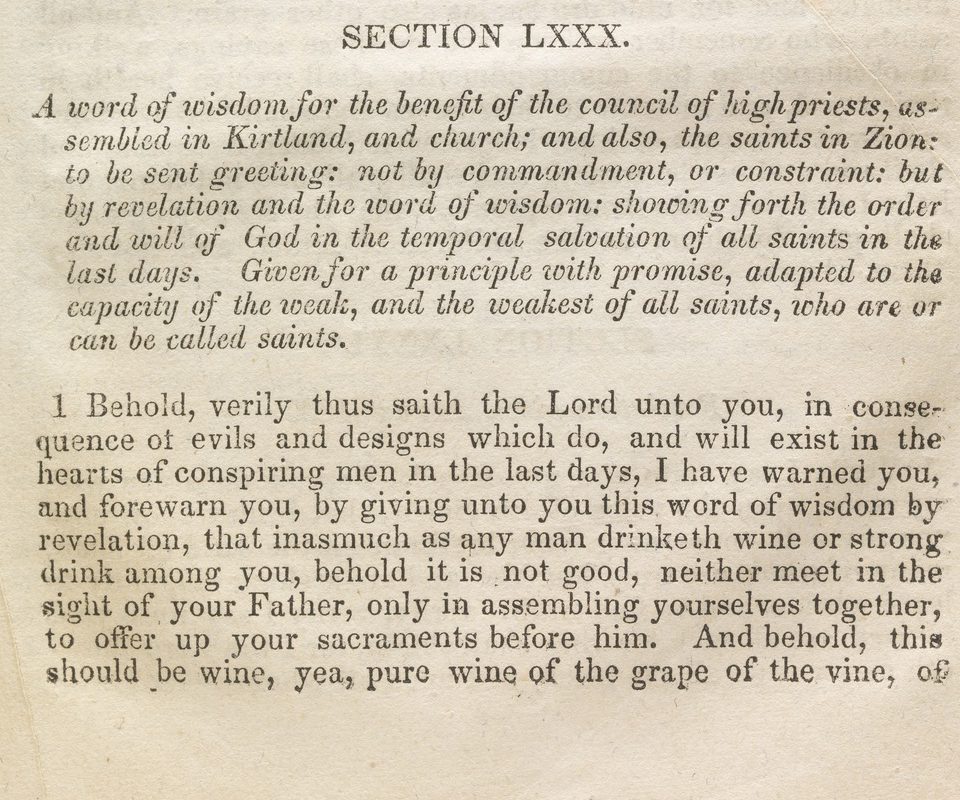
Doctrine and Covenants 89:1-2 and 5-9 (as printed today)
“A Word of Wisdom, for the benefit of the council of high priests, assembled in Kirtland, and the church, and also the saints in Zion… To be sent greeting; not by commandment or constraint, but by revelation and the word of wisdom, showing forth the order and will of God in the temporal salvation of all saints in the last days.” … “that inasmuch as any man drinketh wine or strong drink among you, behold it is not good, neither meet in the sight of your Father, only in assembling yourselves together to offer up your sacraments before him.” (v. 5) “And again, tobacco is not for the body, neither for the belly, and is not good for man, but is an herb for bruises and all sick cattle, to be used with judgment and skill.” (v. 8) “And again, hot drinks are not for the body or belly.” (v. 9)
The text names wine and strong drink, tobacco, and “hot drinks.” It does not name tea, coffee, or caffeine. The Church’s Gospel Topics page says “latter-day prophets have taught that the term ‘hot drinks,’ as written in this verse, refers to tea and coffee.” Verse 3 calls it “a principle with promise, adapted to the capacity of the weak and the weakest of all saints.”
D&C 89 on churchofjesuschrist.orgHow it became a requirement. The Church History Topics page says: “For the next two generations, Church leaders taught the Word of Wisdom as a command from God, but they tolerated a variety of viewpoints on how strictly this commandment should be observed. Many Saints continued to drink coffee and tea, and some chewed tobacco.” Then comes the date: “In 1921, the Lord inspired President Heber J. Grant to require all Saints to abstain from alcohol, tobacco, coffee, and tea in order to obtain a temple recommend.” The same page adds that “The use of some substances, such as caffeine, has been left to the judgment of individual Saints and is not prohibited as a requirement for receiving a temple recommend.” In its August 15, 2019 Newsroom statement, the Church said leaders “have clarified that several substances are prohibited by the Word of Wisdom, including vaping or e-cigarettes, green tea, and coffee-based products.” The same statement gives the principle behind it: leaders “have taught that substances that are destructive, habit-forming or addictive should be avoided.”
The believing case. The revelation called tobacco “not good for man” in 1833. The 1964 Surgeon General’s advisory committee report held cigarette smoking responsible for a 70 percent increase in the mortality rate of smokers over non-smokers and found average smokers had a nine- to ten-fold risk of developing lung cancer. A 1958 Gallup survey had found only 44 percent of Americans believed smoking caused cancer. Believers point to that 131-year gap, and to the Church’s account that leaders were inspired to make the principle binding in 1921. On that view, turning a counsel into a requirement is what ongoing revelation is for.
What early leaders did. History of the Church 6:616, a third-person narrative of Carthage Jail on June 27, 1844, says the guard sent for a bottle of wine: “Dr. Richards uncorked the bottle, and presented a glass to Joseph, who tasted, as also Brother Taylor and the doctor, and the bottle was then given to the guard, who turned to go out.” The record does not say he finished a glass, and FAIR argues wine and tobacco were then considered medicinal. Joseph’s journal for the night of March 29, 1836 in the Kirtland Temple says: “The Bishops and their councils were then washed: After which we partook of the bread and wine.” The journal frames it as sacrament, which verse 5 allows, so it does not show a violation. It shows how the verse was lived in 1836.
| D&C 89 says (1833) | Required for a temple recommend today | Church’s own account of practice | |
|---|---|---|---|
| Wine and strong drink | Wine “not good” except for sacraments | Abstain from alcohol (1921) | Wine in the sacrament until the early 1900s |
| Tobacco | “Not good for man” | Abstain (1921) | “Some chewed tobacco” |
| Tea and coffee | “Hot drinks” (tea and coffee not named) | Abstain (1921) | “Many Saints continued to drink coffee and tea” |
| Caffeine | Not mentioned | Not prohibited; “left to the judgment of individual Saints” | No source found |
| Status | “Not by commandment or constraint” | A requirement | Taught “as a command from God” for two generations |
Mortality ratio, active California Mormons vs. U.S. white adults
Standardized mortality ratio (SMR), all causes, ages 25-99 at entry, 9,815 religiously active California Mormons followed 1980-2004. The U.S. white adult rate is defined as 1.00, so every bar is on true scale.
Source: Enstrom & Breslow, Preventive Medicine, 2008. Comparison group: 15,832 U.S. white adults in the 1987 National Health Interview Survey, followed 1988-1997. 95% CI: men 0.42-0.48, women 0.51-0.59.
What is true on the other side
Take the believing case at its best. The Church does not claim that its teaching about God was complete in 1830. It says revelation is “line upon line.” It says it “does not preclude future additions or changes to its teachings.” It says the 1837 edits were clarifications made by Joseph Smith and Oliver Cowdery. It says the Lectures on Faith were never presented as revelation to the Church, and that a leader’s opinion is not doctrine. Each of those is stated in the Church’s own pages, and none of them is evasive. A member who holds all of them is not being inconsistent.
The page that remains is narrower than a general charge of change. It rests on five things, all on the Church’s own record. First, the first Book of Mormon said the Father in places where the book now says the Son of the Father. Second, a set of lectures printed for 86 years in the “doctrine” half of the Doctrine and Covenants described the Father in terms the Church says “seems to contradict” what Joseph Smith taught in 1843. Third, the First Vision is told in 1832 as “I saw the Lord” and in 1838 as “two Personages.” Fourth, Moroni 8:18 and D&C 20:17 are not phrased “God does not change, but our understanding of Him does.” They say “unchangeable.” Fifth, a revelation that called itself “not by commandment or constraint” became, by a later decision, a condition of entering the temple.
The common rebuttals
“God doesn’t change. Our understanding grows. That’s what line upon line means.”
That is the strongest answer, and for how people come to understand God it holds in full. Here is where it stops. The change in 1 Nephi 11 is not a later reader understanding the text better. It is the text, which presents itself as the record of a man named Nephi, being altered. Either the translated text said “mother of God” and “the Eternal Father” and the 1837 edition reworded it, or the 1830 wording was a mistake, or both are English renderings of one meaning. The Church’s history page says the manuscripts and the 1830 edition read “the mother of God,” “the Eternal Father,” and “the Everlasting God,” calls the 1837 changes “a few important clarifications,” and does not say which of these three explanations it holds. In either case the “growth” happened inside the scripture, not in the reader.
Believers also point out that the Book of Mormon still says, in Mosiah 15:1-5 as printed today, that Christ is “the Father and the Son” (“the very Eternal Father of heaven and of earth”), and read the 1837 edits as making 1 Nephi 11 clearer, not different. They add that the Church compares the 1837 work to how Bible publishers improved editions for English readers.
“Those were small wording fixes. The Book of Mormon was always about Jesus as the Son of God.”
That may be exactly what the 1837 editors were aiming at. But look at what the angel is saying in 1 Nephi 11: the child in the virgin’s arms is, in 1830, “even the Eternal Father,” and the Lamb who is taken by the people is, in 1830, “the Everlasting God.” The Church’s page does not treat them as typographical errors; it lists them as examples of the clarifications. They are statements of who Jesus is, in the chapters explaining who Jesus is. The Church’s own page uses the word “important” for the clarifications it describes. Believers also note that “mother of God” is a long-standing Christian title for Mary, and read the 1830 phrase as that title, not as a claim about where the Father came from.
“The Lectures on Faith were never revelation. They were just lectures.”
True, and the Church says so itself: they “were not given or presented as revelations to the whole Church.” Two things remain. They were printed for 86 years in the part of the book called “doctrine.” And the Church’s history page gives two reasons for the 1921 removal: the lectures had “not been accepted by the Church as anything other than theological lessons,” and one passage “seems to contradict” what came to be D&C 130:22. Put plainly, for 86 years the Church printed as doctrine some lectures that it now says were never presented as revelation.
“A prophet’s opinion isn’t doctrine. You’re quoting speculation.”
That is correct for sermons, and the Church says exactly that. That is why this page does not use sermons. The 1830 and 1837 Book of Mormon pages, the 1835 and current Doctrine and Covenants, and the Church’s own history pages are not a single leader on a single occasion.
Where else the record shows change
Other documented changes have their own pages and are not repeated here: the priesthood and temple restriction on Black members (race), polygamy (polygamy), Adam-God and blood atonement and the other statements the Church has disavowed (the fallibility page), and the temple ceremony and garments (temple changes). Revisions made to the revelations themselves are on the edited revelations page.
The verses say the Church’s God does not change.
The pages say what the Church printed about Him did.
What this means
Hold four pieces of paper side by side. A first-edition page from 1830, in which the angel points to a child in the virgin’s arms and calls him “the Eternal Father.” The same page from 1837, with the Son. An 1835 lecture, printed in the “doctrine” half of the Doctrine and Covenants, in which the Father is “a personage of spirit.” And D&C 130:22, in which the Father has “a body of flesh and bones.” Between the first and last of them is thirteen years, and throughout, the Church’s scripture is also saying that God is unchangeable (Mormon 9:9, Moroni 8:18, and, in the form now printed, D&C 20:17).
The Church’s answer is that God does not change and only our understanding grows. But the changes are in the Church’s own printed account of who God is, not in a reader’s mind.
The Church says it “does not preclude future additions or changes to its teachings.” It revised how the Book of Mormon described Jesus in 1837 and dropped the Lectures on Faith from the Doctrine and Covenants in 1921. So the Church’s own record shows its teaching about who God is changing over time, while its scripture says God does not change. If the nature of God was still being clarified in 1837, in 1843, and in 1921, the record on this page gives no reason to think today’s wording is the final form and not the next one.