The founding claims
The Revelations That Were Edited
The same revelation reads one way in 1829 and 1833, and another way in 1835. All three documents are on the Church’s own website. Here they are, side by side.
The argument
If you grew up in the Church, you were taught that the revelations in the Doctrine and Covenants are the words of God, given on the dates printed above them. This page looks at the pages themselves.
Some revelations presented as the words of God were later rewritten, expanded, and republished with the changes unmarked and the original dates kept. You do not have to trust anyone on this. The Church’s own Joseph Smith Papers, its project to publish Joseph’s original documents, shows every version, and this page shows you the pages.
1. The window where the words changed
Joseph Smith dictated his revelations from 1828 into the early 1830s. Scribes copied them into manuscript books, and the collection went to Missouri to be printed as the Book of Commandments. A mob destroyed the press in 1833 with the printing unfinished. Two years later the collection was republished in Kirtland, Ohio, as the Doctrine and Covenants. Between those two printings, a committee went back through the texts.
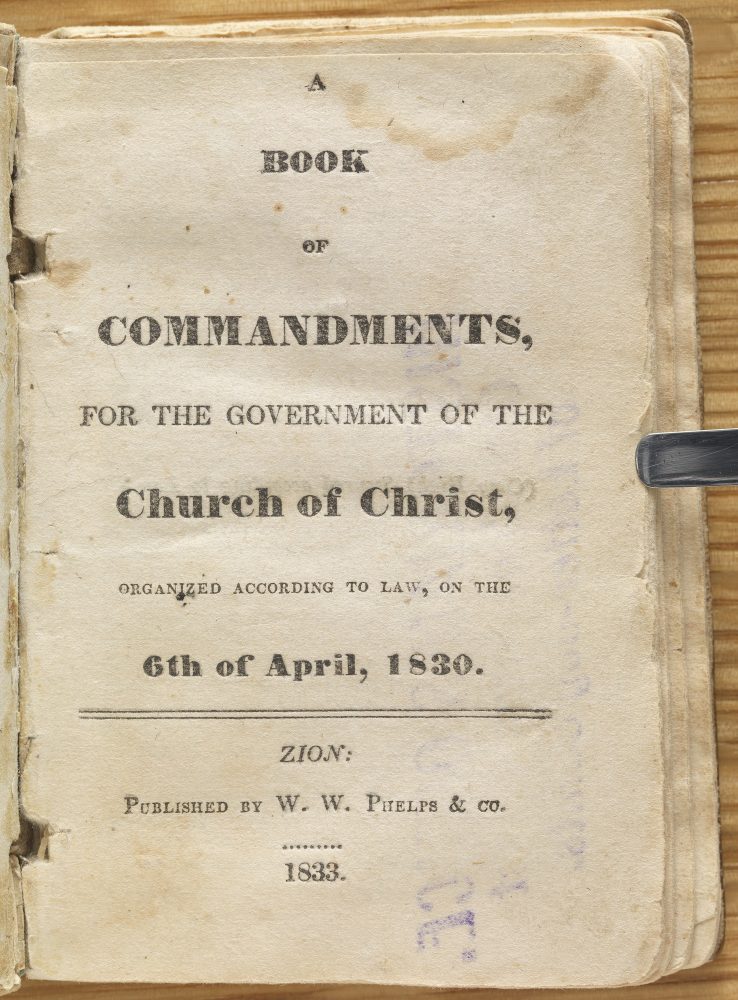
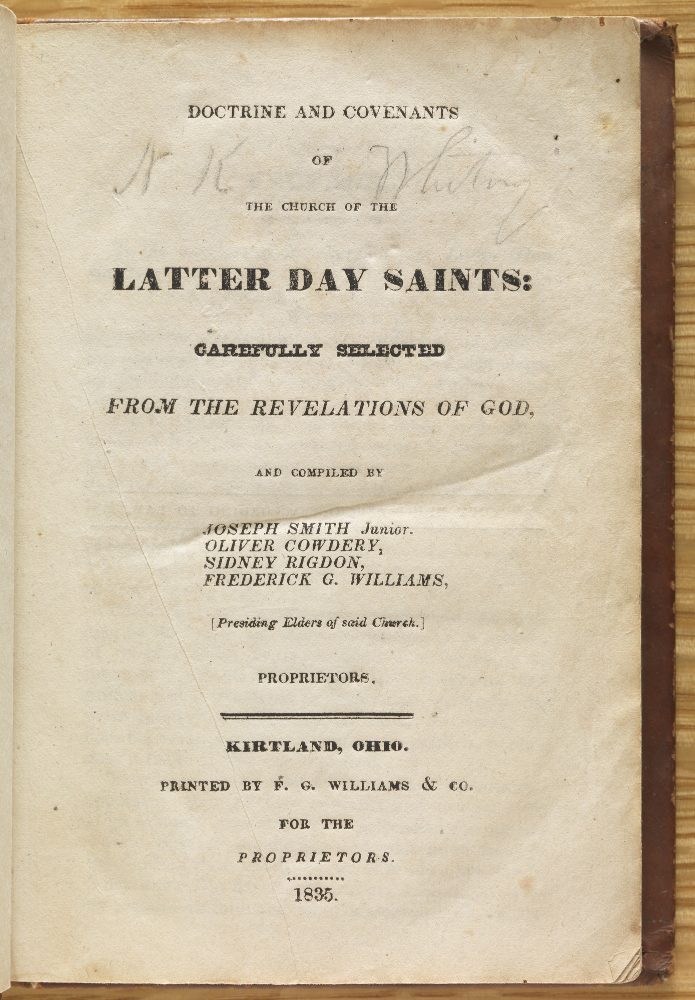
Seven years from voice to book
Every date below is from the Joseph Smith Papers, the Church’s own documentary project.
Source: Joseph Smith Papers, historical introduction to the 1835 Doctrine and Covenants
That middle step is not a critic’s description. It is how the Church’s own project describes what the committee did:
Joseph Smith Papers, historical introduction to the 1835 Doctrine and Covenants
“The editors of the Doctrine and Covenants also made a focused effort to update the revelations to reflect changes in church government, structure, and doctrine that had occurred since the revelations were first dictated.”
Offices that did not exist when a revelation was dictated were written into it before publication, with the revelation still carrying its original date. The introduction’s own example is a February 1831 revelation revised to name an office established four months later and a council organized three years later.
The introduction, Joseph Smith PapersWhat this proves: the revelations were edited after they were given, by a committee, to match a church that had changed. The Church’s own historians say so. The next section shows you one edit with your own eyes.
2. Check it yourself: one revelation, three documents
In March 1829, before the Book of Mormon was finished, Martin Harris, the farmer who would pay to print it, wanted proof that Joseph really had the gold plates. Joseph dictated a revelation in reply. Part of it is about Joseph’s gift. Here is that passage in the three versions the Joseph Smith Papers shows.

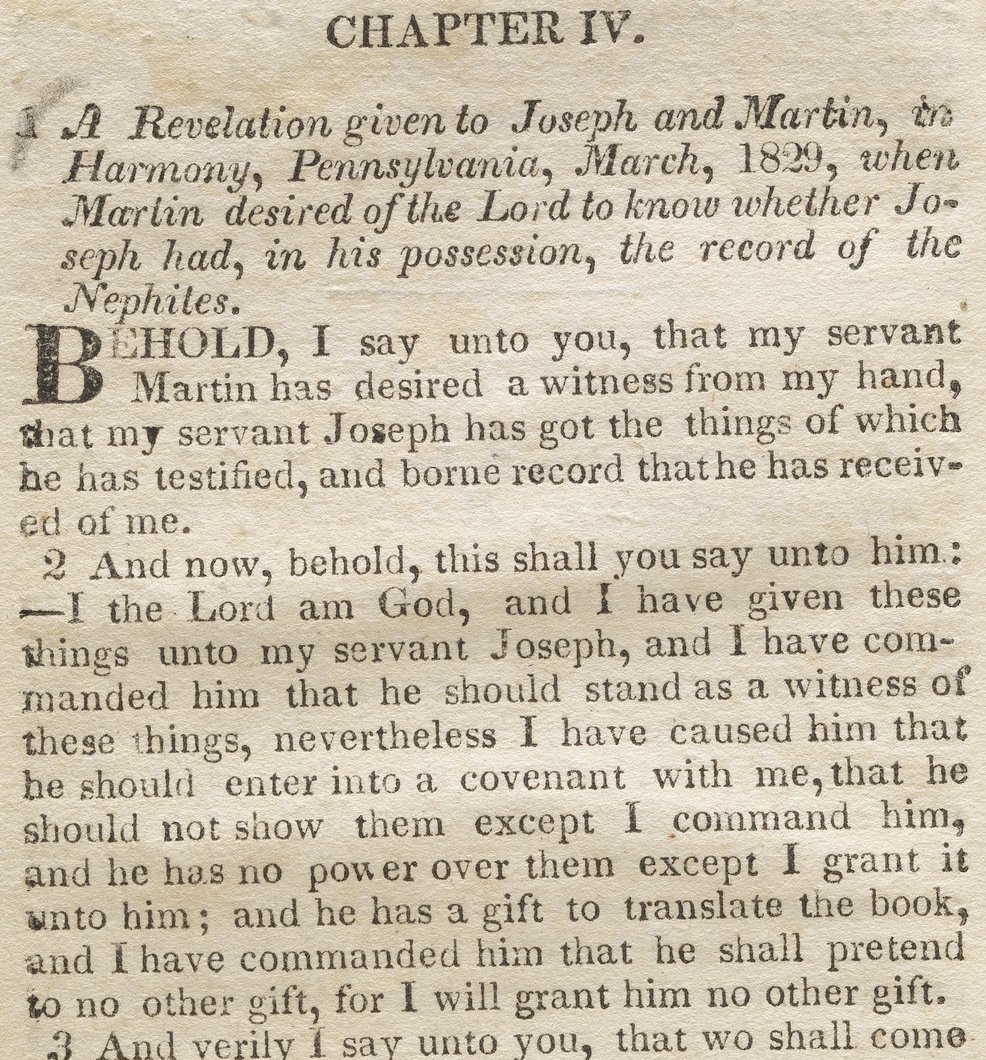
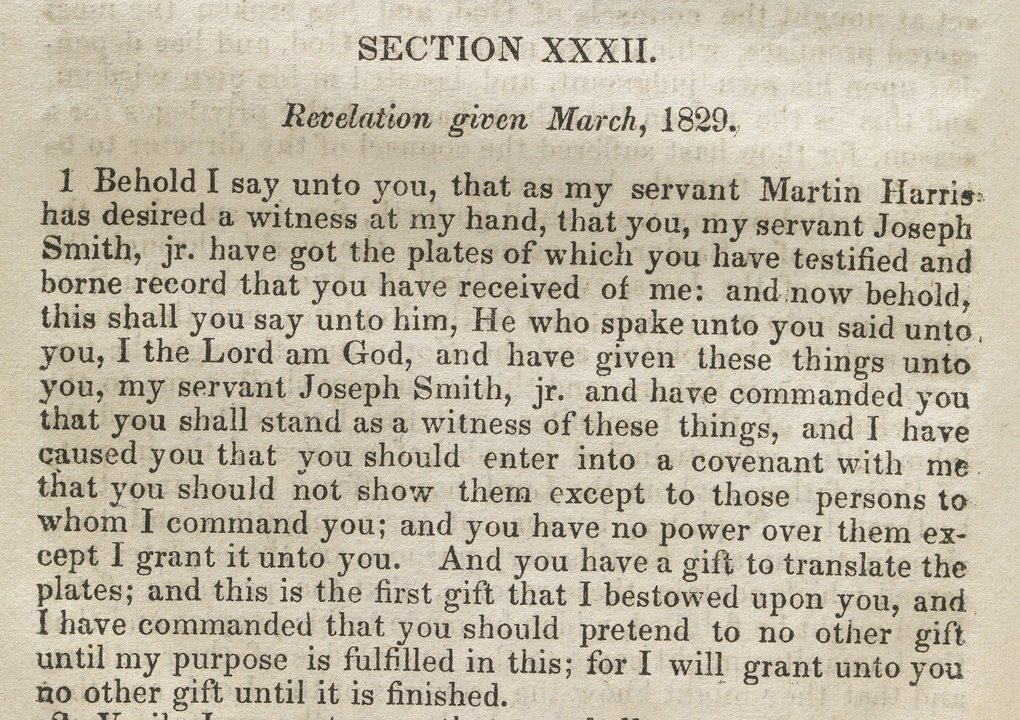
| 1829 manuscript | 1833 printing | 1835 printing | |
|---|---|---|---|
| The gift | “A gift” | “a gift” | “the first gift” |
| The limit | “no other gift” | “no other gift” | “no other gift until my purpose is fulfilled” |
| The promise | “I will grant unto him no other gift” | “I will grant him no other gift” | “no other gift until it is finished” |
| Date on it | March 1829 | March 1829 | March 1829 |
Look at what Joseph was doing around then. From 1830 to 1833 he dictated a revision of the Bible. In the summer of 1835, the same summer the new edition was approved, he began translating the Egyptian papyri that became the Book of Abraham. The original said “I will grant him no other gift,” with no end date. The revision made the limit last only “until it is finished,” and by 1835 the Book of Mormon had been finished for six years. A limit that would have ruled out his later work became one that had already expired. The revision is still dated 1829, and it is what the Doctrine and Covenants says today (D&C 5:4).
What this proves: a promise in the voice of God was rewritten after it no longer fit, and the rewrite kept the old date. One edit could be a coincidence. The next section shows it was a pattern.
3. It was not just one verse
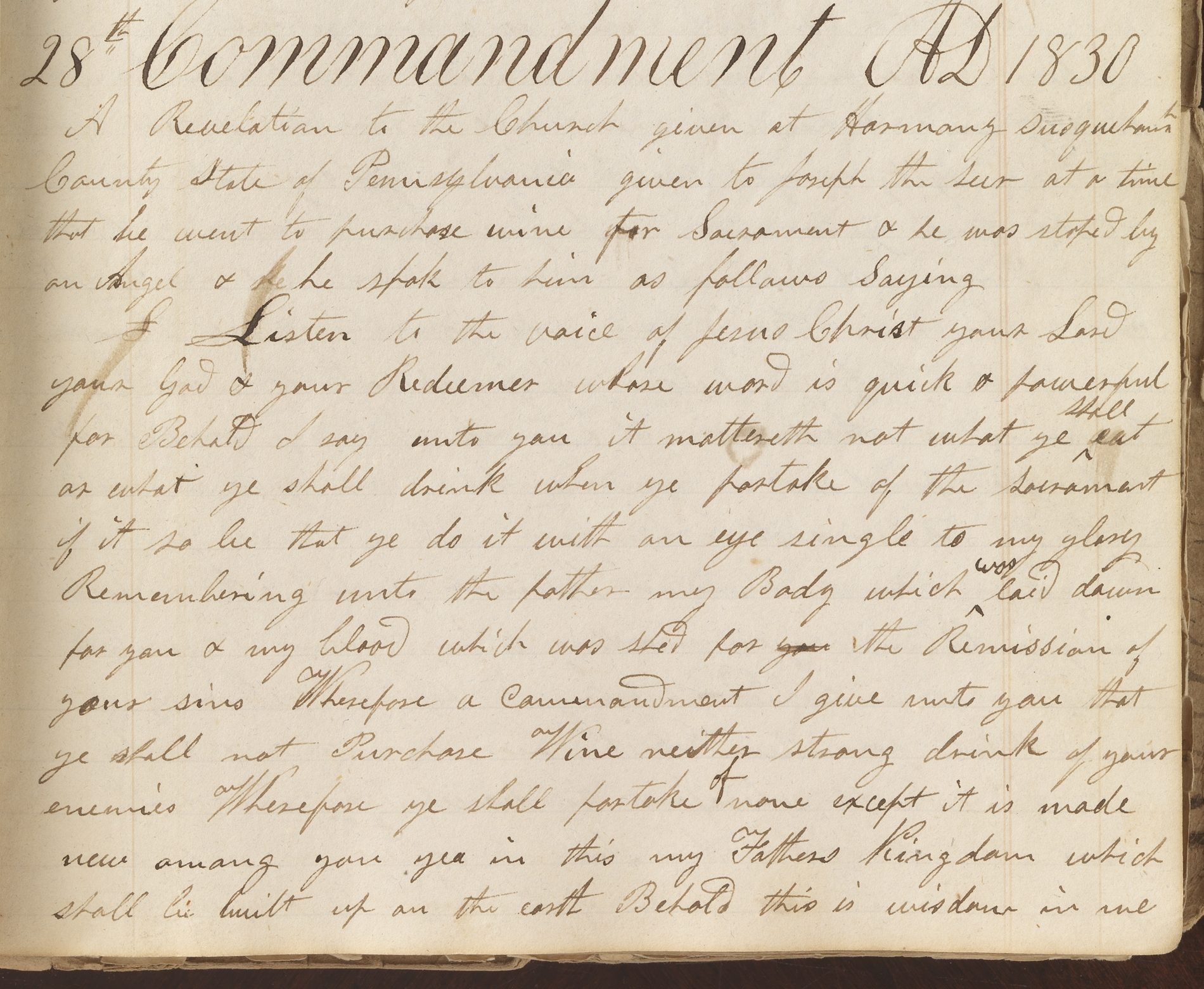
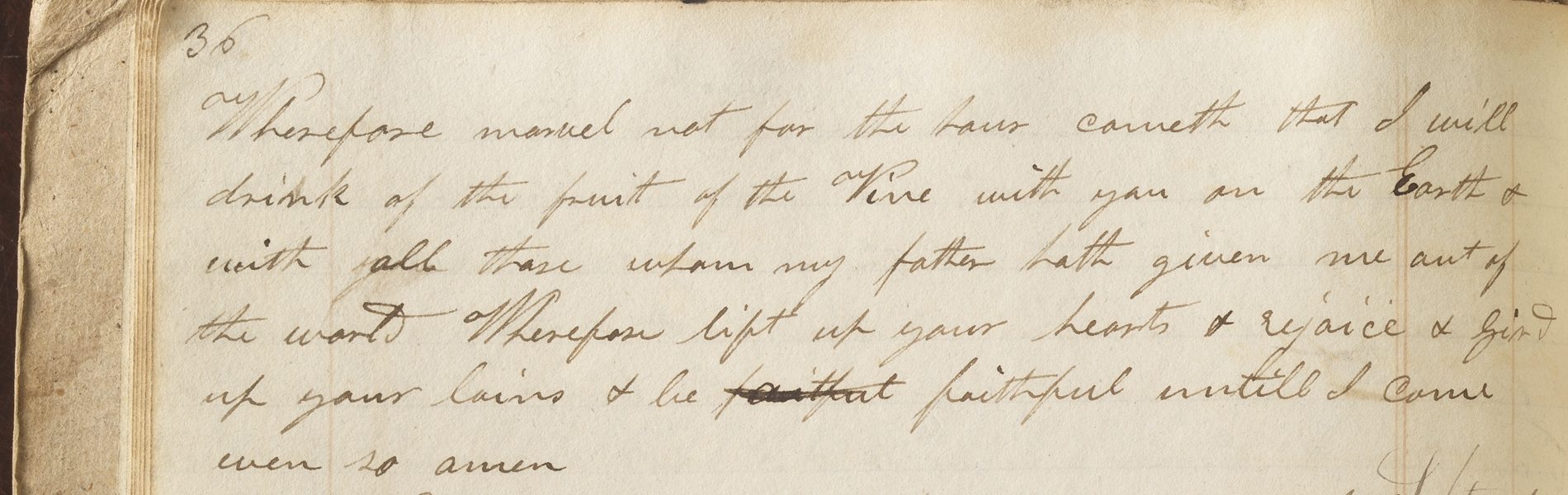
The revelation now printed as D&C 27 was received around August 1830. The early copies are short: instruction about the sacrament and the wine used in it. The expanded version members read today first appears five years later. Here is the paper trail, all of it on the Church’s own sites.
Where the 1835 text went in
“…I will drink of the fruit of the Vine with you on the Earth [1835: and with Moroni … and also with Elias … and also John the son of Zacharias … to ordain you unto this first priesthood … and also Elijah … and also, with Joseph, and Jacob, and Isaac, and Abraham … and also with Michael, or Adam … And also with Peter, and James, and John … by whom I have ordained you and confirmed you to be apostles …] & with all those whom my father hath given me out of the world”
Black: the early copy, word for word. Red: a shortened extract of what first appears in the 1835 printing, inserted in the middle of that sentence.
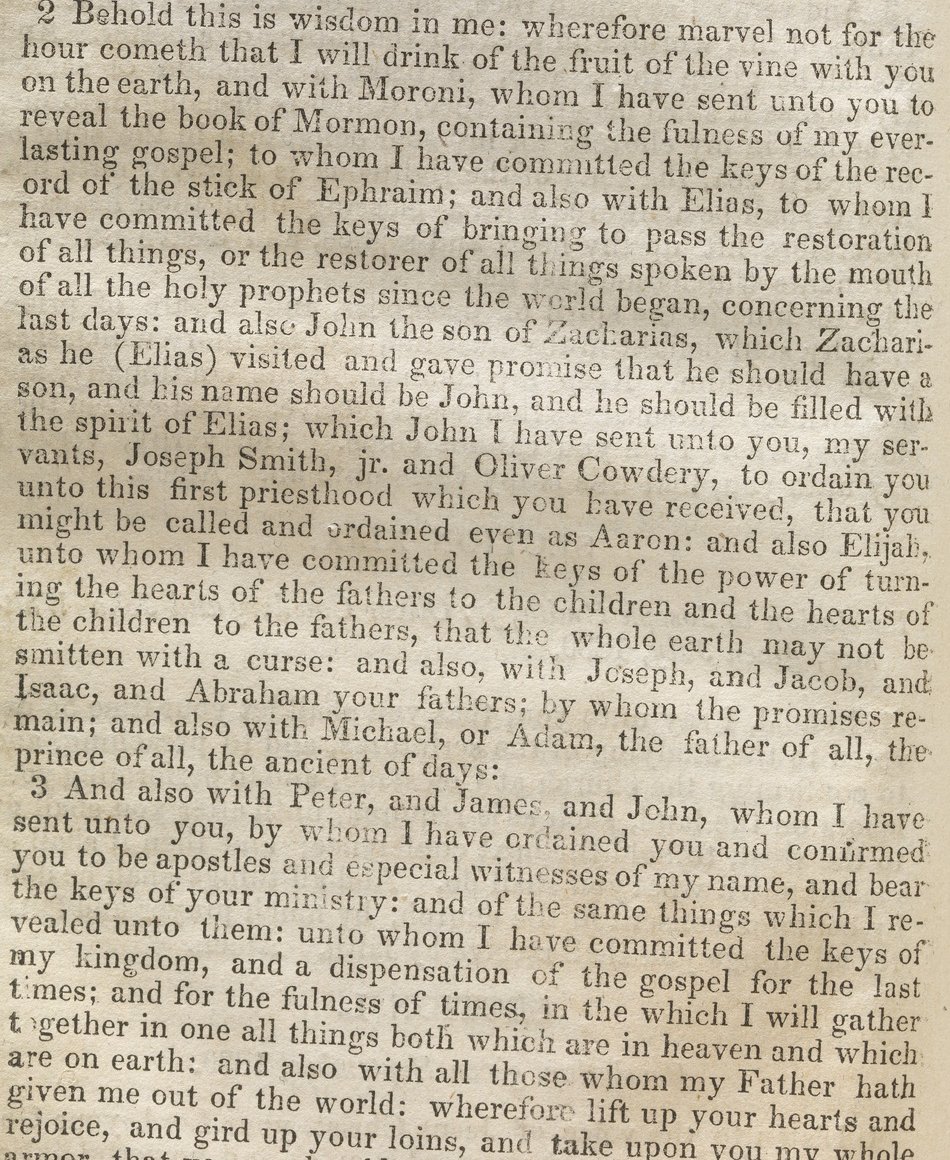
Joseph Smith Papers, historical introduction to Revelation, circa August 1830 [D&C 27]
editors’ note, Church project
What it establishes: The same introduction records that the 1835 printings “included two additional paragraphs” and that the earliest surviving text of the expanded version is the 1835 Doctrine and Covenants itself. The early manuscript is about wine and the sacrament. It says nothing about priesthood.
The manuscript and the note, Joseph Smith PapersDoctrine and Covenants 27:8, inside the expanded portion
revelation dated 1830; text first known 1835
What it establishes: John the Baptist ordaining Joseph and Oliver: the scriptural anchor of the Aaronic priesthood restoration.
D&C 27Doctrine and Covenants 27:12, the same expanded portion
revelation dated 1830; text first known 1835
What it establishes: Peter, James, and John ordaining Joseph and Oliver: the anchor of the Melchizedek priesthood restoration. Neither sentence appears in the early manuscripts of this revelation.
D&C 27What this proves: two foundational events of the faith, angels restoring the priesthood, enter official scripture as an unmarked addition, first known in 1835, to an 1830 revelation about sacrament wine. The restoration page traces the same pattern through the sermons and records of those years.
What is true on the other side
The Church does not hide any of this. The Joseph Smith Papers is a Church project. It publishes the manuscripts and printings side by side, and its editors note the differences. Every image on this page comes from it. If you want the originals, the Church is where you get them.
And a believing member can hold that God may tell a living prophet to expand or revise an earlier revelation. That is a coherent position, and thoughtful members hold it.
The common rebuttals
“God can tell his prophet to revise or expand an earlier revelation. Line upon line.”
On its own terms, this is coherent. Notice what it cannot explain. “Line upon line” is a phrase from scripture for God giving truth a little at a time, new revelation added to old. These revisions do not say revised. The 1835 text keeps the original date, speaks in the same voice of God, and carries no mark where the later hand entered. A reader of the Doctrine and Covenants cannot tell, from the book, which words came on the day and which came six years later. And it says nothing about the direction of the edit you just saw: a limit with no end date became one that had already expired.
“The scribes wrote imperfectly. Joseph was just correcting their errors.”
A scribal correction fixes spelling, grammar, a misheard word. The 1829 copy states the limit twice in one sentence, and the 1833 printing, set from the Church’s own manuscript book, prints it the same way. Nothing in the early record suggests the limit was a copying mistake. And no theory of scribal error covers D&C 27, where the change is not a corrected word but two added paragraphs carrying the priesthood restoration.
“The revelations were always in Joseph’s own language. D&C 1 says they were given ‘after the manner of their language.’”
That verse is real, and it is the strongest defense, because it concedes the point. If the words were always Joseph’s, chosen and re-chosen as he saw fit, then “the revelation says” tells you what Joseph wrote as of his latest revision, not what a divine voice said on a given day. Either way, the words in the book are Joseph’s, and he and his committee changed them.
What this means
Strip this page to what you can hold in your hands. A revelation from March 1829 promised Joseph one gift and no other, twice in a sentence, in the earliest copy and again in the first printing. Six years after it was given, the same revelation, still dated 1829, still in the voice of God, promised something different. A revelation from August 1830 about sacrament wine grew two paragraphs by 1835, and the paragraphs it grew are where angels restore the priesthood.
The revelation that limited Joseph to one gift was revised by a committee he sat on, after the limit was in his way, and the revision still carries the original date.
Every claim this faith makes eventually rests on the revelations. The manuscripts, published by the Church itself, show what kind of documents they are: not transcripts of a divine voice, but working texts, edited as circumstances changed, with the edits presented as the original. You do not have to take anyone’s word for it. The Church itself has published the documents.