The founding claims
The Priesthood Restoration Dates
Early sources claim divine authority and a priesthood, but the angelic ordinations, with named messengers, dates and scenes, are first told in 1834 and 1835, years after the Church was organized.
The point in one sentence
The Church says its priesthood authority came from angels in 1829, but no known document from 1829 to 1831 describes either visit. The first mention is in 1832. The first detailed accounts, with a messenger, a scene, and later a name and a date, come in 1834 and 1835, four to five years after the Church was organized and in the same years as the revisions shown on the edited revelations page.
The world the claim came from
If you grew up in the Church, you were taught that John the Baptist gave Joseph Smith and Oliver Cowdery the Aaronic Priesthood on May 15, 1829, and that Peter, James, and John gave them the higher priesthood after that. This page looks at when those visits were first written down.
In the spring of 1829 Joseph Smith was dictating the Book of Mormon in Harmony, Pennsylvania, to a new scribe, Oliver Cowdery, who by his own account first met Joseph on April 5, 1829. The book’s account of Jesus visiting the Americas includes a scene where Jesus gives his disciples authority to baptize. BYU Studies, the Brigham Young University journal, in its collection of the early priesthood documents, describes what happened next: “Having learned through the writings of ancient prophets that baptism by proper authority was necessary, Joseph Smith and Oliver Cowdery sought that ordinance. In response to their supplication, John the Baptist appeared and conferred the priesthood of Aaron upon them.”
Authority was the live question of the whole age. Cowdery put the problem in his own words five years later: “amid the great strife and noise concerning religion, none had authority from God to administer the ordinances of the gospel.” A church that could say its ordinances were administered by men ordained by resurrected messengers was making a claim that set it apart from the churches around it. That is why the claim matters, and it is why the date of the claim matters.
Then the Church itself was organized, on April 6, 1830, at the Peter Whitmer home in Fayette, New York. A few months later a newspaper in Painesville, Ohio, reported what one of the men carrying the Book of Mormon through the area was telling people. The sentence is worth reading twice, because it cuts both ways: he “holds forth that the ordinances of the gospel, have not been regularly administered since the days of the Apostles, till the said Smith and himself commenced the work.” Authority was being claimed, out loud, within months of the Church’s founding. The same paper’s next report, on December 7, says that the “friends and advocates of this wonderful book state that Mr. Oliver Cowdry has his commission directly from the God of Heaven, and that he has credentials, written and signed by the hand of Jesus Christ.” The angels in the November report are tied to translating the plates. Neither report describes an angel laying hands on anyone.
What the Church says happened
Joseph Smith Papers, “Priesthood Restoration” (the Church’s own documentary project)
“According to later accounts, John the Baptist appeared to Smith and Cowdery on 15 May 1829 and bestowed on them the ‘priesthood of Aaron,’ which gave them the authority to baptize; he then promised that they would later receive a higher authority to bestow the gift of the Holy Ghost.”
Notice the first three words. The Church’s own project does not date the event from a record made in 1829. It dates it from later accounts. Of the higher authority it says: “The events surrounding the restoration of this higher authority, later called the Melchizedek Priesthood, are more difficult to reconstruct.” It adds that accounts differ, some describing Peter, James, and John and others a voice commanding Joseph and Oliver to ordain each other elders: “The exact dates when these events took place are unknown.”
The Joseph Smith Papers, Priesthood RestorationJoseph Smith History 1:72, 1:74, in the Pearl of Great Price, printed in your scriptures today
“The messenger who visited us on this occasion and conferred this Priesthood upon us, said that his name was John, the same that is called John the Baptist in the New Testament…” And then: “In the meantime we were forced to keep secret the circumstances of having received the Priesthood and our having been baptized, owing to a spirit of persecution…”
The account in your scriptures names the messenger, and it also supplies the believing explanation for the silence: Joseph and Oliver kept it secret. The same verse says the messenger acted “under the direction of Peter, James and John,” and verse 75 places the secrecy in the Harmony neighborhood, where Joseph says mobs had threatened them. It is one of the strongest points on the other side, and it gets its full weight below.
Joseph Smith History 1, on churchofjesuschrist.orgDoctrine and Covenants 27:12, the second visit
“And also with Peter, and James, and John, whom I have sent unto you, by whom I have ordained you and confirmed you to be apostles, and especial witnesses of my name…”
The text of the Peter, James, and John visit as members read it today. Its own history is on the edited revelations page: these verses are not in the Book of Commandments of 1833. The Joseph Smith Papers notes that Joseph’s later history says all of section 27 was dictated in 1830, and that it is unclear why the extra material is missing from the 1831 and 1833 texts.
D&C 27 on churchofjesuschrist.orgThe Church dates the angels to 1829. The first document that mentions them is from 1832, and the first detailed account is from 1834.
The visits are told. The question is what the record looks like in the years before anyone told them.
From the claimed event to the first story
Every entry is a document or a dated fact in the Church’s own record, or a newspaper report where marked. Gaps are counted from May 15, 1829.
Sources: Joseph Smith Papers; BYU Studies, “The Earliest Accounts of the Restoration of the Priesthood” (Cannon and BYU Studies staff); BYU Religious Studies Center (Staker) on D&C 13
The exhibits
The Church’s own sources come first: its documentary project, its history topics page, and the BYU Studies collection of every known early statement. Then two early associates of Joseph Smith, quoted as BYU Studies quotes them. Quotes are verbatim, with ellipses where words are dropped, and every source is linked. Bold is added for emphasis.
Joseph Smith Papers, historical introduction to the 1832 history
The Church’s own project
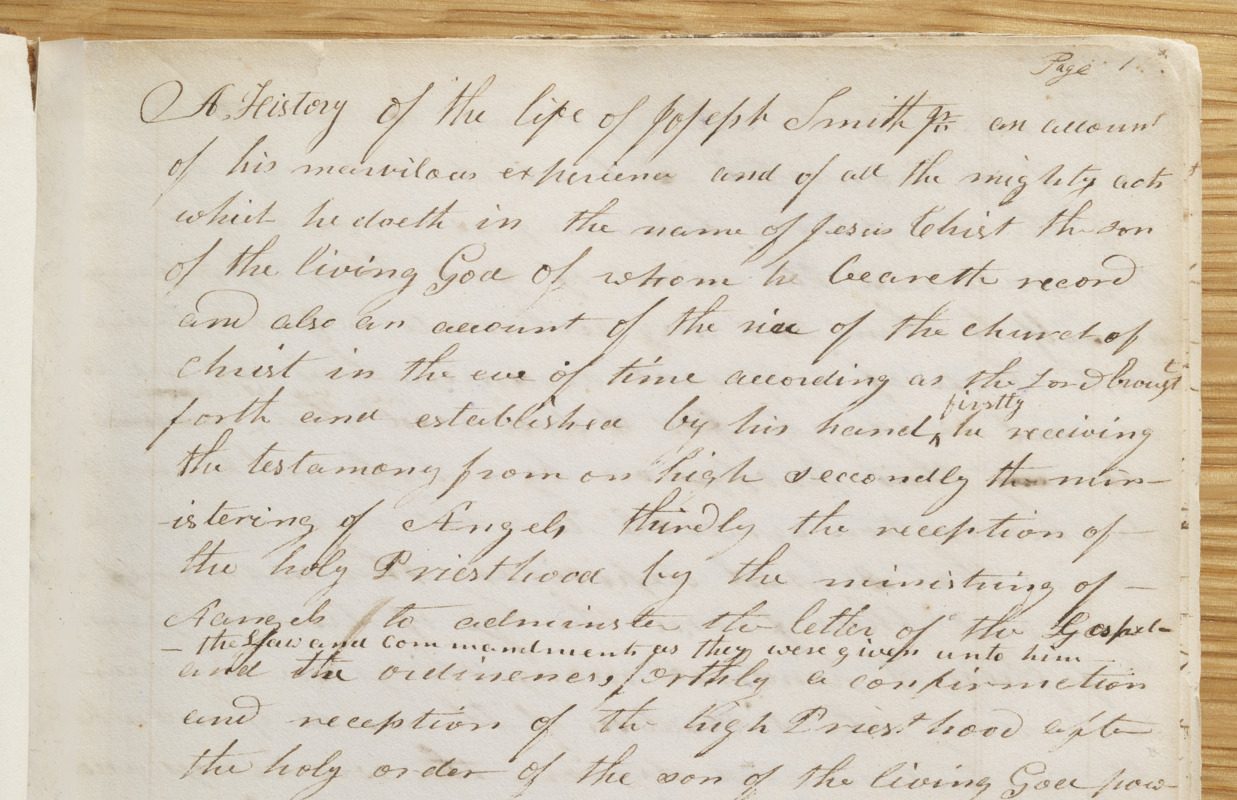
What it establishes: The earliest written reference is an outline of what the history would cover, not an account of it. The same introduction says: “It is not clear why JS ended his earliest history before completing his stated intentions. Some of his other documentary endeavors, including the journal he began the same year, are similarly incomplete, perhaps indicating that other activities simply took precedence.” The narrative stops in spring 1829, just before Cowdery enters the story.
Read the introduction on josephsmithpapers.orgThe Church of Jesus Christ, Church History Topics, “Restoration of the Aaronic Priesthood”
On churchofjesuschrist.org
What it establishes: The Church’s history page names 1834 as the date of the earliest detailed account. Five years after the event, by the Church’s own count. The same page says a non-Church newspaper, the Painesville Telegraph, reported Cowdery’s claim of receiving a commission from angelic visitors just months after the Book of Mormon was published, and that the phrase “Aaronic Priesthood” first appears in Joseph’s revelations in 1834.
Read the topic pageBrian Q. Cannon and BYU Studies staff, “The Earliest Accounts of the Restoration of the Priesthood,” in Opening the Heavens (BYU Press, 2017)
First published in BYU Studies 35, no. 4 (1995–96)
What it establishes: BYU’s own scholars say the details were “seldom if ever shared” before 1832, and attribute that to persecution, the believing explanation, which is weighed below. Of the higher authority the same article says: “The written record regarding the restoration of the Melchizedek Priesthood is less complete.”
Read the article (PDF, pages 228–246)Same article, on the Peter, James, and John revelation
BYU Studies
What it establishes: A footnote adds: “These verses did not appear in the earlier text of the revelation printed in the Book of Commandments, 1833.” It also adds, on the believing side: “Joseph Smith recalled in 1839 that all of section 27 was received as a revelation in August 1830 but that most of the revelation, including these words, was not recorded until September 1830.” That revelation’s history is covered on the edited revelations page.
Same articleSame article, footnote 2, citing Gregory A. Prince, Having Authority (1993)
BYU Studies, footnote 2
What it establishes: The names of the two priesthoods came later than the events. The footnote adds that priesthood authority “had been restored prior to that time,” which is the believing reading. Other records use related terms earlier: McLellin’s journal for Oct 25, 1831 has “the lesser Priest-Hood,” and the Church’s history page says “Aaronic Priesthood” first appears in Joseph’s revelations in 1834.
Footnote 2 of the same articleDavid Whitmer, a witness to the Book of Mormon, interviewed by Zenas H. Gurley, as quoted by BYU Studies
January 14, 1885 (his claim)
What it establishes: Whitmer’s claim, recorded 55 years after the Church was organized, and in the same footnote he says he does not believe John the Baptist ordained them. Treat it as a recollection, not a document. BYU Studies, noting that Whitmer remained true to his testimony as a witness to the Book of Mormon, adds that he “rejected any aspect of the Restoration that recognized or promoted central Church authority.” In the same statement he says that in June 1829 Joseph and Oliver ordained each other elders, and that Oliver told him in 1829 they had baptized each other, “seeking by that to fulfill the command.”
Footnote 4 of the same articleWilliam E. McLellin, statement of 1878, as quoted by BYU Studies
1878 (his claim)
What it establishes: McLellin heard angel stories in 1831, so the angels of the plates were not hidden. He says these two visits were not among the stories. The bracket is BYU Studies’, and it is a recollection 47 years after 1831. BYU’s footnote 2 notes that his own journal for Oct 25, 1831 uses “the High-Priesthood” and “the lesser Priest-Hood.” That shows he knew priesthood terms in 1831, not that he had heard of John.
Footnote 4 of the same articleCheck it yourself: the 1834 page
The Church’s history page says the earliest detailed account is in Oliver Cowdery’s 1834 letters; the Joseph Smith Papers identifies the passage as his letter to W. W. Phelps of Sept 7, 1834, printed in the Church’s own newspaper, the Messenger and Advocate, in Kirtland, Ohio, in October 1834. A scan of the paper is on the Internet Archive. Here are the two pages that matter. Read them before you read anything about them.
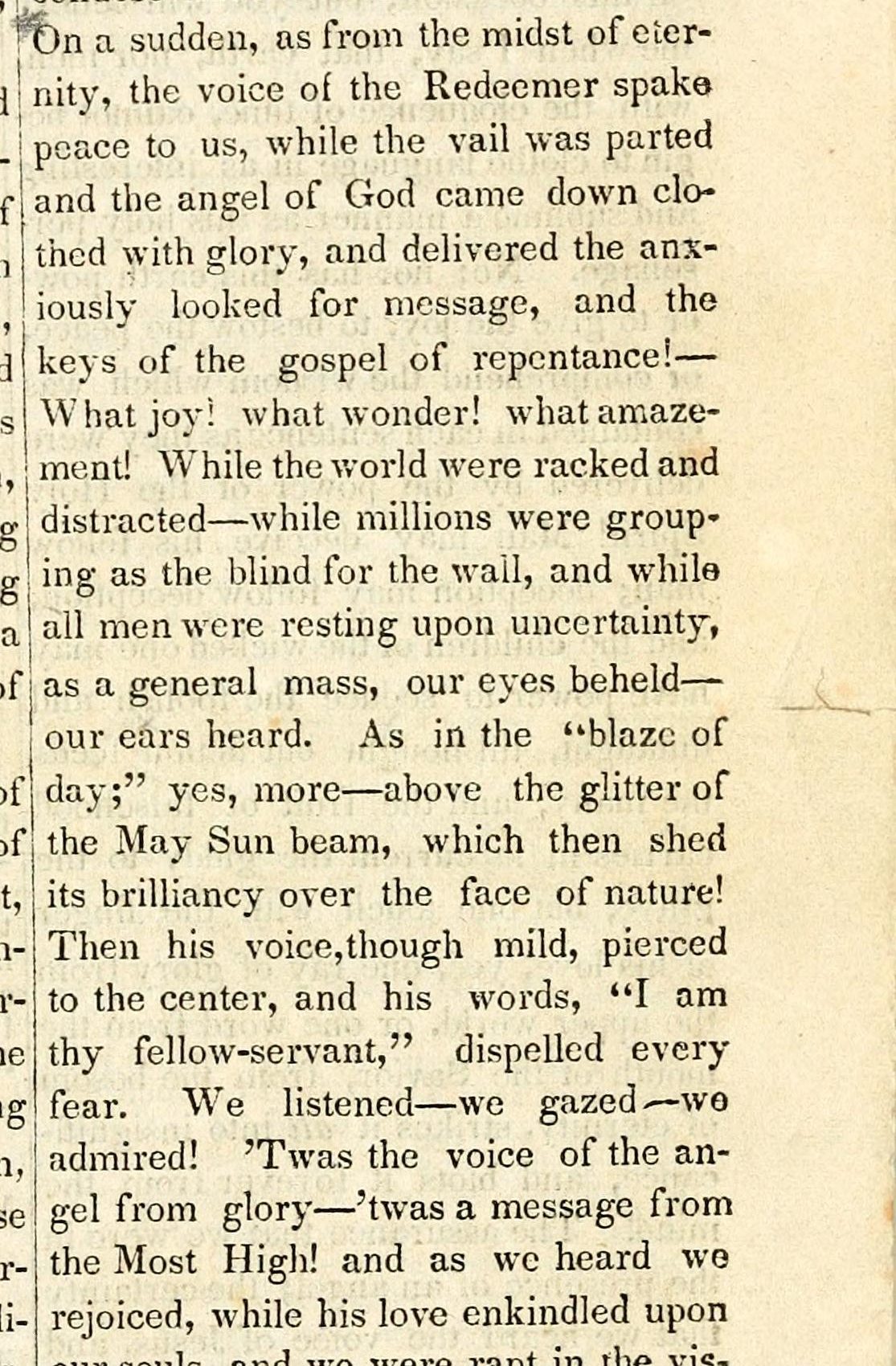
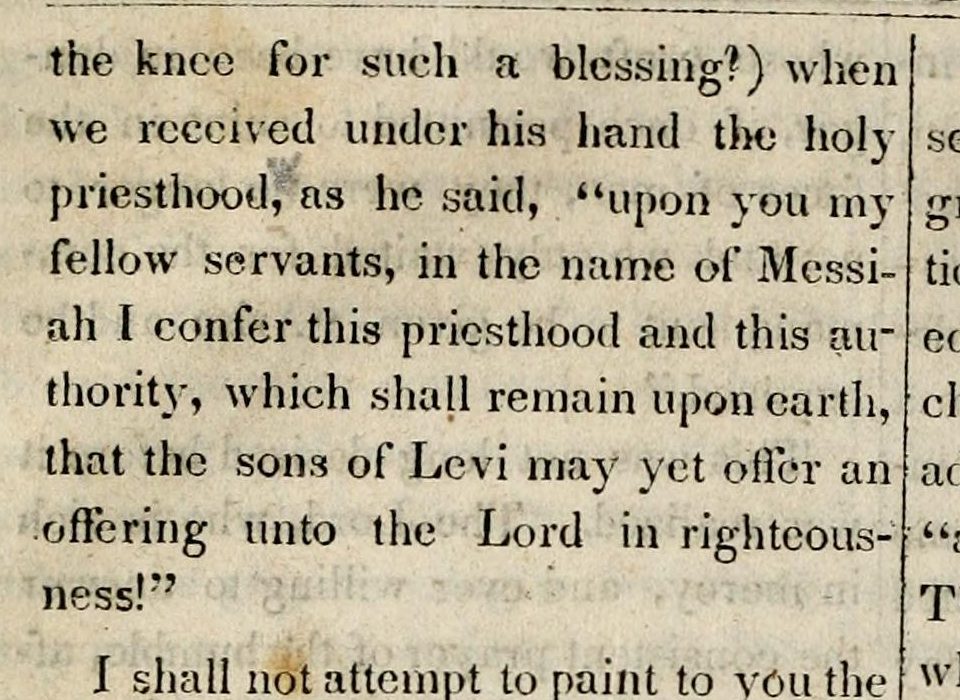
Two things are on that page and two things are not. It is a vivid, first-person account of an angel conferring a priesthood, in the first detailed account of the event anywhere in the record. It names no one: not John the Baptist, not John, not Aaron. It also gives no day; the only date clue for the visit is “the May Sun beam.” Compare the corresponding words as they read in your scriptures today. They come from Joseph’s own 1839 history (Joseph Smith History 1:69), and were added to the Doctrine and Covenants as section 13 in 1876. The 1834 letter already has the “sons of Levi” clause, and both versions end with the offering “unto the Lord in righteousness.”
| Oct 1834, Messenger and Advocate, p. 16 | Joseph Smith History 1:69 (1839; D&C 13:1 since 1876) | |
|---|---|---|
| What the angel confers | “I confer this priesthood and this authority” | “I confer the Priesthood of Aaron, which holds the keys of the ministering of angels…” |
| Who the angel is | No name given | No name in the verse. JS-History 1:72 (1839) says his name was John, “the same that is called John the Baptist.” The 1835 D&C 27 already calls him “John the son of Zacharias.” |
A note near the end of the same letter adds one more piece of context. Cowdery writes: “I will hereafter give you a full history of the rise of this church… I shall therefore leave the history of baptism, &c. till its proper place.” The full account was still to come.
The whole record on one table
| Date | Document | What it says about the angelic priesthood ordinations |
|---|---|---|
| 1829 | “Articles of the Church of Christ,” in Cowdery’s handwriting | BYU Studies says the document testifies that Cowdery had been given power to baptize. No visit is described. |
| Apr 1830 (printed 1831) | Articles and Covenants (D&C 20) | Joseph was “called of God and ordained an apostle of Jesus Christ, an elder of the church.” Who ordained him, and how, is not stated. |
| Nov 16, 1830 | Painesville Telegraph (not a Church paper) | Cowdery “pretends to have a divine mission, and to have seen and conversed with Angels.” The angels are tied to translating the plates. No ordination described. |
| Dec 7, 1830 | Painesville Telegraph (not a Church paper) | The book’s “friends and advocates” state that Cowdery “has his commission directly from the God of Heaven” and credentials “written and signed by the hand of Jesus Christ.” No angel ordination described. |
| Summer 1832 | Joseph Smith’s first history | First mention: “the reception of the holy Priesthood by the ministring of Angels,” and a later “confirmation and reception of the high Priesthood,” in an outline the narrative never reaches. |
| 1833 | Book of Commandments | The Peter, James, and John verses are not in its text of what is now D&C 27. |
| Feb 12, 1834 | Kirtland council minutes (Joseph Smith Papers) | Joseph says he will set forth “the dignity of the office which has been conferred upon me by the ministering of the Angel of God, by his own voice and by the voice of this Church.” No name, no date. |
| Apr 21, 1834 | Minutes and Discourse, Norton, Ohio (Joseph Smith Papers) | The Joseph Smith Papers’ introduction says Joseph discussed “the ‘revelation’ of both the priesthood of Aaron, or the lesser priesthood, and the high priesthood.” That is the editors’ summary; the minutes do not record what he said about either. |
| Oct 1834 | Cowdery in Messenger and Advocate | First detailed account: an angel, “the holy priesthood,” unnamed, no day given. |
| 1835 | Doctrine and Covenants | First printed text of Peter, James, and John ordaining Joseph and Oliver, in the revised D&C 27, which also names John the son of Zacharias as sent to Joseph and Oliver. |
| 1839 | Joseph Smith’s own detailed history | John identified as “the same that is called John the Baptist,” acting under the direction of Peter, James, and John. Secrecy explained as a “spirit of persecution.” |
| 1876 | Doctrine and Covenants | The words now numbered D&C 13 are added. |
What is true on the other side
This needs its full weight, because it is not weak. Several things on the record favor the believer, and the page above is worth less if they are left out.
- The claim of authority is early. A document in Cowdery’s own hand from 1829 testifies that he had been given power to baptize. Newspaper reports in November and December 1830 say he claimed a divine mission, that the book’s friends and advocates said he had a commission “directly from the God of Heaven,” and that the ordinances had not been rightly administered until he and Smith began. Whitmer, in 1885, recalled that Oliver told him in 1829 they had baptized each other to fulfill the command. Joseph and Oliver were not silent about authority.
- The angel stories themselves were not hidden. The Testimony of the Three Witnesses in the first edition of the Book of Mormon says “an angel of God came down from heaven” (about the plates). McLellin heard Joseph tell “angel visits many times” in 1831. The record does not show Joseph keeping angels secret, only, by his own later account, the priesthood and baptism.
- The 1832 line exists, and it is not a stray line. The priesthood “by the ministring of Angels” is in Joseph’s own history three years after the date the Church gives and two years before Cowdery’s letter, along with a later “confirmation and reception of the high Priesthood.” The Joseph Smith Papers calls the outline Joseph’s “stated intentions” for the history, and the history ends, after six pages, in spring 1829, just before Cowdery enters the story. A believer can reasonably say it stopped before it reached the subject.
- Joseph gave a reason for the silence. He wrote that they “were forced to keep secret the circumstances of having received the Priesthood and our having been baptized, owing to a spirit of persecution,” and verse 75 describes threats of mobbing in the Harmony neighborhood in 1829. The Church’s history page repeats it. BYU Studies says that details of the John the Baptist visit were “seldom if ever shared prior to 1832.” That is the believing reading, and it is coherent.
- The vocabulary lag has an explanation. The same BYU footnote that says the terms “Aaronic Priesthood” and “Melchizedek Priesthood” were not adopted until 1835 asserts that the authority was restored before then. The footnote and the Church’s history page also place “priesthood” in written sources in 1831 and “Aaronic Priesthood” in Joseph’s revelations in 1834.
- Cowdery kept saying it after he had left. The Joseph Smith Papers lists his 1846 letter to Phineas Young and a 1848 discourse recorded by Reuben Miller, both reaffirming the two ordinations, after Joseph’s death. A June 1829 revelation (D&C 18:9) speaks to Cowdery and Whitmer “even as unto Paul mine apostle, for you are called even with that same calling with which he was called.” BYU Studies calls this their “apostolic calling,” and adds that the revelation “did not detail the restoration of priesthood authority or any ordination in connection with that calling.”
- Absence of evidence is not proof of absence. BYU Studies concludes that the record “strongly shows that Joseph Smith and Oliver Cowdery repeatedly testified that they received power from on high to perform ordinances, first from John the Baptist and then from Peter, James, and John,” and that their testimonies “began early in Church documents.” BYU Studies adds that the testimonies “intensified as these first and second elders drew closer to their own impending deaths,” and that the accounts, “corroborated by numerous statements from other early members of the Church,” are “intellectually challenging and spiritually invigorating.”
- Whitmer is not a clean witness for the other side. BYU Studies says he “rejected any aspect of the Restoration that recognized or promoted central Church authority.” A diary entry dated 1917 reports that on a visit in 1861 Whitmer recalled Cowdery, hands on his own head, testifying that Peter, James, and John had laid their hands on him. That is a recollection of a recollection, but it points the other way.
The common rebuttals
“They kept it secret because of persecution. Joseph said so himself.”
Joseph did say so, in 1838 or 1839, about ten years after the event, and it is the explanation the Church gives. It may be true. But an explanation for a missing record is not a record. By Joseph’s account, the secrecy was local and early: mobs had threatened them in the Harmony area in 1829 (JS-H 1:75). The authority claim itself was public by November 1830, when a non-Church Ohio newspaper reported that Cowdery said the ordinances had not been rightly administered until he and Smith began. That does not show that anyone was told about the angels’ ordinations. Nothing written from 1829 to 1831 backs up the secrecy or the visits. Both rest on later memory.
“The 1832 history already mentions the priesthood and the angels, so the claim was recorded early.”
It was, and this page says so. It is an outline of what the history would cover, in a history that ends in spring 1829, before it reaches that point. The outline says the priesthood came “by the ministring of Angels” and lists a later “confirmation and reception of the high Priesthood.” It names no angel, no date, and no place. What it establishes is that Joseph claimed angelic priesthood by 1832, three years in. What it cannot establish is what happened in 1829, because it describes nothing.
“David Whitmer left the Church and was an old man in 1885. He even said Joseph and Oliver ordained each other elders in 1829. Why trust his memory?”
You shouldn’t lean on it, and nothing on this page needs David Whitmer. The 1885 and 1878 recollections are listed as claims and labeled as such. The dated documents carry the argument by themselves: the Church’s own history page says the earliest detailed account was published in 1834, and the Joseph Smith Papers says the first history of 1832 “includes nothing further about the reception of priesthood authority.” Whitmer and McLellin only add that two people who were close to Joseph say they first heard it afterward, two to four years after the Church’s organization.
Authority was claimed in writing by 1829. The angelic ordinations that explain it are first mentioned about three years after the date the Church gives, and first described about five years after.
Nothing in the record from 1829 to 1831 describes the visits. Everything else about them was written down after the Church was running.
What this means
You were taught that the angels came in 1829. Look at what the record shows. The Church’s own project dates the visits from “later accounts.” The earliest written mention is an outline in the 1832 history, one the narrative never reaches. The first detailed account is a letter printed in a Kirtland newspaper in October 1834, a letter that names no angel and gives no day. The Peter, James, and John verses are first printed in 1835, in a revised D&C 27. That revision already names John the son of Zacharias. The early manuscripts of that revelation, the Joseph Smith Papers notes, “contain only the first portion of the combined revelation as published in 1835,” The Joseph Smith Papers says the editors of that edition made “a focused effort to update the revelations to reflect changes in church government, structure, and doctrine,” and also says that Joseph’s later history holds that all of section 27 was dictated in 1830, and that it is unclear why the extra material is missing from the earlier texts. The Aaronic ordination text now numbered D&C 13 comes from Joseph’s 1839 history and entered the Doctrine and Covenants in 1876. The names “Aaronic Priesthood” and “Melchizedek Priesthood” came into use in 1834-35.
The Church’s claim to priesthood authority runs through two events, and the first detailed account of either was written when the Church was already four years old.
The believing case is real, and the strongest part of it is not the silence. It is the repeated testimony of two men, including Cowdery’s after he had left the Church, and a record that shows the authority claim itself did not appear out of nowhere in 1834. But the accounts of the ordinations come from the two men who received them, and they were first put in writing after the Church was running. The record leaves a narrower question than whether the visits happened. Why did the most important authority events of the Church go untold in any detail until years after the Church was organized, and why do the details first appear during the same 1834-35 revisions shown on the edited revelations page? The secrecy Joseph describes is one answer. The other is that the ordinations were first described when later needs called for them. Either way, the Church’s claim that its authority came by angels rests on accounts written after the fact.