The institution
When Prophets Were Wrong
The Church’s own pages say its leaders have made mistakes and set aside some of what past leaders taught, but the pages cited here never say how a member could tell, at the time, which words those were.
The point in one sentence
If you grew up in the Church, you were probably taught to follow the prophet. The Church itself now says that a single leader’s statement is not necessarily doctrine, and its own pages set aside some of what men sustained as prophets and apostles taught. That is honest. It also means a member has no way, in the Church’s own pages, to know in advance which of today’s teachings will be set aside next. The Church sorts that out afterward.
The world these sermons came from
The Church’s own account of Brigham Young’s preaching during the 1856–57 reformation describes the tone: “At times during the reformation, President Young, his counselor Jedediah M. Grant, and other leaders preached with fiery rhetoric, warning against the evils of those who dissented from or opposed the Church.” Many sermons of that era were collected in the Journal of Discourses. The Church’s page on it says the content was “transcribed, sometimes inaccurately, and published between 1854 and 1886 in England.”
On race, the Church’s essay gives the sequence plainly: “In 1852, President Brigham Young publicly announced that men of black African descent could no longer be ordained to the priesthood, though thereafter blacks continued to join the Church through baptism and receiving the gift of the Holy Ghost.” It continues that “Over time, Church leaders and members advanced many theories to explain the priesthood and temple restrictions.” In 1949 the First Presidency, the three men at the top of the Church, wrote a statement on the matter that it used as standard language in its private correspondence. In 1978 the restriction ended.
The same Church now has a stated test for what counts as doctrine. That test is where this page begins, because it is the believing position at its strongest.
What the Church says about its own leaders
Start with what believers hold, in the Church’s words. Prophets are men, and the scriptures say so. In the Doctrine and Covenants the Lord says the commandments “were given unto my servants in their weakness, after the manner of their language, that they might come to understanding,” and that the process includes correction: “inasmuch as they erred it might be made known.” Nobody is claiming a prophet is infallible, and the Church does not either.
Doctrine and Covenants 1:24–28
Behold, I am God and have spoken it; these commandments are of me, and were given unto my servants in their weakness, after the manner of their language, that they might come to understanding. And inasmuch as they erred it might be made known; And inasmuch as they sought wisdom they might be instructed; And inasmuch as they sinned they might be chastened, that they might repent; And inasmuch as they were humble they might be made strong, and blessed from on high, and receive knowledge from time to time.
The believing position, from scripture: the servants are weak, they can err, and the error is made known; they are instructed, and they “receive knowledge from time to time.” This page accepts all of it.
D&C 1 on churchofjesuschrist.orgChurch newsroom, “Approaching Mormon Doctrine,” 4 May 2007
Not every statement made by a Church leader, past or present, necessarily constitutes doctrine. A single statement made by a single leader on a single occasion often represents a personal, though well-considered, opinion, but is not meant to be officially binding for the whole Church. With divine inspiration, the First Presidency (the prophet and his two counselors) and the Quorum of the Twelve Apostles (the second-highest governing body of the Church) counsel together to establish doctrine that is consistently proclaimed in official Church publications.
This is the Church’s stated test, and it is a real one: doctrine is what the First Presidency and the Twelve establish together and proclaim consistently, found in the standard works, official declarations and the Articles of Faith. On this test, a sermon by one man is not by itself doctrine.
The statement on newsroom.churchofjesuschrist.orgPresident Dieter F. Uchtdorf, general conference, October 2013
And, to be perfectly frank, there have been times when members or leaders in the Church have simply made mistakes. There may have been things said or done that were not in harmony with our values, principles, or doctrine.
Said from the pulpit of general conference by a member of the First Presidency. The sentence that follows is: “I suppose the Church would be perfect only if it were run by perfect beings.”
The talk on churchofjesuschrist.orgMen sustained as prophets said things the Church now sets aside, and the Church sorts afterward which words were doctrine.
The rest of this page is what that sorting has looked like, in the Church’s own words.
From the pulpit to the Church’s later words
Statements by sustained prophets and apostles, and what the Church has said since.
Sources: Church History Topics; Gospel Topics essays; general conference; BYU Speeches; Journal of Discourses (jod.mrm.org). Every quotation is on the table and exhibits below, with its link.
The exhibits
Church sources first. Each quotation is word for word, and the link under it opens the page it came from.
The Church of Jesus Christ, Gospel Topics essay, “Race and the Priesthood”
2013
What it establishes: The Church’s own pages name the ideas it now disavows. They were advanced, in the essay’s words, by “Church leaders and members,” and the disavowal sentence does not name any leader. It adds: “None of these explanations is accepted today as the official doctrine of the Church.”
Read the essay on churchofjesuschrist.orgPresident Spencer W. Kimball, general conference, Priesthood Session
October 1976
What it establishes: The President of the Church, in general conference, denounces the Adam-God theory and warns against “this and other kinds of false doctrine.” He words it as doctrines “alleged to have been taught by some of the General Authorities of past generations,” and does not name Brigham Young, so the page does not claim more than he did.
Read the talkThe Church’s page on the Journal of Discourses
On the Church’s own site
What it establishes: Twenty-six volumes of sermons by early Church leaders are now described by the Church as not authoritative by themselves. The page also says transcription was imperfect: “some significant mistakes have been documented.” That is a real caution about the text, and it is a separate point from the statement above.
Read the pageElder Bruce R. McConkie, “All Are Alike unto God,” to a CES Religious Educators Symposium
18 August 1978
What it establishes: An apostle tells Church educators to set aside what he and earlier presidents said. The paragraph before is the believing reading: “We get our truth and our light line upon line and precept upon precept. We have now had added a new flood of intelligence and light on this particular subject.” The paragraph after is the broadest statement on the page: “It doesn’t make a particle of difference what anybody ever said about the Negro matter before the first day of June of this year, 1978.” The Church’s race essay quotes McConkie on the same point: new “light and knowledge” that had erased previously “limited understanding.”
Read the talk on BYU SpeechesThe Church of Jesus Christ, Gospel Topics essay, “Peace and Violence among 19th-Century Latter-day Saints,” note 36
On the Church’s own site
What it establishes: The Church cites Brigham Young, Journal of Discourses 4:53–54, for the teaching. The essay says Young and others “preached with fiery rhetoric” and “taught that some sins were so serious that the perpetrator’s blood would have to be shed in order to receive forgiveness.” Note 36 also says the concept was a “stock component of anti–Latter-day Saint rhetoric,” so “this rhetoric” can be read either way. The same note quotes historian Paul Peterson saying most Saints recognized the sermons as “hyperbole or incendiary talk.” The essay calls it neither doctrine nor a mistake.
Read the essayThe visual breakdown: what was said, and what the Church says now
Each row pairs a statement by a sustained leader, word for word, with the Church’s own later words about it. Only one row has a disavowal of that specific teaching. The wording on the right is otherwise a description or a general statement, and each row says what the later page does and does not do.
| The statement | What the leader said | What the Church’s own pages say later, and what kind of statement it is |
|---|---|---|
| Adam is God (Brigham Young, 9 April 1852) | “When our father Adam came into the garden of Eden, he came into it with a celestial body, and brought Eve, one of his wives, with him. He helped to make and organize this world. He is Michael, the Archangel, the Ancient of Days! … He is our Father and our God, and the only God with whom we have to do.” (Journal of Discourses 1:50) | President Kimball, general conference, October 1976: “Such, for instance, is the Adam-God theory. We denounce that theory and hope that everyone will be cautioned against this and other kinds of false doctrine.” (source) A disavowal of the theory by name, 124 years later. Kimball does not name Brigham Young or this sermon. |
| Blood atonement (Brigham Young, 21 September 1856) | “There are sins that men commit for which they cannot receive forgiveness in this world, or in that which is to come, and if they had their eyes open to see their true condition, they would be perfectly willing to have their blood spilt upon the ground, that the smoke thereof might ascend to heaven as an offering for their sins; and the smoking incense would atone for their sins, whereas, if such is not the case, they will stick to them and remain upon them in the spirit world.” (Journal of Discourses 4:53–54) | The Church essay: “President Young, his counselor Jedediah M. Grant, and other leaders preached with fiery rhetoric, warning against the evils of those who dissented from or opposed the Church. … leaders taught that some sins were so serious that the perpetrator’s blood would have to be shed in order to receive forgiveness.” Note 36 adds: “it is likely that in at least one instance, a few Latter-day Saints acted on this rhetoric.” (source) Not a disavowal: a description. The essay describes it as rhetoric. It does not say “disavow.” |
| Race mixing (Brigham Young, 8 March 1863) | “Shall I tell you the law of God in regard to the African race? If the white man who belongs to the chosen seed mixes his blood with the seed of Cain, the penalty, under the law of God, is death on the spot. This will always be so.” (Journal of Discourses 10:110) | A general disavowal; the sermon is not named. The 2013 essay does not name this sermon. It disavows “theories advanced in the past” including “that mixed-race marriages are a sin,” and says “Church leaders today unequivocally condemn all racism, past and present, in any form.” (source) Nothing on the pages cited here addresses a death penalty for it. |
| The priesthood restriction (First Presidency statement of 17 August 1949, used in private correspondence) | “The attitude of the Church with reference to Negroes remains as it has always stood. It is not a matter of the declaration of a policy but of direct commandment from the Lord, on which is founded the doctrine of the Church from the days of its organization, to the effect that Negroes may become members of the Church but that they are not entitled to the priesthood at the present time.” (quoted by FAIR; the Church History Library says it was never issued publicly) | General statements; neither names the 1949 text. Elder McConkie, 1978: “We spoke with a limited understanding and without the light and knowledge that now has come into the world.” (source) The 2013 essay: “None of these explanations is accepted today as the official doctrine of the Church.” The essay does not mention the 1949 statement. |
| The Kirtland Safety Society (Joseph Smith, 6 January 1837, as recorded by Wilford Woodruff) | “… he had receieved that morning the word of the Lord upon the subject of the Kirtland Safety Society … He did not tell us at that time what the LORD said upon the subject but remarked that if we would give heed to the commandments the Lord had given this morning all would be well.” (Woodruff’s journal) | Church History Topics quotes the 6 January statement itself (Joseph said that if the Saints “would give heed to the Commandments the Lord had given this morning all would be well”) and says the society “struggled for months before ceasing operations by August 1837,” and: “Not all the possible contributing factors, however, were in the Saints’ control.” (source) Not a disavowal, and no verdict on the claim: the Church reports the statement and gives causes. |
Read down the right-hand column. Only the first row is a disavowal of that specific teaching, and it names the theory, not Brigham Young. The second is described by the Church as rhetoric and is not set aside. The third and fourth are covered only by general statements that do not name the sermon or the statement. The fifth, Kirtland, is not disavowed: the Church reports the statement and gives causes. It is the row where a leader is reported to have attached the Lord’s name to a worldly venture whose results could be seen, and it has its own section next.
Kirtland: the word of the Lord about a bank
The strongest believing account comes first, because it is strong. The Church says the society was founded “just prior to a broader financial crisis known in the United States as the Panic of 1837.” It explains the cause: “Higher interest rates in Britain, combined with policy changes in the United States that disrupted land sales and put pressure on the nation’s developing banking system, led to an extended economic depression in the United States.” Joseph paid for it. Saints, the Church’s narrative history, says he “had lost thousands of dollars in the collapse of the Safety Society, far more than anyone else,” and adds that “unlike many others, he had not abandoned the institution when it began to fail.” The Joseph Smith Papers record that he and Rigdon resigned as officers before 7 July 1837. The Church’s history reports that many members blamed shortcomings in the community and says outside opposition “also played a role”; it also notes the legislature did not issue a charter. And the promise on record is conditional.
Here is what the record holds. Saints (early November 1836) says Joseph “urged all the Saints to invest in the Safety Society, quoting Old Testament scriptures that called on the ancient Israelites to bring their gold and silver to the Lord,” and that “Joseph felt that God approved of their efforts, and he promised that all would be well if the Saints heeded the Lord’s commandments.” Then, on 6 January 1837:
Wilford Woodruff’s journal, 6 January 1837 (spelling as in the original; editorial insertion marks omitted)
I also herd President Joseph Smith jr declare in the presence of F Williams, D Whitmer, S. Smith, W. Parrish, & others in the Deposit office that he had receieved that morning the word of the Lord upon the subject of the Kirtland Safety Society he was alone in a room by himself & he had not ownly the voice of the spirit upon the subject but even an audaible voice. He did not tell us at that time what the LORD said upon the subject but remarked that if we would give heed to the commandments the Lord had given this morning all would be well.
This is Woodruff’s report of what Joseph said, in a diary entry dated 6 January 1837, to men gathered in the Deposit office. What is claimed: a word of the Lord about the society that morning, including “an audaible voice,” and commandments the Lord had given. What is not recorded: Joseph “did not tell us at that time what the LORD said,” and the promise is conditional, “if we would give heed.” The entry then has Woodruff praying the society would become “the greatest of all institutions on EARTH.” That is Woodruff’s prayer, not Joseph’s sentence.
Woodruff’s entry on wilfordwoodruffpapers.orgJoseph Smith, postscript to the Articles of Agreement, printed in the Messenger and Advocate, January 1837
In connexion with the above Articles of Agreement of the Kirtland Safety Society, I beg leave to make a few remarks to all those who are preparing themselves, and appointing their wise men, for the purpose of building up Zion and her Stakes. It is wisdom and according to the mind of the Holy Spirit, that you should call at Kirtland, and receive counsel and instruction upon those principles that are necessary to further the great work of the Lord … And further, we invite the brethren from abroad, to call on us, and take stock in our Safety Society.
Joseph’s own published words. The phrase “the mind of the Holy Spirit” attaches to the advice to come to Kirtland, and the postscript makes no explicit promise about how the society would fare. It then quotes Isaiah 60:9 and 17 and 62:1, including “their silver and their gold (not their bank notes)” and “For brass I will bring gold, and for iron I will bring silver.” A believer reads that as scripture about the gathering; a critic reads it as an implied promise of prosperity.
The postscript on josephsmithpapers.org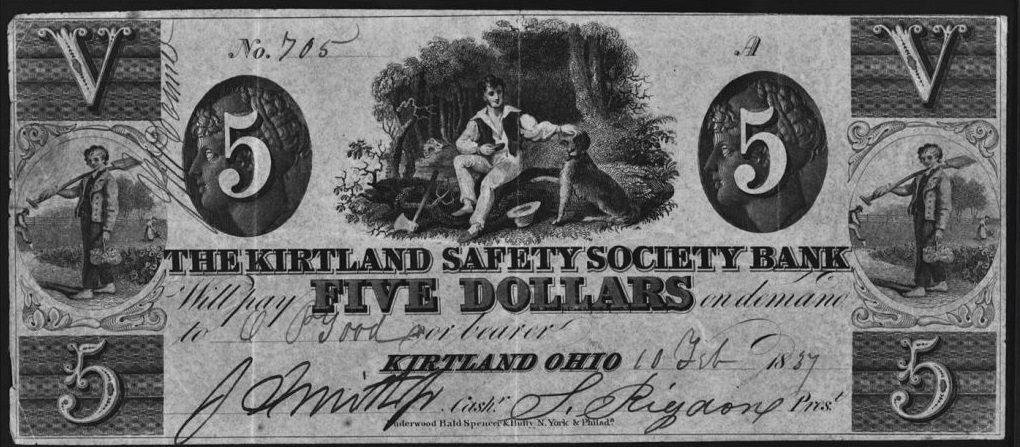
Here is the Church’s own account of what followed. Its history says the optimism of the Saints “had included a sense that the Kirtland Safety Society would succeed if the Saints were faithful,” and: “Many Church members looked to shortcomings within their community, blaming Church leaders for failing to anticipate problems, individuals for engaging in land speculation and overspending, or Church membership in general for not adequately supporting the society. Not all the possible contributing factors, however, were in the Saints’ control. Outside opposition, often fueled by prejudice against the Saints, also played a role in undermining the society.” The society “struggled for months before ceasing operations by August 1837.” Both Joseph and Rigdon were tried and fined under an 1816 Ohio law.
Put the claim next to the outcome. The claim was a word of the Lord about a specific worldly venture: all would be well if the commandments were heeded. The venture closed within the year. A conditional promise cannot simply be proved wrong by a failure, because the failure can be put down to disobedience, and a success credited to obedience. Believers read conditional prophecy that way for a reason, and scripture contains many. The difficulty is narrower. The sources this page found do not say what the commandments were, so there is no way to judge whether they were kept. The promise could be read as kept or as unmet, whichever way things went. Kirtland is the one row in the table where a prophet is reported to have attached the Lord’s name to a venture whose results could be seen. The Church’s later words quote the statement and give causes, and do not give a verdict on the claim.
What is true on the other side
The Church’s test for doctrine is not a dodge. It says doctrine is what the First Presidency and the Twelve establish together and proclaim consistently, and a lone sermon is not that. By that test, Adam-God was never doctrine, blood atonement sermons were rhetoric, and Kirtland was a venture, not a revelation to be added to the canon. Joseph’s condition, recorded in the minutes of 3 September 1837 after the society had failed, “unless the institution was conducted upon righteous principles it could not stand,” is consistent with a prophet who warned and was ignored. The believing position does not require that a prophet never be wrong. It requires that the Church be right about which statements are binding, and it has the means to say so.
Two things in the record sit uneasily with that. The 1949 statement is not a lone sermon. It is a First Presidency statement, the body the Church now names as establishing doctrine, and it calls the restriction “direct commandment from the Lord, on which is founded the doctrine of the Church.” A believer will answer that it was used in private correspondence, was never issued publicly, and says the priesthood is withheld “at the present time.” The pages cited here do not say whether the Church today counts it as doctrine. And “consistently proclaimed” is a test that can be applied only after enough time has passed to see whether it was.
The common rebuttals
“Nobody says prophets are perfect. The Church never has.”
That is true, and this page agrees with all of it: D&C 1, President Uchtdorf and the newsroom statement say it directly. The question is a different one. If a prophet can be wrong while teaching, what does a member in 1952 or 1976 or today do with Sunday’s teaching? The Church’s answer is the doctrine test, and part of that test, “consistently proclaimed,” can only be applied after time has passed.
“Those were never doctrine anyway. Only what the Twelve and First Presidency establish together counts.”
The 1949 statement was written by the First Presidency, and it says the restriction rests on “direct commandment from the Lord, on which is founded the doctrine of the Church.” It was used in the First Presidency’s private correspondence. The Church’s essay says only that the explanations are not accepted “today” as official doctrine. Someone told this in 1949 had no way to know that in 1978 an apostle would tell Church educators that what earlier leaders had said on the subject was said “with a limited understanding.”
“The Lord reveals line upon line. Of course there is correction over time.”
Elder McConkie said it himself, in the paragraph right before “forget everything”: “We get our truth and our light line upon line and precept upon precept.” Take that at face value. It means that teaching develops and earlier teaching can be corrected, and D&C 1:25 says errors are made known later. Nothing in the process labels which present teachings those are while a member is being asked to act on them.
“Banks failed all over America in 1837. Why is Joseph on trial for one?”
He is not on trial as a banker, and nobody here faults him for the Panic. The claim is the one in Woodruff’s journal: that the Lord had spoken about this society. A prophet who reports the Lord’s word on a venture invites the venture to be read as a test of the report.
The Church tells members which statements were doctrine only after the fact.
Some of the statements the Church has since set aside, or described as rhetoric, were taught from the same pulpits as the ones members are asked to live by today.
What this means
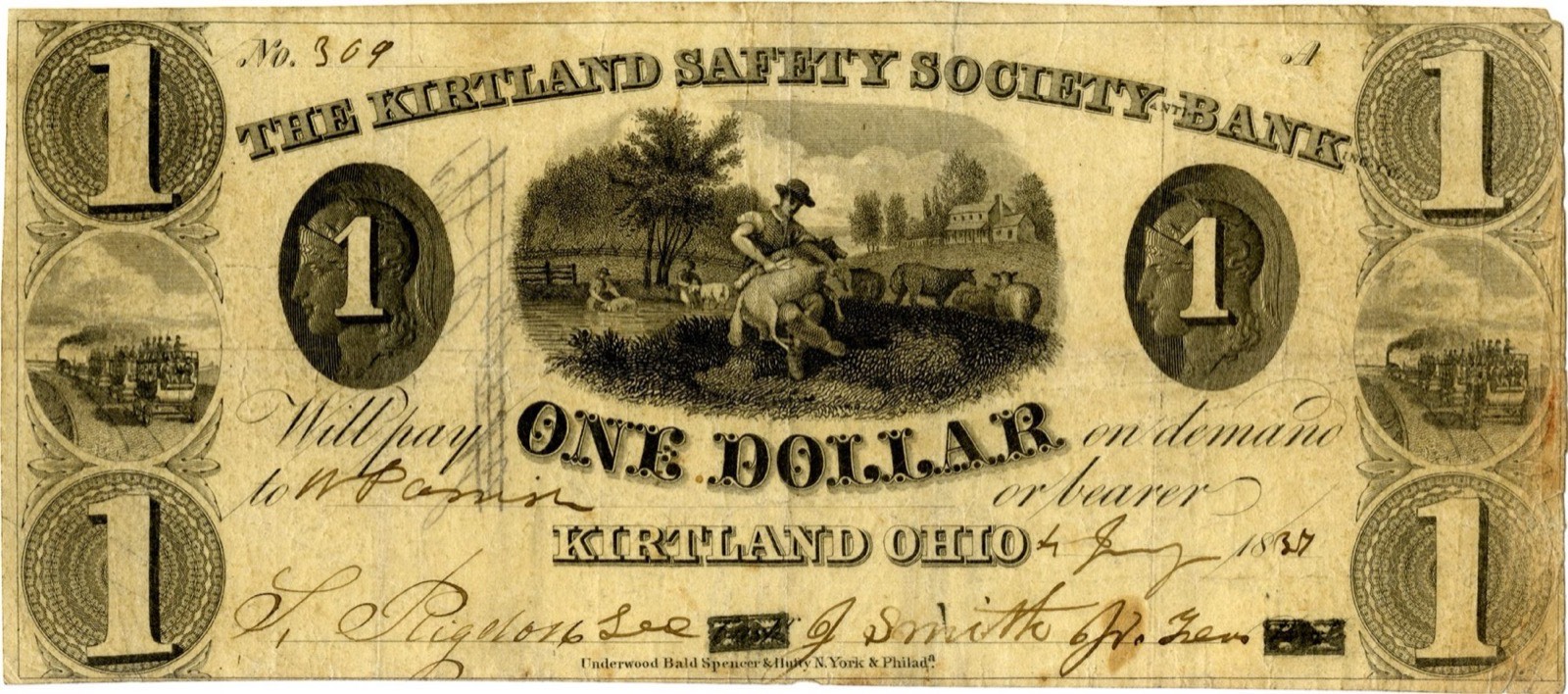
You have read the Church’s own test for doctrine and agreed with it. You have read a President of the Church calling the Adam-God teaching “false doctrine,” an apostle telling educators to forget what he and earlier presidents had said about race that was contrary to the present revelation, an essay that disavows theories advanced by “Church leaders and members,” and a page that says the Journal of Discourses is not authoritative by itself. You have held a one-dollar note from the week Woodruff recorded Joseph telling men in the Deposit office that the Lord had spoken about the society, and a five-dollar note from the month its notes were reportedly trading at 12½ cents on the dollar.
The Church names some of what it now sets aside, but only after the fact. In the pages cited here, it does not say how a member could have known at the time.
The same pattern shows up elsewhere on this site: the Race and the Priesthood page covers the ban in full, what changed and the money page take up related ground, the temple that was never built, and the Joseph page covers the founder himself. What the evidence shows is plain. Statements given by men sustained as prophets were later set aside, in the words of an apostle as “limited understanding,” and in the Church’s own words as theories it “disavows,” and the Church tells us afterward which ones. In the pages cited here, a member today has nothing to tell which of the teachings they are asked to live by belong to the next set.