The founding claims
The Temple That Was Never Built
D&C 84 set a temple in Independence, Missouri inside one generation. The explanations in the Church’s own scripture all came afterward.
The point in one sentence
In 1832 a revelation still printed in the Doctrine and Covenants (the Church’s book of revelations) said, in the voice of God, that a temple “shall be reared in this generation” on a specific lot in Independence, Missouri. It was never built there. The Church’s scripture gives two different reasons, one in 1834 and one in 1841, and both were written after the Saints were driven out.
The world it came from
If you grew up in the Church, you were probably taught that Zion would be built in Jackson County, Missouri, and that mobs drove the Saints out. Both are in the Church’s own history. This page looks at what the 1832 revelation said about the temple, and what was said about it later.
In 1831 the Church was a year old, living mostly in and around Kirtland, Ohio, and its leaders had been told that the “gathering” had a place. On July 20, 1831, a revelation given to Joseph Smith “in Zion, Jackson County, Missouri” (the heading in your scriptures) said of that frontier land: “this is the land of promise, and the place for the city of Zion.” Then it got specific: “the place which is now called Independence is the center place; and a spot for the temple is lying westward, upon a lot which is not far from the courthouse.” (D&C 57:1-3)
The Church’s own history page tells what came next: “On August 2, 1831, Sidney Rigdon pronounced the land ‘consecrated and dedicated to the Lord for a possession and inheritance for the Saints.’ The next day, Rigdon dedicated a site half a mile west of the center of Independence for the building of a temple, and Joseph Smith laid the first cornerstone.” (Church History, “Independence, Missouri”)
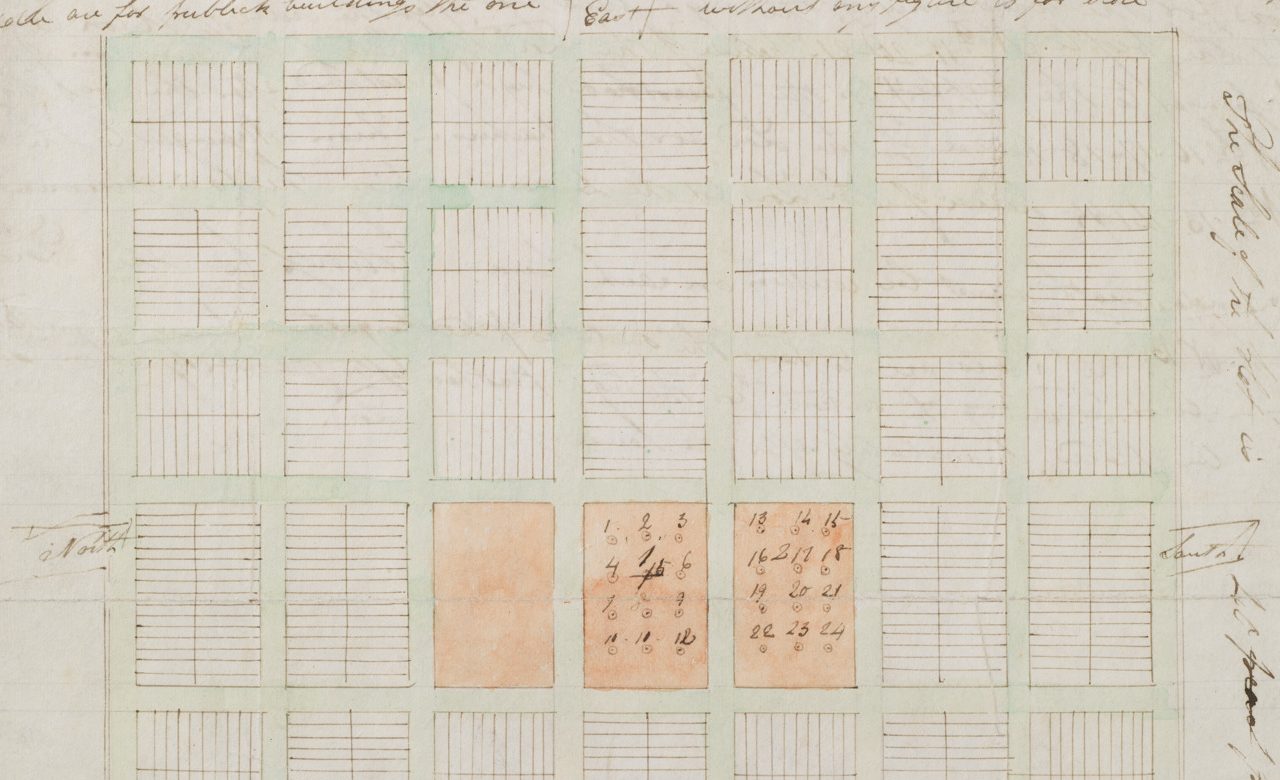
Two years passed between the dedication and the expulsion. In June 1833, the same page says, “the First Presidency, then in Kirtland, Ohio, sent a plat, or city plan, to Church leaders in Missouri for the ‘City of Zion,’ showing how the city should be organized around a complex of two dozen temples.” The Joseph Smith Papers add the scale: the plan was drawn for roughly fifteen to twenty thousand people.
Meanwhile the Saints’ neighbors in Jackson County had decided they did not want them there. The Church’s history manual describes how a meeting “quickly turned into a mob that decided to destroy the printing office and the press. They surrounded the printing office and residence of W. W. Phelps, threw the furniture into the street and garden, broke the press, scattered the type, and destroyed nearly all the printed work, including most of the unbound sheets of the Book of Commandments.” By November the exile was complete: “Most of the exiled Saints found temporary quarters in Clay County, although a few sought refuge in other nearby counties.” (Church History in the Fulness of Times, ch. 11) The Church History page puts the result in one sentence: “the entire population of Saints being driven from the county.”
The same chapter says the mob meeting followed fears about the Saints’ growing numbers and a newspaper article about free people of color, and that by October the Saints had abandoned passive resistance and armed themselves; there was fighting with deaths on both sides on November 4.
What the revelation said
The revelation sits between the dedication (1831) and the expulsion (1833). It was given in Kirtland, Ohio, on September 22 and 23, 1832, and begins by naming the place.
D&C 84:2-3, given at Kirtland, Ohio, September 22 and 23, 1832
Yea, the word of the Lord concerning his church, established in the last days for the restoration of his people, as he has spoken by the mouth of his prophets, and for the gathering of his saints to stand upon Mount Zion, which shall be the city of New Jerusalem. Which city shall be built, beginning at the temple lot, which is appointed by the finger of the Lord, in the western boundaries of the State of Missouri, and dedicated by the hand of Joseph Smith, Jun., and others with whom the Lord was well pleased.
The place is not general. It is the temple lot, in western Missouri, dedicated the year before by Joseph and others.
D&C 84 on churchofjesuschrist.orgD&C 84:4-5
Verily this is the word of the Lord, that the city New Jerusalem shall be built by the gathering of the saints, beginning at this place, even the place of the temple, which temple shall be reared in this generation. For verily this generation shall not all pass away until an house shall be built unto the Lord, and a cloud shall rest upon it, which cloud shall be even the glory of the Lord, which shall fill the house.
Three things are claimed: a temple, within “this generation,” with a cloud, which the verse says “shall be even the glory of the Lord.” Verse 5 also says what happens to the generation: “shall not all pass away.”
D&C 84:4-5D&C 84:31 (the verse begins “Therefore, as I said concerning the sons of Moses”)
for the sons of Moses and also the sons of Aaron shall offer an acceptable offering and sacrifice in the house of the Lord, which house shall be built unto the Lord in this generation, upon the consecrated spot as I have appointed
The same deadline, repeated, and the same place: “the consecrated spot.” Verses 2 to 5 and 31 to 32 contain no “if.” Later in the same revelation (84:54-58) the Church is told it is “under condemnation” and will “remain under this condemnation until they repent,” with a “scourge and judgment” otherwise; the text does not say whether that bears on the temple.
D&C 84:31The strongest answer, at full strength
The Church’s answer is not a dodge, and it is in scripture. On January 19, 1841, in Nauvoo, Illinois, a revelation addressed this exact situation, and named the county:
D&C 124:49-51, Nauvoo, Illinois, January 19, 1841
Verily, verily, I say unto you, that when I give a commandment to any of the sons of men to do a work unto my name, and those sons of men go with all their might and with all they have to perform that work, and cease not their diligence, and their enemies come upon them and hinder them from performing that work, behold, it behooveth me to require that work no more at the hands of those sons of men, but to accept of their offerings. And the iniquity and transgression of my holy laws and commandments I will visit upon the heads of those who hindered my work, unto the third and fourth generation, so long as they repent not, and hate me, saith the Lord God. Therefore, for this cause have I accepted the offerings of those whom I commanded to build up a city and a house unto my name, in Jackson county, Missouri, and were hindered by their enemies, saith the Lord your God.
This is how believers hold the matter: a commanded work, done with all their might, stopped by force, accepted as an offering. Verse 51 names Jackson County and a house. The history above is the church’s own account of that force: a mob, a destroyed press, a county emptied of Saints.
D&C 124 on churchofjesuschrist.orgFour verses earlier, the same revelation says: “if you build a house unto my name, and do not do the things that I say, I will not perform the oath which I make unto you” (124:47). Believers read verses 49 to 51 as the other half of that principle: a failure the Saints caused ends the promise; a failure enemies cause does not. That matters for how this page reads the evidence. D&C 124:45-48 and D&C 84:54-58 tie the outcome to the Saints’ obedience, so the 1832 temple verses cannot be called a promise with no possible exception. They can be called a promise whose conditions are stated elsewhere.
FAIR, the Church-supporting apologetics group, has two relevant pages. On “The temple in Independence, Missouri,” it argues that mobs prevented the work and D&C 124:49 absolves the Saints; that “nobody can predict the timetable of the Lord”; and that “this generation” “could be referring to Latter-Day Saints as a whole, and not only are we still here, but we are growing in number.” It also writes: “Even if we look at the prophecy in Doctrine and Covenants 84 as if the term ‘this generation’ does mean a time frame of about 100 - 120 years (just to give [the critics] the benefit of the doubt), it still does not mean it is a false prophecy by LDS terms.” (FAIR, “The temple in Independence, Missouri”) On its page about alleged false prophecies, under the heading “Commandment, not Prophecy,” it treats the verse as a commandment, and a step in its method reads “Remember that most prophecies are contingent on conditions being met,” citing Jeremiah 18:7-10. (FAIR, “Alleged false prophecies of Joseph Smith”)
A revelation named a place, a deadline, and a sign. Two years later, one scripture named a reason it was not met. About eight years later, another scripture named a different one.
Both are in your scriptures. Read in order, they do not say the same thing.
From the lot to the present
Dates and events are from the Church’s own history pages and the scripture headings.
Sources: Church History, Independence, Missouri; D&C headings; Journal of Discourses 17:111; Church Newsroom
The exhibits
These are the Church’s own sources first, quoted verbatim, with the sentence on either side kept where it changes the meaning.
Church History, “Independence, Missouri,” on the dedication
churchofjesuschrist.org
What it establishes: The Church’s own account of the 1831 dedication. The site was dedicated and a cornerstone laid.
Read the Church History pageSame page, on the 1833 expulsion
churchofjesuschrist.org
What it establishes: The believing point, in the Church’s own words: the work stopped because the Saints were removed by force.
Same pageDoctrine and Covenants 105:2-5, near Fishing River, Clay County, Missouri, June 22, 1834
Scripture, 1834
What it establishes: This revelation is about the redemption of Zion, not the temple by name. It gives a different reason from D&C 124: the Church’s own shortcomings, not only its enemies. Both are scripture.
D&C 105D&C 124:51 (Nauvoo, January 19, 1841)
Scripture, 1841
What it establishes: The Church’s own scriptural answer, dated about eight years after the revelation it answers and seven years after the expulsion.
D&C 124Orson Pratt, “Interest Manifested, Etc.,” Journal of Discourses 17:103-113 (p. 111), delivered June 14, 1874, New Tabernacle, Salt Lake City (he says the revelation “was given forty-two years ago”)
June 14, 1874
What it establishes: An apostle, forty-two years on, reading “generation” as the people living in 1832 and still expecting the temple. Read the sentences around it as well. Earlier in the same discourse he says the Saints will return to the law of God “when we will,” and that the Saints have been persecuted because “we have not fulfilled his law; we have disobeyed the word which he gave through his servant Joseph, and hence the Lord has suffered us to be smitten and afflicted under the hands of our enemies.” Pratt gives the Saints’ own disobedience as a reason alongside the enemies.
Journal of Discourses 17:103-113The Church’s own Missouri historic sites page, photo caption
churchofjesuschrist.org
What it establishes: The 2.5-acre parcel the Church captions as the temple lot is owned by a separate church, the Church of Christ (Temple Lot), which, according to Wikipedia, does not accept the Doctrine and Covenants as a doctrinal standard. Wikipedia says most of the larger original tract (about 63 acres) belongs to the Community of Christ, and that the Temple Lot church holds that its parcel is the one Joseph Smith dedicated.
Church Missouri historic sites overviewThe visual breakdown
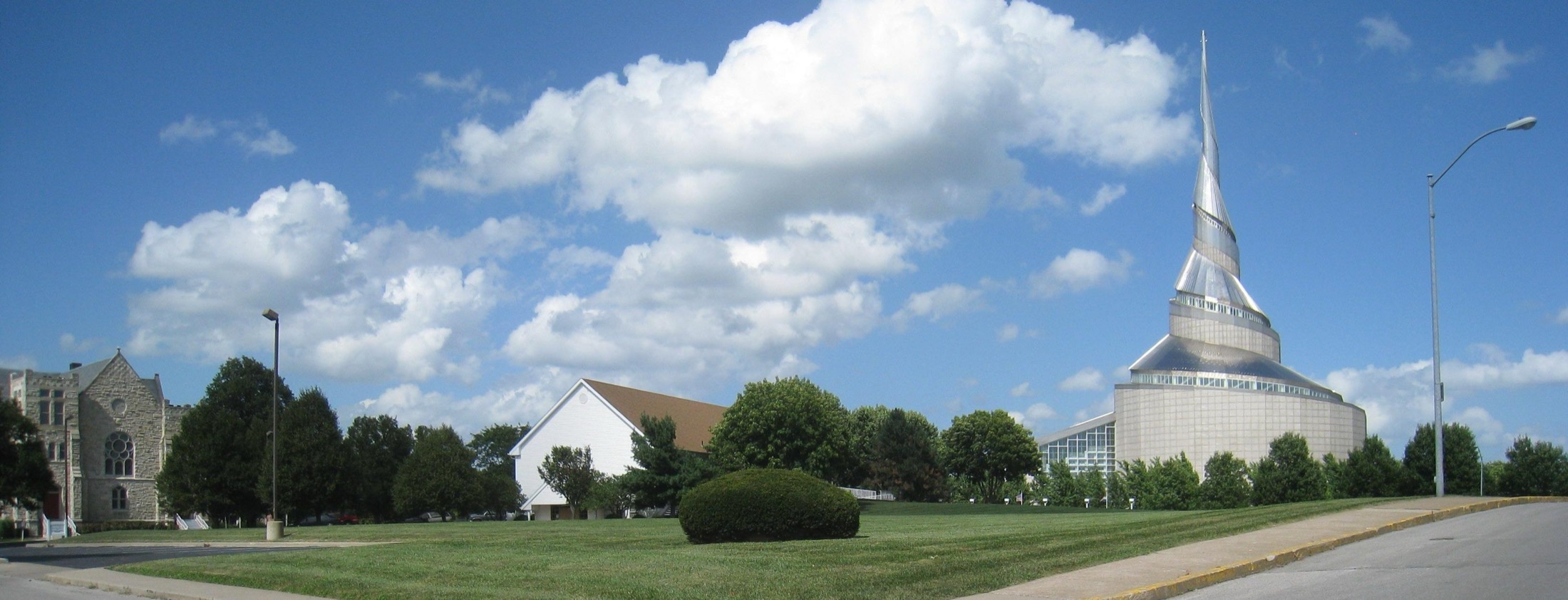
Here is the lot today, and below it the verse set against what happened to each part of it. The photograph shows the 2.5-acre grass-covered parcel (the “Hedrickite Temple Lot” on Wikimedia Commons) that is the highest portion of the larger Temple Lot.
| The verse says | What the record shows |
|---|---|
| “the city New Jerusalem shall be built by the gathering of the saints, beginning at this place” (84:4) | The Saints gathered in 1831 to 1833 and were driven from the county in 1833; a plat for the city was drawn and sent, not built. |
| “even the place of the temple” (84:4) | The site was dedicated and a cornerstone laid in 1831. The Church’s own history site captions the temple lot cornerstone marker as “owned by Church of Christ (Temple Lot).” |
| “which temple shall be reared in this generation” (84:4) | No temple was built there by the Church. Orson Pratt read “generation” as the people living in 1832 and still expected it in 1874. |
| “this generation shall not all pass away until an house shall be built unto the Lord” (84:5) | FAIR’s hypothetical window of 100 to 120 years ends between 1932 and 1952. FAIR also offers a second reading, “Latter-Day Saints as a whole,” a people that is still here. |
| “a cloud shall rest upon it, which cloud shall be even the glory of the Lord” (84:5) | The Church built no temple there, and no Church source in this page reports a cloud. The spiral temple in the photograph was built by the Community of Christ, a separate church. |
| “upon the consecrated spot as I have appointed” (84:31) | The Church’s temple for the area, dedicated May 6, 2012, is the Kansas City Missouri Temple, in Clay County, not on the lot. |
| (D&C 124:51, 1841) “I have accepted the offerings of those ... hindered by their enemies” | The Church’s answer: the work was commanded, attempted, stopped by force, and the offering accepted. |
What is true on the other side
Read as believers read it, the sequence is coherent. A commandment was given to build in Jackson County. The Saints tried: they dedicated the lot, laid a cornerstone, drew the plan. They were driven out. A revelation given in Nauvoo in 1841 says God accepts the offering when a work is stopped this way, and the same revelation says the promise lapses if the Saints “do not do the things that I say.” Prophecies, believers add, are conditional as a general rule (Jeremiah 18:7-10), so the condition does not have to be written into each one. “This generation” can mean the Latter-day Saints as a whole, who have not passed away. And the plan did not die with the expulsion; the Church’s own history page says that “even after Brigham Young and the Twelve Apostles led the majority of the Saints west, many hoped to return one day to build Zion near Independence.”
This is why the page does not argue that the Saints did not try, or that the Church has no answer, or that the 1832 verses admit no exception at all. What the page asks is what the answer does to the original sentence.
The common rebuttals
“‘Generation’ just means an era or a dispensation, not forty years.”
The reading is available, but it was not the reading of the apostle quoted above. In 1874 Orson Pratt took “generation” to mean the people living in 1832 and expected the temple “before the generation that was living forty-two years ago has all passed away.” Verse 5 also counts that generation by people leaving it: “shall not all pass away.” An era does not pass away one person at a time. Believers also read “this generation” as the Latter-day Saints as a whole, a people that has not all passed away; FAIR says this is possible (“could be referring to Latter-Day Saints as a whole”). Against that stand the wording of verse 5 and Pratt’s 1874 reading. FAIR also says, for the sake of argument, that even a 100 to 120 year frame would not make it a false prophecy, and answers with D&C 124:49.
“It was a command, not a prediction.”
Verse 4 opens “Verily this is the word of the Lord,” and the Saints were plainly told to build. But verse 5 describes an outcome: a house built, “a cloud shall rest upon it,” and a generation that “shall not all pass away” before it. The verse that says “shall not all pass away until” is making a statement about what will be true, not only about what the Saints should do. FAIR makes this argument under the heading “Commandment, not Prophecy” on its page about alleged false prophecies.
“Prophecies are always conditional. Jeremiah says so.”
Jeremiah 18:7-10 does say it, and it says it as a general rule, not as a clause attached to each promise: “And at what instant I shall speak concerning a nation, and concerning a kingdom, to build and to plant it; If it do evil in my sight, that it obey not my voice, then I will repent of the good, wherewith I said I would benefit them.” On that reading, no condition needs to be written into a promise for the condition to apply. D&C 84 as quoted above states no condition in verses 2 to 5 and 31 to 32, but the same revelation says the whole Church was “under condemnation” for having “treated lightly the things you have received” (84:54-58), and D&C 105 (1834) and D&C 124:45-48 tie Zion and the house to the Saints’ obedience. So the fair claim is not that the 1832 promise could never have had a condition. It is narrower: the temple verses state a deadline and no condition, and the conditions are supplied elsewhere, in different words and with different reasons (D&C 105 points to the Church’s own failings; D&C 124 describes Saints who “go with all their might and ... cease not their diligence” and are hindered by enemies). Deuteronomy 18:22, from the same Bible, gives the other standard: “When a prophet speaketh in the name of the Lord, if the thing follow not, nor come to pass, that is the thing which the Lord hath not spoken, but the prophet hath spoken it presumptuously: thou shalt not be afraid of him.” Which standard governs depends on whether a promise with an unwritten condition counts as a promise with a deadline.
The temple verses in the 1832 text have a deadline and no stated condition. The explanations are dated 1834 and 1841.
A promise that can be explained after the fact, by either of two different reasons, can never be shown wrong.
What this means
A lot in Independence was dedicated in 1831. A revelation in 1832 said a temple would rise there “in this generation,” under a cloud of glory, on “the consecrated spot.” A plan for twenty-four buildings was drawn in 1833 and sent west. The Saints were driven out the same year. In 1834 one revelation pointed to the Church’s own failings; in 1841 another said God accepted their offering instead. In 1874 an apostle was still expecting the temple within the 1832 generation. Today the Church’s own site captions the Independence temple lot as “owned by Church of Christ (Temple Lot),” a small separate church; according to Wikipedia that church holds a 2.5-acre parcel of the original tract, and most of the rest is held by the Community of Christ.
The Church’s answer is real, scriptural, and fits the history of violence. It is also an answer that came after the work stopped, not before, and the Church’s scripture gives a different one in 1834.
The page does not ask whether the Saints tried; the Church’s own sources say they did. It does not claim the verses admit no exception; the same scripture ties the outcome to the Saints’ obedience. It asks what a reader should do with a dated sentence in the voice of God when its explanations are supplied afterward, and are not the same explanation. If a missed deadline can be explained after the fact, by enemies or by the Saints’ own failings, what would a failed promise have looked like?