The people
Polygamy
The Church’s own essay: 30 to 40 wives, a 14 year old, women with living husbands, and public denials.
The point in one sentence
If you grew up in the Church, you may have heard that plural marriage (a man having more than one wife) was a hard commandment God gave Joseph Smith. The Church’s own Gospel Topics essay, published on its website, tells more. Joseph Smith married between 30 and 40 women, including a 14 year old and at least a dozen already married to living husbands. His wife Emma likely did not know about all of them. He practiced it in secret and denied it in public.
The world this happened in
Nauvoo in the early 1840s was one of the largest cities in Illinois, and Joseph Smith was nearly all of it at once: prophet, mayor, lieutenant general of its militia, and, by January 1844, a declared candidate for president of the United States. Inside that city, plural marriage ran as a sealed circle, kept among those who were told. The Church’s essay says participants “pledged to keep their involvement confidential,” and this is how the same essay describes the public face of the practice:
Gospel Topics essay, "Plural Marriage in Kirtland and Nauvoo"
The rumors prompted members and leaders to issue carefully worded denials that denounced spiritual wifery and polygamy but were silent about what Joseph Smith and others saw as divinely mandated “celestial” plural marriage.
The Church’s own description of the denials: they were carefully worded and did not mention the plural marriages that were being practiced. The rebuttals section comes back to this sentence.
The essayThe denials had scripture behind them. The 1835 Doctrine and Covenants, canonized through this entire period, declared “we believe, that one man should have one wife,” and that article stayed in print until 1876, spanning every secret marriage on this page.
The numbers, from the Church's own Gospel Topics Essay
Not from a critic. From churchofjesuschrist.org.
Source: "Plural Marriage in Kirtland and Nauvoo," Gospel Topics Essays
The exhibits
Every quote below is from the Church’s own Gospel Topics essay or its own canonized scripture, except the last, which is Joseph’s own recorded words.
Gospel Topics essay, "Plural Marriage in Kirtland and Nauvoo," footnote 24
Church-published
What it establishes: The Church’s own count of Joseph’s wives, consistent with historian Todd Compton’s independently documented 33.
The essayThe same essay, on Fanny Alger
marriage dated to the mid-1830s
What it establishes: The first plural marriage, entered while he was married to Emma.
The essayThe same essay, on the youngest wife
Helen Mar Kimball
What it establishes: Joseph was 37. The essay elsewhere calls this "inappropriate by today’s standards."
The essayThe same essay, on polyandry
Nauvoo period
What it establishes: At least a dozen of his sealings were to women with living husbands.
The essayThe same essay, on Emma
Church-published
What it establishes: The Church concedes his own wife was kept unaware of some of the marriages.
The essayThe same essay, on why he proceeded
Church-published
What it establishes: In the Church’s own account, an angel threatened Joseph with destruction unless he went forward. That is how the essay explains why he began.
The essayDoctrine and Covenants 132:54, canonized scripture today
revelation recorded 1843
What it establishes: A revelation, in Joseph’s voice, threatening Emma with destruction if she refused plural marriage. It remains in the standard works, on the Church’s own scripture site, right now.
Read D&C 132Joseph Smith, public sermon, Nauvoo
May 26, 1844, five weeks before his death
What it establishes: A public denial of polygamy while he had 30 to 40 documented plural wives. Even FAIR, a Latter-day Saint group that defends the Church, cites it.
The sermon transcript, BYUSome believers argue that Joseph Smith never practiced plural marriage, and that Brigham Young introduced it after his death. Their strongest point is real: Joseph denied it publicly, and much of the detailed evidence comes from affidavits and testimony given decades later. But the Church itself rejects this view. Its own essay says of Joseph’s plural wives, “Careful estimates put the number between 30 and 40” (Gospel Topics essay), and its history page on Emma says that in early 1843 she “personally consented to and witnessed Joseph’s marriages to four women” (Church History Topics). The revelation on plural marriage, now Doctrine and Covenants 132, was recorded July 12, 1843, during Joseph’s life, according to its own section heading. A member who denies Joseph practiced polygamy is not defending the Church’s position. The Church’s position is that he did.
The wife the revelation named
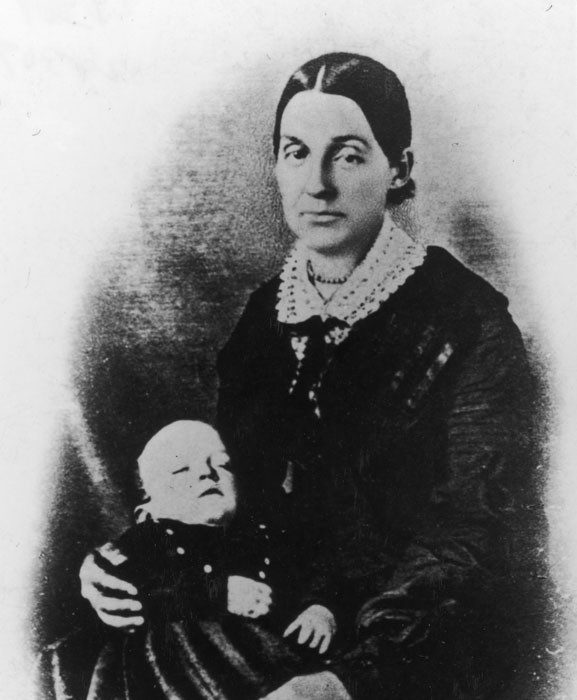
Of Joseph Smith’s wives, only one is named in the text of the revelation itself. Emma Hale Smith was not a bystander to plural marriage. In the Church’s own account she was a woman of real faith and real sacrifice: the Church says she was the president of the Female Relief Society of Nauvoo and “the first woman to receive temple ordinances,” and the first Latter-day Saint hymnbook was printed under her name. The Church’s essay is just as direct about what plural marriage cost her: “For Joseph Smith’s wife Emma, it was an excruciating ordeal.” Nothing below takes her faith back. The question is what the record shows about the gap between what was said in public and what was done in private, and what the revelation says about her.
Doctrine and Covenants 132:51-56, recorded at Nauvoo, July 12, 1843
“51 Verily, I say unto you: A commandment I give unto mine handmaid, Emma Smith, your wife, whom I have given unto you, that she stay herself and partake not of that which I commanded you to offer unto her; for I did it, saith the Lord, to prove you all, as I did Abraham, and that I might require an offering at your hand, by covenant and sacrifice.
52 And let mine handmaid, Emma Smith, receive all those that have been given unto my servant Joseph, and who are virtuous and pure before me; and those who are not pure, and have said they were pure, shall be destroyed, saith the Lord God.
53 For I am the Lord thy God, and ye shall obey my voice; and I give unto my servant Joseph that he shall be made ruler over many things; for he hath been faithful over a few things, and from henceforth I will strengthen him.
54 And I command mine handmaid, Emma Smith, to abide and cleave unto my servant Joseph, and to none else. But if she will not abide this commandment she shall be destroyed, saith the Lord; for I am the Lord thy God, and will destroy her if she abide not in my law.
55 But if she will not abide this commandment, then shall my servant Joseph do all things for her, even as he hath said; and I will bless him and multiply him and give unto him an hundred-fold in this world, of fathers and mothers, brothers and sisters, houses and lands, wives and children, and crowns of eternal lives in the eternal worlds.
56 And again, verily I say, let mine handmaid forgive my servant Joseph his trespasses; and then shall she be forgiven her trespasses, wherein she has trespassed against me; and I, the Lord thy God, will bless her, and multiply her, and make her heart to rejoice.”
Her name is in verses 51, 52 and 54. Verse 52 says she is to receive the women given to Joseph who are ‘virtuous and pure’; verse 54 says what happens if she will not abide; verses 55 and 56 provide for Joseph and close with a blessing if she forgives him. Bold added. The Church’s own summary of verses 51-57 reads “Emma Smith is counseled to be faithful and true.” Believers read verse 54 as the command to ‘abide and cleave unto my servant Joseph, and to none else,’ with the warning attached to that command.
Read section 132 on the Church’s siteWhat did Emma do? The Church’s essay gives both halves in one paragraph: “Emma approved, at least for a time, of four of Joseph Smith’s plural marriages in Nauvoo, and she accepted all four of those wives into her household. She may have approved of other marriages as well. But Emma likely did not know about all of Joseph’s sealings. She vacillated in her view of plural marriage, at some points supporting it and at other times denouncing it.” The essay adds that the revelation “required that a wife give her consent,” and that “After Emma opposed plural marriage, Joseph was placed in an agonizing dilemma, forced to choose between the will of God and the will of his beloved Emma.” The Church’s history page dates her consent to early 1843, and then says: “But by July, her attitude toward the practice had shifted again, and she burned a manuscript copy of the revelation on plural marriage now found in Doctrine and Covenants 132.” Believers read a woman who struggled and, at times, said yes. The revelation’s own text sets that yes beside a warning: verse 54 says she would be destroyed if she did not abide the commandment given to her.
What was said in public
According to the Joseph Smith Papers, “The Voice of Innocence from Nauvoo” was composed by William W. Phelps and approved by priesthood leaders at a general priesthood meeting on March 7, 1844. The Relief Society, with Emma presiding, then adopted it in March 1844, and it was printed in the Nauvoo Neighbor on March 20 above the names of Emma Smith and Hannah M. Ells. The Church Historian’s Press, the Church’s own publisher, introduces it this way:
Church Historian’s Press, The First Fifty Years of Relief Society, editorial headnote to “The Voice of Innocence from Nauvoo”
“As the practice of plural marriage slowly expanded, the Relief Society was drawn into disputes involving the gap between public pronouncements against ‘spiritual wifery’ and the private practice of authorized plural marriage.” … “By this point, Emma Smith opposed plural marriage as practiced by her husband and others in Nauvoo. She thus encouraged Relief Society members to follow the published statements of Joseph Smith and the church, as well as her husband’s teachings ‘from the Stand,’ implying that they should abide by his public remarks against spiritual wifery rather than any private teachings regarding plural marriage.”
The Church’s editors do not say Emma lied. They say she opposed the practice and pointed members to Joseph’s public remarks, and they name the gap. The resolution itself targets “John C. Bennett’s ‘Spiritual Wife System’” and says: “let polygamy, bigamy, fornication, adultery, and prostitution, be frowned out of the hearts of honest men …”
Read the headnote and resolutionsThe essay describes the climate, though it does not mention this resolution by name. It says men were using the rumors to seduce women into ‘spiritual wifery’ and were cut off when discovered, and that “The rumors prompted members and leaders to issue carefully worded denials that denounced spiritual wifery and polygamy but were silent about what Joseph Smith and others saw as divinely mandated ‘celestial’ plural marriage.” Believers can fairly say the resolution was aimed at Bennett’s counterfeit. The essay’s wording is that denials of this kind were carefully worded and left something out.
Her 1879 denial, and how the Church describes it
The Church’s history page says she “rarely spoke about the practice after Joseph’s death,” and: “After her death in 1879, her sons published a transcript of an interview in which she purportedly denied Joseph had ever sanctioned plural marriage.” The text circulates from the Saints’ Herald of October 1, 1879, as a question-and-answer published by her sons. In the online transcription of that issue (the faenrandir transcription, not the printed scan), she is recorded as saying: “There was no revelation on either polygamy or spiritual wives,” and: “No such thing as polygamy or spiritual wifery was taught, publicly or privately, before my husband’s death, that I have now, or ever had any knowledge of.” Asked whether he had other wives, she is recorded as answering: “He had no other wife but me; nor did he to my knowledge ever have.”
She never lost her faith in the Book of Mormon. She is also named in a revelation that commands her to receive the women given to Joseph, and says she would be destroyed if she did not abide its law.
How it ended: a newspaper, an order, and three weeks
By 1844 the sealed circle could not hold. William Law, a counselor in the First Presidency until early that year, broke with Joseph over the practice. With six other men he bought a printing press, and on June 7, 1844, they published the first and only issue of the Nauvoo Expositor, carrying sworn affidavits that plural marriage was being taught and practiced in secret.

Three days later the city council, with Joseph presiding as mayor, declared the paper a public nuisance, and Joseph signed the order. This is the document itself, in the hand of his clerks, hosted today on the Church’s own Joseph Smith Papers site:

Mayor’s order to the Nauvoo city marshal, June 10, 1844, Joseph Smith Papers transcript
You are hereby commanded to destroy the printing establishment press from whence issues the Nauvoo Expositor, and pie the Type of said printing establishment in the streets and burn all the Expositors and libellous hand bills found in said establishment.
Signed “By order of the city council Joseph Smith Mayor.” To pie the type is to dump the letters into the street. The Church’s history page records that the marshal and a posse of about 100 men carried it out that evening.
The order, Joseph Smith PapersThe martyrdom story most members are taught leaves out what he was in jail for. The jailing began with a newspaper, and the newspaper had printed sworn statements about the marriages on this page.
And it did not stop in 1890
Members are usually taught that the 1890 Manifesto ended polygamy. The Church's essay documents 25 plural marriages performed between October 1890 and September 1903, after it. That is why a Second Manifesto was needed in 1904.
The 1890 Manifesto is taught as the end of polygamy. The Church’s own essay counts 25 plural marriages performed after it.
That is why a Second Manifesto was needed in 1904. The number comes from the Church’s own essay.
The common rebuttals
“People married young back then. You cannot judge the 1840s by today.”
Grant the era completely and the defense still fails, because the rest of the record was scandalous by the 1840s’ own standards. Marrying women who had living husbands was not normal in 1843. Keeping marriages from your wife was not normal in 1843. And the way it was handled shows that its own leaders did not expect Nauvoo to accept it. It was run in secret, behind pledges of confidentiality and public denials. When a newspaper printed it, the response was not a shrug but a destroyed press. The secrecy shows how the people involved judged it.
“God commanded it, the way he commanded Abraham, Jacob, Moses, and David.”
The two books this faith canonized give opposite verdicts on exactly those men, in the voice of the same God:
| The Book of Mormon, Jacob 2:24 | D&C 132:38–39 | |
|---|---|---|
| On David and Solomon’s wives | “which thing was abominable before me, saith the Lord” | “David’s wives and concubines were given unto him of me” |
| The rule it teaches | “there shall not any man among you have save it be one wife” (Jacob 2:27) | “in nothing did they sin save in those things which they received not of me” |
The essay leans on Jacob’s exception clause, the “raise up seed” verse, to bridge them. The clause cannot do that work, because the contradiction is not about whether God may ever command plural marriage. It is about David and Solomon specifically: one canonized book calls their wives an abomination, and the other says God gave those wives himself, sparing only Uriah’s. Both cannot be true of the same two kings. The second is the revelation recorded in Joseph’s lifetime, in 1843, that permits plural marriage.
“The sealing to Helen Mar Kimball was for eternity only, not a real marriage.”
Even FAIR, a Latter-day Saint group that defends the Church, says it presumably became a real marriage over time and admits the question cannot be documented either way. So the defense rests on something no one can document. And the fact that matters stands untouched by it: a 37 year old prophet was sealed to a 14 year old, and the Church’s own essay is the source for both numbers.
“He never lied. The denials were carefully worded and technically true.”
This is FAIR’s actual argument, and it is worth looking at what it concedes. Wording built to be defensible on a technicality, while leaving every listener believing something false, is deception, not a defense against it. The essay’s own phrase, “carefully worded denials,” says the same thing in the Church’s voice. Five weeks before his death, with 30 to 40 documented wives, Joseph told a public congregation he could “only find one.” No careful wording makes that sentence true.
What this means
Put the defenses next to what they are defending. A man marries between thirty and forty women. At least a dozen have living husbands. One is fourteen. His wife does not know about all of them, and canonized scripture, in the voice of God, threatens her with destruction if she does not abide it. In public he denies it. When seven men print sworn statements about it in a newspaper, he has the press destroyed as mayor, and he is killed by a mob at Carthage Jail twenty days later.
None of this comes from critics. The count is the Church’s essay, the threat is the Church’s scripture, and the order to destroy the press sits on the Church’s own website.
The question is no longer whether it happened. The Church settled that when it published the essay. The question is what kind of explanation survives every item at once: the ages, the living husbands, the secrecy from Emma, the denials from the pulpit, and the type in the street. “God commanded it” has to carry all five. For anyone who does not already take Joseph Smith at his word that God commanded it, the Church’s own pages give nothing else to carry them.