The founding claims
The Kinderhook Plates
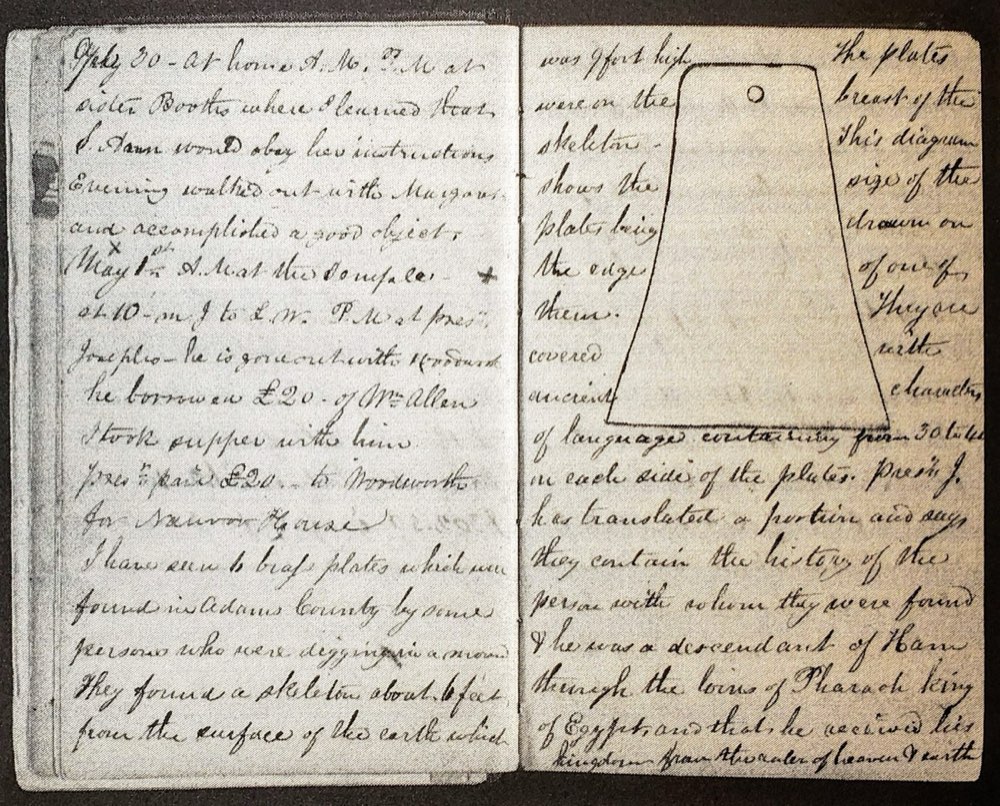
He was shown six fake plates, and his secretary wrote within days that he had translated a portion.
The point in one sentence
In 1843 Joseph Smith, who said he could translate ancient metal plates, was shown six brass plates that, by Wilbur Fugate’s later account, three local men had just made, and his clerk William Clayton wrote in his journal within days that “Prest J. has translated a portion” of them.
If you grew up in the Church, you were taught that an angel showed Joseph Smith ancient plates and that he translated them. This page is about a second set of plates, shown to him in 1843, that turned out to be fake.
The world the plates came from
The Latter-day Saints’ founding claim was that an angel had shown Joseph Smith an ancient record engraved on plates, and that he had translated it. Those plates were no longer available to anyone else.
The Church’s history topic page describes what happened next: “In 1843, a group of men unearthed six bell-shaped brass plates about three inches in height from an American Indian burial mound near Kinderhook, Illinois. The plates contained symbols resembling an ancient script, and one member of the group thought the artifacts appeared well suited for Joseph Smith to translate.”
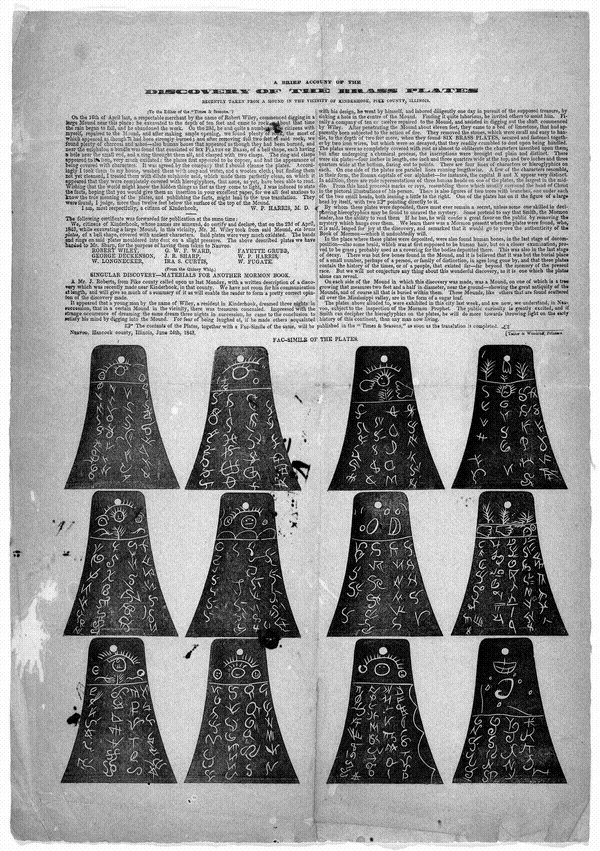
The discovery was announced in public. Dr. W. P. Harris signed a statement for the Times and Seasons, the Church’s Nauvoo newspaper, saying that near the burned bones “a bundle was found that consisted of six plates of brass, of a bell shape, each having a hole near the small end, and a ring through them all, and clasped with two clasps.” The same paper’s editor wrote, in the same issue: “Circumstances are daily transpiring which give additional testimony to the authenticity of the Book of Mormon.” The Quincy Whig, a newspaper in the nearby town of Quincy, ran the story under the headline “Singular Discovery,” and the Nauvoo printing office later produced a full-page broadside with drawings of all twelve sides.
What was said that week
William Clayton, Joseph Smith’s clerk, personal journal, 1 May 1843 (as quoted by BYU Religious Studies Center)
I have seen 6 brass plates which were found . . . by some persons who were digging in a mound. They found a skeleton. . . . Prest J. has translated a portion and says they contain the history of the person with whom they were found & he was a descendant of Ham through the loins of Pharaoh king of Egypt, and that he received his kingdom from the ruler of heaven & earth.
Written by the clerk who was with Joseph almost daily. It reports two things: that Joseph translated a portion, and what he said the plates contained. The characters were invented, so there was no history to translate.
BYU Religious Studies Center, with the journal textThe Church of Jesus Christ of Latter-day Saints, Church History Topics, “Kinderhook Plates”
Joseph apparently examined the plates and, according to his clerk William Clayton, remarked that they contained “the history of … a descendant of Ham through the loins of Pharaoh king of Egypt.”
The Church today repeats Clayton’s report as what Joseph said, then adds that he “evidently did not attempt a revelatory translation.”
The Church’s own topic pageThe plates carried invented marks, not writing. Clayton’s journal says Joseph translated a portion.
Everything after this point is a question of what “translated a portion” meant.
What is true on the other side
Joseph Smith never published a translation of the Kinderhook plates. A Nauvoo broadside (a one-sheet printed notice) said the contents would be published in the Times and Seasons “as soon as the translation is completed.” None appeared, and the Joseph Smith Papers say no translation endorsed by Joseph has been located. Stanley Kimball, in the Ensign, showed that the first-person wording “I have translated a portion of them” was Clayton’s journal entry (“President J. has translated a portion”) changed into Joseph’s voice when his history was printed in installments in the 1856 Deseret News, so it cannot be treated as Joseph’s own sentence. The Church’s topic page says Joseph “evidently did not attempt a revelatory translation as he had done with the Book of Mormon plates” and that whether he suspected a forgery, felt unable to translate, or took a scholar’s interest “remains unconfirmed.” “Whatever he thought of the plates, he quickly lost interest in them.” The BYU authors note that the accounts mention no Urim and Thummim, seer stone or divine revelation.
It is wrong to say Joseph wrote “I have translated a portion” in his own hand. That wording was created when the entry was edited into the serialized history of Joseph Smith (Deseret News, 1856), later printed in History of the Church. The original is Clayton’s sentence about Joseph, and nothing on the page records Joseph writing it. It is also unproven that the hoaxers meant to trap him: Fugate called it a joke, and Kimball weighs whether it was a joke or a trap and does not settle it.
Two historians, Don Bradley and Mark Ashurst-McGee, writing for BYU’s Religious Studies Center, argue that Clayton’s entry is reliable (“Modern historians recognize Clayton as one of the most accurate and important Nauvoo sources on Joseph Smith”) and that Joseph did attempt a translation, by “ordinary methods of traditional translation”: comparing a plate character to his “Egyptian Alphabet.” They conclude: “He mistakenly accepted the Kinderhook plates as authentic artifacts; he mistakenly identified their characters as Egyptian; and he mistakenly thought that he had translated one or more of these characters.”
The question the sources leave open is whether what Joseph did was a prophetic act or an amateur’s comparison of symbols. The BYU authors call it the work of “an enthusiastic, yet amateur, linguist”; the Church’s page leaves his reasons unconfirmed. Either way, the plates held no ancient writing to translate.
From the plates to the verdict
A joke in 1843, a laboratory result in 1980.
Sources: Ensign, Aug. 1981; Church History Topics; Joseph Smith Papers; BYU Religious Studies Center
The exhibits
Church sources first, then the confession, then the lab. Every quote is verbatim and linked.
Joseph Smith Papers, Journal Dec. 1842–June 1844, Book 2, editorial note to the 7 May 1843 entry
Church History Department
What it establishes: The Church’s own scholarly edition prints Clayton’s sentence and then says no translation endorsed by Joseph has been located, “suggesting that whatever JS initially thought about the plates, he soon lost interest in them.”
Joseph Smith Papers, page 195 and its notesChurch History Topics, “Kinderhook Plates”
Church History Department
What it establishes: The Church itself connects Clayton’s report to Joseph’s earlier translation of a glyph from the Kirtland-era Egyptian material, which it says closely matches one plate symbol.
Read it on churchofjesuschrist.orgWilbur Fugate, letter, 1879 (quoted in Stanley B. Kimball, Ensign, Aug. 1981)
1879
What it establishes: A confession from one of the participants, in a letter to James T. Cobb dated 30 June 1879. It is a letter, not a sworn affidavit. Kimball also cites an 1878 Fugate letter.
The Ensign articleDr. W. P. Harris, 1855 letter (published 1912), quoted in the same Ensign article
1855
What it establishes: The same doctor whose signed statement describing the dig was printed in Joseph’s own newspaper later wrote that Whitton told him how the plates were made.
The Ensign articleStanley B. Kimball, “Kinderhook Plates Brought to Joseph Smith Appear to Be a Nineteenth-Century Hoax,” Ensign, Aug. 1981
August 1981
What it establishes: The test was done by Professor D. Lynn Johnson of Northwestern in 1980 on the plate owned by the Chicago Historical Society (now the Chicago History Museum): roughly 73 percent copper and 24 percent zinc. The Church magazine published it.
Read the full articleDon Bradley and Mark Ashurst-McGee, “Joseph Smith and the Kinderhook Plates,” BYU Religious Studies Center
BYU Religious Studies Center
What it establishes: Two historians writing for BYU’s Religious Studies Center conclude that Joseph attempted a translation by ordinary methods, with no mention of a seer stone or revelation, and call it a mistake.
Read the chapterThe visual breakdown
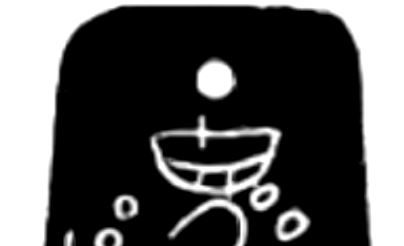
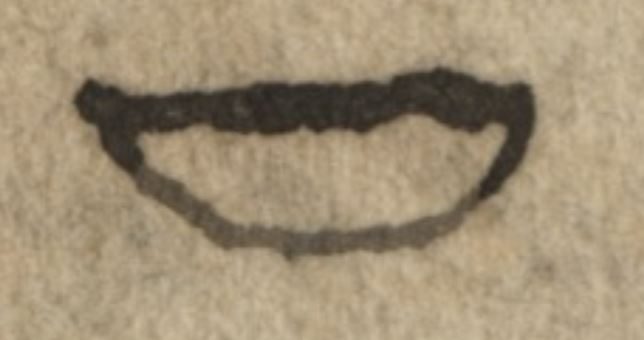
Two BYU historians argue that the content of Clayton’s report can be “substantially drawn” from one character, the boat-shaped one at the top of one plate, which resembles a character in the “Egyptian Alphabet” manuscripts (mid-1830s pages, written in the hands of Joseph Smith and others, that pair characters with definitions; the page below calls them the GAEL). Here are the two.
| What Clayton recorded | What it was | |
|---|---|---|
| Source | “six brass plates” of a buried “history” | Six plates cut from sheet metal by a blacksmith (Fugate said copper; the 1980 test found brass), in a joke Fugate said he planned with Wiley and Whitton. |
| Characters | “ancient characters of language”, 30 to 40 on each side | Beeswax impressions filled with acid. The Church says the characters “do not match any known language.” |
| Who | “a descendant of Ham through the loins of Pharaoh king of Egypt” | Nobody. The GAEL definition for the boat character reads: “honor by birth, kingly power by the line of Pharoah. possession by birth one who riegns upon his throne universally …” per BYU. |
| Kingdom | “he received his kingdom from the ruler of heaven & earth” | The same definition continues: “possessor of heaven and earth.” |
| Result | “Prest J. has translated a portion” | No translation endorsed by Joseph has been found. The metal was brass typical of the mid-nineteenth century. |
Set Clayton’s words beside the GAEL definition. “Pharaoh” and “heaven and earth” appear in both, and the definition speaks of kingship “by birth.” Bradley and Ashurst-McGee conclude that the reported content “can be substantially drawn from that character’s definition.” The GAEL is the same Egyptian Alphabet material whose interpretations BYU’s authors say are “clearly related to content in the Book of Abraham” (see the Book of Abraham page).
The common rebuttals
“He never claimed revelation. He was just comparing symbols like any amateur linguist.”
That is close to the account in the Church’s topic page and in the BYU chapter: no seer stone, no revelation, an ordinary comparison with characters in the Egyptian Alphabet. If that is all it was, it shows an amateur’s mistake, not a failed revelation. What the record does hold is narrower: Clayton wrote that Joseph said the plates contained the history of a descendant of Ham, the plates contained no history, and the BYU authors say the reported content can be substantially drawn from an earlier Egyptian Alphabet definition.
“Clayton only heard it secondhand. We do not know what Joseph really said.”
The exact words do come from Clayton, not Joseph. The BYU authors argue the entry is reliable: Clayton was with Joseph almost daily, and Church leaders made some of his journal reports into scripture, D&C 130 and 131. Parley Pratt wrote on 7 May 1843 that the plates “contain the genealogy of one of the ancient Jaredites back to Ham the son of Noah,” which the Joseph Smith Papers call a similar report, though the details differ from Clayton’s. The Joseph Smith Papers prints Clayton’s sentence as his report of what Joseph said.
“It was a hoax. Everybody can be fooled, so it proves nothing.”
The believing answer is that being deceived about an object is not a failed revelation, and that Joseph was not claiming revelation here. The sources agree on that much: the Church page says he “evidently did not attempt a revelatory translation.” What they also record is that the plates were forged, that Clayton reported Joseph said they held a history, and that the BYU authors say Joseph “mistakenly thought that he had translated one or more of these characters.”
The gold plates are gone. These were brought to him, and they were fake.
Within days his clerk wrote that he had translated a portion.
What this means
Look at the sequence as it stands in the record. Three men in Kinderhook cut six plates from sheet metal, etched marks into them with acid, buried them in a mound, and uncovered them in front of a crowd. Within a week the plates were in Nauvoo, and one was at Joseph Smith’s house on 3 May. Within days his secretary wrote that Joseph “has translated a portion” and that the plates told the history of a descendant of Ham through Pharaoh. A Nauvoo broadside said the contents would be published in the Times and Seasons “as soon as the translation is completed.” The BYU authors argue that the content of Clayton’s report can be substantially drawn from the definition of one character in the Egyptian Alphabet manuscripts, written about 1835 by Joseph Smith and others.
The plates held no history, no Pharaoh and no king. The reported reading matches a definition in the Egyptian Alphabet manuscripts.
Joseph never published a translation, and the Joseph Smith Papers suggest he soon lost interest. But Clayton’s journal says he had translated a portion. The Church’s topic page treats Joseph’s response as an ordinary comparison of symbols rather than a revelatory translation, and leaves open why he dropped it. Believers read that as showing no revelation was claimed here. Whatever he meant, the plates were forged, his clerk wrote that Joseph had translated a portion, and no translation endorsed by Joseph has ever been found. So what did “translated a portion” mean, when the plates held no history to translate?