The founding claims
Is It Ancient History?
The Church says DNA cannot decide it. One thing we can check is the Bible text inside the book, and in places it matches 1611 English word for word.
The point in one sentence
The Church’s own essays say DNA cannot confirm the Book of Mormon, so this page looks at the one thing you can check yourself with two books open: its Bible chapters. In many verses they carry the exact wording of the 1611 King James translators, including words those English scholars added to make the sense clear. Those words were chosen in 1611, so the English of these chapters was borrowed from the King James Bible and is not evidence of an ancient record. Many believers grant exactly that, and their reply is stated at full strength below.
The strongest case for the book
It deserves to come first, because it is a real argument and the Church makes it in its own voice. The Church’s Gospel Topics essay (one of its published essays on hard questions) “Book of Mormon and DNA Studies” says: “Nothing is known about the DNA of Book of Mormon peoples, and even if their genetic profile were known, there are sound scientific reasons that it might remain undetected.” It then lays out the reasons. The founder effect: a small party’s DNA may not look like its homeland’s. The bottleneck: war and disease can erase genetic lines. Drift: in small populations, markers disappear by chance. The essay’s own illustration is Iceland, where “the majority of people living in that country today inherited mitochondrial DNA from just a small percentage of the people who lived there only 300 years ago.”
The essay also argues that the book does not say what critics assume it says: “The Book of Mormon itself, however, does not claim that the peoples it describes were either the predominant or the exclusive inhabitants of the lands they occupied.” It quotes President Anthony W. Ivins in 1929: “The Book of Mormon … does not tell us that there was no one here before them.” And the Church takes no position on where any of it happened: “the Church’s only position is that the events the Book of Mormon describes took place in the ancient Americas.” A claim that is tied to the ancient Americas but not to a fixed place, with a population whose DNA the Church says is unlikely to be detectable today, is a claim that no single excavation or gene test is positioned to refute.
That is the argument at full strength. This page does not argue that DNA disproves the book. The Church says it cannot. It asks what is left to check once that door is closed.
The world it came from
If you grew up in the Church, you were taught that the Book of Mormon is a true history of ancient peoples in the Americas, and that the whole Church rests on it. The Church’s own essays now say much more carefully what can and cannot be checked.
The Church’s DNA essay summarizes the book as “a record of God’s dealings with three groups of people who migrated from the Near East or West Asia to the Americas hundreds of years before the arrival of Europeans.” The Church’s essay is candid about how Latter-day Saints first read that: “most early Latter-day Saints assumed that Near Easterners or West Asians like Jared, Lehi, Mulek, and their companions were the first or the largest or even the only groups to settle the Americas.” Joseph Smith himself, according to the Church’s geography article, “accepted what he felt was evidence of Book of Mormon civilizations in both North America and Central America.”
The standard the Church set for the book is the highest one available. President Ezra Taft Benson, in a talk printed in the Ensign in November 1986, called it the keystone of our religion: “Just as the arch crumbles if the keystone is removed, so does all the Church stand or fall with the truthfulness of the Book of Mormon.” That is why the questions below are not a side issue.
The Introduction was a different matter. It is not part of the Book of Mormon’s text (the Church’s essay says so; it was written in 1981). Until the October 2006 Doubleday edition it said the Lamanites were “the principal ancestors of the American Indians.” The Church asked for the change, and the Introduction now says “among the ancestors.” Church spokesman Mark Tuttle said in 2007 that the change would be included in the next edition the Church prints, so the Church’s own editions changed later than Doubleday’s. The Church’s essay says the update “reflects this understanding,” that Joseph Smith “appears to have been open to the idea of migrations other than those described in the Book of Mormon.” The essay adds that many Latter-day Saint leaders and scholars over the past century “have found the Book of Mormon account to be fully consistent with the presence of other established populations.” Latter-day Saint scholars had argued for decades that the older wording was inaccurate.
What the Church said about its own book
President Ezra Taft Benson, “The Book of Mormon: Keystone of Our Religion,” Ensign, November 1986
A keystone is the central stone in an arch. It holds all the other stones in place, and if removed, the arch crumbles. … Just as the arch crumbles if the keystone is removed, so does all the Church stand or fall with the truthfulness of the Book of Mormon.
Benson’s claim is about the book’s truthfulness. The Church’s own Introduction describes the book as “a record of God’s dealings with ancient inhabitants of the Americas.”
The chapter, on churchofjesuschrist.orgThe Introduction to the Book of Mormon, as printed in the Church’s current edition
After thousands of years, all were destroyed except the Lamanites, and they are among the ancestors of the American Indians.
The earlier wording, as quoted by the Deseret News in 2007, read: “were destroyed, except the Lamanites, and they are the principal ancestors of the American Indians.” Same sentence, one claim narrowed.
The current IntroductionThe Church changed what its Introduction says about who the Lamanites were, and says DNA cannot settle the question either way.
So this page looks at one place where the text can be set beside something we can read.
From the printing to the Church’s own caveats
Dates are from the sources named in the exhibits below.
Sources: Larson, Dialogue 23:1 (1990); Deseret News, Nov. 9, 2007; Church Gospel Topics Essays
The exhibits
Church sources first, then the record of one man who looked. Quotations marked with quote marks are word for word from the page linked; summaries are labeled as summaries.
The Church of Jesus Christ, Gospel Topics essay, “Book of Mormon and DNA Studies”
What it establishes: The Church does not dispute the genetic finding. It disputes what follows from it.
Read the essay on churchofjesuschrist.orgSame essay, its conclusion
What it establishes: The Church’s position cuts both ways: DNA does not prove the book, and it says DNA cannot disprove it. It also says that arguments “some defenders of the Book of Mormon make based on DNA studies are also speculative.”
Same essaySame essay, on the Church’s own reading of the book
What it establishes: The Church describes the book’s purpose as primarily spiritual. Benson’s standard (the Church stands or falls with its truthfulness) is also one the Church published. The essay points readers to the promise in Moroni 10:4, to ask “with a sincere heart, with real intent, having faith in Christ.”
Same essayDeseret News, “Intro change in Book of Mormon spurs discussion”
November 9, 2007
What it establishes: The Church’s spokesman’s explanation for the wording change. The same article reports that Doubleday’s editor said the one-word change was requested by the Church, and that Tuttle said the Introduction was written in 1981 and is not part of the text Joseph Smith translated.
Read the articleStan Larson, “The Odyssey of Thomas Stuart Ferguson,” Dialogue: A Journal of Mormon Thought 23:1
1990, citing “Ferguson 1976b”
What it establishes: The “paper” is Ferguson’s 1975 response to papers by V. Garth Norman and John L. Sorenson on Book of Mormon geography. Larson cites the source as “Ferguson 1976b”; the article text does not name a recipient or say what kind of document it is.
Read the articleHe was a lawyer, not an archaeologist. FAIR, a Latter-day Saint apologetics group, quotes John Sorenson that he “held an undergraduate law degree but never studied archaeology or related disciplines at a professional level, although he was self-educated in some of the literature of American archaeology,” and quotes Peterson and Roper (FARMS Review 16:1, 2004): “We know of no one who cites Ferguson as an authority, except countercultists.” His 1975 paper and the statement drawn from it are one man’s judgment, not a finding of the field. It is on this page because of what he was trying to do, not because his conclusion settles anything. FAIR’s page.
What the Church’s own DNA essay says each way
Quoted from the essay. Left: what it says has been found. Right: what it says cannot be said.
- “[T]he majority of Native Americans carry largely Asian DNA.”
- Scientific consensus: the vast majority belong to Y-chromosome haplogroups C and Q and mitochondrial haplogroups A, B, C, D and X, “all of which appear to have come to the Americas via migrations from East Asia.”
- Other markers from Europe, West Asia, and Africa exist, but it is “difficult to determine whether they are the result of migrations that predated Columbus, such as those described in the Book of Mormon, or whether they stem from genetic mixing that occurred after the European conquest.”
- “Nothing is known about the DNA of Book of Mormon peoples.”
- Even if it were known, “there are sound scientific reasons that it might remain undetected.”
- “In short, DNA studies cannot be used decisively to either affirm or reject the historical authenticity of the Book of Mormon.”
Source: Gospel Topics essay, “Book of Mormon and DNA Studies”
The one-third figure, in the essay’s own words
Shown as 10 of 30 cells. It is the essay’s upper bound, and it is about DNA that arrived long before the Book of Mormon.
The essay: “a 2014 study indicates that as much as one-third of Native American DNA may have originated anciently in Europe or West Asia,” which scientists read as Europeans or West Asians who migrated east and mixed with a group that reached the Americas “millennia before the events described in the Book of Mormon.” The essay does not present it as evidence of Lehi.
Source: Gospel Topics essay, “Book of Mormon and DNA Studies”
Check it yourself: the Bible inside the book
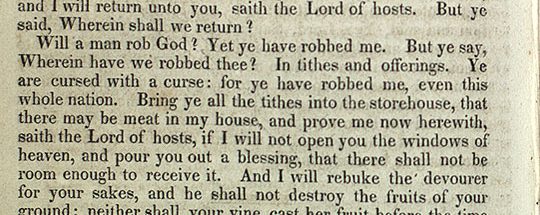
The Book of Mormon was dictated in 1829 and printed in 1830. It reproduces whole chapters of the King James Bible: Isaiah 2 through 14 carry (with changes) 2 Nephi 12 through 24, the Sermon on the Mount is 3 Nephi 12 through 14, and Malachi 3 and 4 are 3 Nephi 24 and 25. That has a believing explanation, covered below. This section is only what you can see with two books open.
The 1611 translators had a practice. When English needed a word the Hebrew or Greek did not have, they added it, and printed it differently so the reader would know. Here is the 1611 printing of Malachi 3:10:
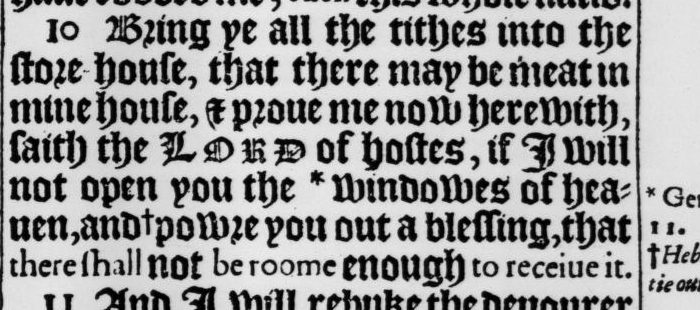
Now set the passage beside the Book of Mormon. In the King James column, the words in italics are the ones printed in italics in standard King James editions. (The Church’s own online King James edition does not print italics, so check a printed Oxford, Cambridge or other standard KJV, or the 1611 image above.)
| Passage | King James Bible | Book of Mormon | Modern translations |
|---|---|---|---|
| Mal. 3:10 / 3 Ne. 24:10 Jesus, c. 34 AD | …a blessing, that there shall not be room enough to receive it. | …a blessing that there shall not be room enough to receive it. The italicized phrase is identical, word for word. | ESV: “until there is no more need.” NRSVUE: “an overflowing blessing.” NIV: “so much blessing that there will not be room enough to store it.” |
| Isa. 13:21 / 2 Ne. 23:21 Nephi, c. 550 BC | …owls shall dwell there, and satyrs shall dance there. | …owls shall dwell there, and satyrs shall dance there. | ESV: “wild goats will dance.” NIV: “wild goats will leap about.” NRSVUE: “goat-demons will dance.” |
| Isa. 13:22 / 2 Ne. 23:22 | …and dragons in their pleasant palaces: and her time is near to come… | …and dragons in their pleasant palaces; and her time is near to come… | ESV and NRSVUE: “jackals in the pleasant palaces.” NIV: “jackals her luxurious palaces.” |
Satyrs are part-man, part-goat creatures from Greek and Roman myth. The 1611 translators used the word for a Hebrew term that modern translations render as wild goats or goat-demons, and so does 2 Nephi 23:21, in the same sentence with the same neighbors, in a record said to date to about 550 BC.
The NIV reaches nearly the same English independently, so these particular words are a natural way to complete the Hebrew, not a quirk of 1611. The point is not that the words are odd. It is that they are the translators’ additions, and they appear in a speech given in 34 AD.
Where the Book of Mormon does not follow the King James
It would be a strawman to say it simply copies. It departs from the King James in places, and some of the departures go the way modern translations go:
| Passage | King James Bible | Book of Mormon | Modern translations |
|---|---|---|---|
| Matthew 5:22 / 3 Nephi 12:22 | …angry with his brother without a cause shall be in danger of the judgment… | …angry with his brother shall be in danger of his judgment… | ESV: “everyone who is angry with his brother will be liable to judgment.” |
| Isaiah 9:3 / 2 Nephi 19:3 | Thou hast multiplied the nation, and not increased the joy… | Thou hast multiplied the nation, and increased the joy | ESV: “you have increased its joy.” |
| Isaiah 2:16 / 2 Nephi 12:16 | And upon all the ships of Tarshish… | And upon all the ships of the sea, and upon all the ships of Tarshish… | FAIR notes the added phrase matches the Greek Septuagint and the 1535 Coverdale Bible. |
Latter-day Saint scholars count the changes. FAIR quotes Royal Skousen: “Of all the italics contained in the KJV, 38% are changed in some way in the Book of Mormon.” That figure covers the Bible quotations in the book generally, not Isaiah alone. FAIR does not state a separate number for the rest, but it implies about 62 percent of those italicized words were not changed. Separately, FAIR says there are differences in more than half of the 433 Isaiah verses the Book of Mormon quotes, and about 200 verses have the same wording as the King James. So the Book of Mormon text is not the King James text. It is the King James text with changes, and the unchanged parts include the translators’ additions and renderings, as in the table above.
The same word a committee of English scholars picked in 1611 for a Hebrew term sits inside a record said to be from 550 BC.
Believers answer that the translation used the English Bible as its base. That is a coherent answer. It also means the English of these chapters is not evidence of anything about the plates.
The animals, the metal, and the wheel
The same standard applies to the other checkable claims: things the book says existed, and what archaeology and paleontology say about the Americas. Here is each one with the believing reply, from the pages cited.
| What the book says | Where | What mainstream science says | What believing scholars reply |
|---|---|---|---|
| Horses, in use among the people | 1 Nephi 18:25; Alma 18:9; 3 Nephi 3:22; Ether 9:19 | Fossil record shows horses became extinct in the Americas about 10,000 years ago (as summarized by Wikipedia). FAIR concedes “most scholars continue to believe that horses became extinct at the end of the Pleistocene period.” | Two replies, both from FAIR. Survival: small horse populations might have lasted into later times (FAIR quotes paleontologist Paul Martin that there is “no theoretical reason why a herd of mastodons, horses, or ground sloths could not have survived in some small refuge until 8000 or even 4000 years ago”), and FAIR points to horse bones from Mayapan and other Yucatan sites that were “considered to be pre-Columbian on the basis of depth of burial and degree of mineralization.” Loan shift: the translator used a familiar word for an unfamiliar animal such as the tapir; FAIR notes the Maya called Spanish horses tzimin (“beast”) and tapirs tzimin che (“forest beast”). |
| Steel swords and a bow of fine steel | Ether 7:9; 2 Nephi 5:15; 1 Nephi 4:9; 1 Nephi 16:18 | Steel production is not found in the pre-Columbian Americas. The book places steel in the Americas at Ether 7:9 (the Jaredites, far earlier than Lehi) and 2 Nephi 5:15 (after Lehi’s party arrives, about 580 BC). 1 Nephi 4:9 and 16:18 are in the Old World and this page does not press them. | Believing writers do not agree on one answer; common ones are that the word in the English translation stands for another metal or hardened metal in the original, or that evidence has not been found in the places not yet excavated. |
| Chariots | Alma 18:9; 3 Nephi 3:22 | “There is no archaeological evidence to support the use of wheeled vehicles in pre-Columbian Mesoamerica”; wheeled toys existed (as summarized by Wikipedia). | Loan shift, or limited geography (the general reply Wikipedia summarizes as “supporting evidence simply remains to be found”). |
These replies work differently. Loan shift and reframing change what the word means; limited geography and later discovery say the evidence is not where anyone has dug. Each is a real argument, and each is hard to test, which is the point of the Church’s own statement that its only position on location is the ancient Americas.
A common criticism is that the Book of Mormon has coins. The word “coin” does not appear in the text of the book. Alma 11 describes weighed pieces of gold and silver with names such as senine and seon. Latter-day Saint sources routinely cite this when the claim comes up.
The common rebuttals
“Of course the Bible chapters match. Joseph was given the King James wording as the way to render them, and any translator uses an existing translation.”
That is a coherent answer, and it is the one FAIR gives: academic translators commonly use earlier translations as a base text, and, as Skousen reads the original manuscript, it shows no signs of visual copying (FAIR: “none of the King James language contained in the Book of Mormon could have been copied directly from the Bible”). On that view the English of these verses is a borrowed wording, so the match between 3 Nephi 24:10 and Malachi 3:10 is not evidence for or against an ancient source underneath. That answer explains the match. It also means the English of these chapters cannot be offered as evidence for an ancient source.
“The Book of Mormon isn’t just the King James. It changes it, and the language is older than 1611.”
Both halves are partly true. The table above lists changes, and Stanford Carmack argues in Interpreter that “had Joseph followed the usage of pseudo-biblical writings or the King James Bible to formulate the Book of Mormon’s extended command syntax, either consciously or subconsciously, we would expect few instances of the archaic, ditransitive construction, not 99 of them.” That is about the book’s own sentences, as the article frames it, not its quotations. Neither point touches the passages above, which in these verses keep the translators’ additions and the word “satyrs” unchanged. Carmack’s argument is about which English Joseph could have produced in 1829. It does not address whether the Bible chapters match, which is the point of this page.
“You can’t prove a negative. The Church itself says DNA and archaeology can’t settle it.”
Correct, and this page does not claim they settle it. The Church’s essay says that DNA cannot confirm the book either, and that arguments “some defenders of the Book of Mormon make based on DNA studies are also speculative.” Elder Oaks is quoted in the essay: “It is our position that secular evidence can neither prove nor disprove the authenticity of the Book of Mormon.” If so, then DNA and archaeology cannot settle it in either direction, and one thing a reader can check with two books open is the Bible chapters. Believing scholars point to other places the text can be tested, such as its language (Carmack, above) and its names, and this page does not examine those. A position that no evidence can confirm is not the same as one that evidence has confirmed.
“Ferguson was an amateur, and one man’s opinion proves nothing.”
Agreed, and the note above says so. Nothing on this page depends on him. His 1975 paper and the statement drawn from it are what one longtime Latter-day Saint who looked concluded; they are not a proof, and nothing else on this page depends on them.
Neither the ground nor the genes can settle it, says the Church. The page you can hold in your hand can at least be checked.
Set Malachi 3:10 from 1611 beside 3 Nephi 24:10 from 1830, and read them.
What this means
You were taught that the Church stands or falls with the truthfulness of the Book of Mormon. Here is what the Church’s own words now say. The Introduction, which the Church says is not part of the text and was written in 1981, called the Lamanites the “principal ancestors” of the American Indians until the 2006 Doubleday edition and now says “among” them. The Church’s DNA essay says the majority of Native Americans carry largely Asian DNA, that nothing is known about the DNA of Book of Mormon peoples, and that the evidence is “inconclusive.” The Church takes no position on where in the Americas the events happened. And one thing the book contains that we can set beside a known source, its Bible chapters, includes, in the verses compared above, the 1611 translators’ supplied words in a speech from 34 AD and their word “satyrs” in a record from 550 BC.
The Church says DNA cannot decide it. The one place you can check the book yourself, its Bible chapters, matches the 1611 Bible, even in the words the translators added.
The believing answer is that God gave Joseph the English of an existing translation, and that the Church’s essay points readers to a spiritual witness, not a dig. If that is the answer, then the English of these chapters is not ancient evidence, and the Church says secular evidence can neither prove nor disprove the book. So what kind of evidence could show this is ancient history, and does anyone expect to find it?