The founding claims
How It Was Translated
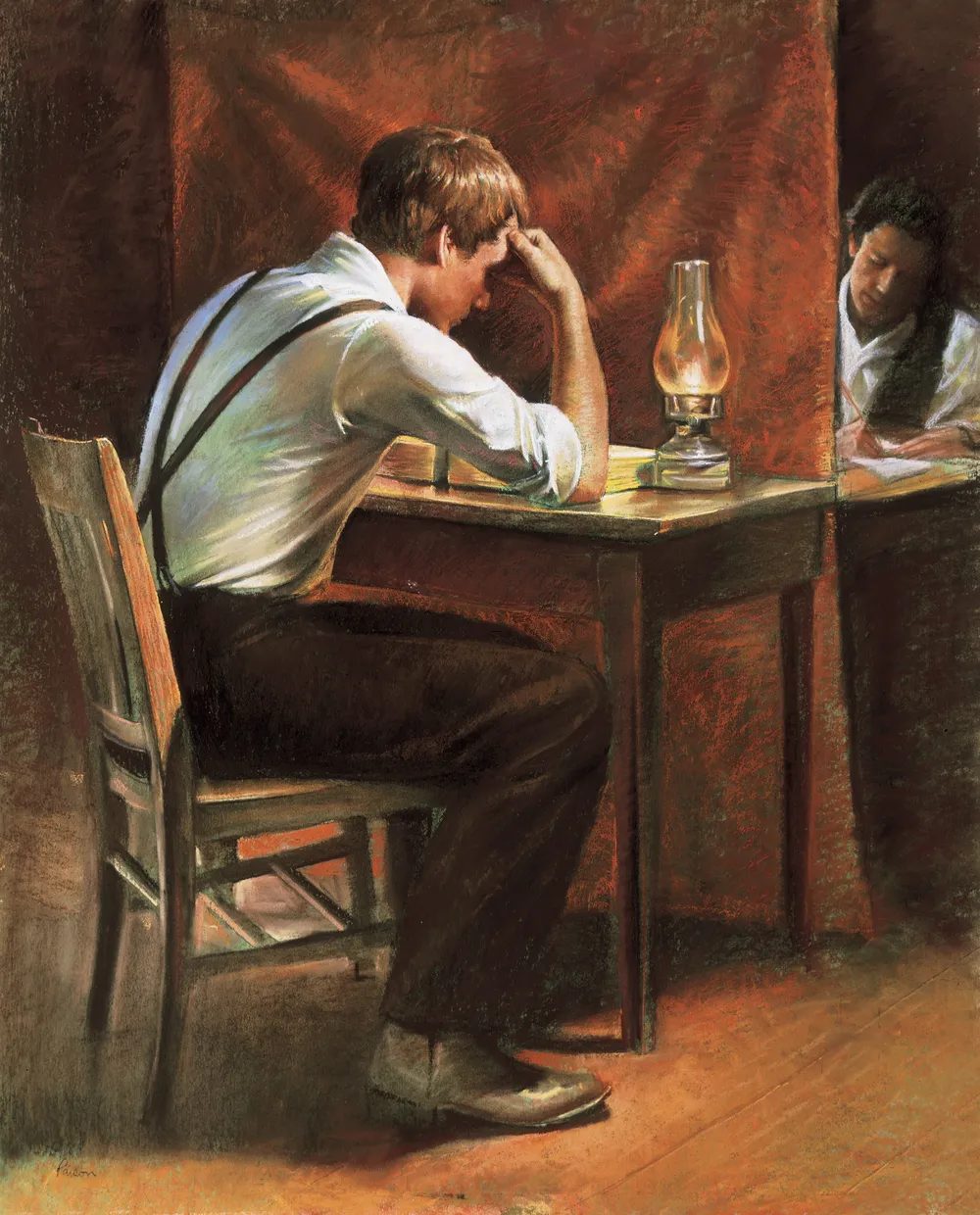
The Church now publishes the stone, the hat, and the covered plates. A Church painting of the scene shows none of them.
The point in one sentence
The Church’s own account of how the Book of Mormon was translated is not the picture members were taught. Joseph put a seer stone (or the interpreters) in a hat, pressed his face into it, and read aloud English words that appeared there. It was the kind of stone he had used to look for lost objects and buried treasure. The plates lay covered on the table, and no account says the scribe could see them.
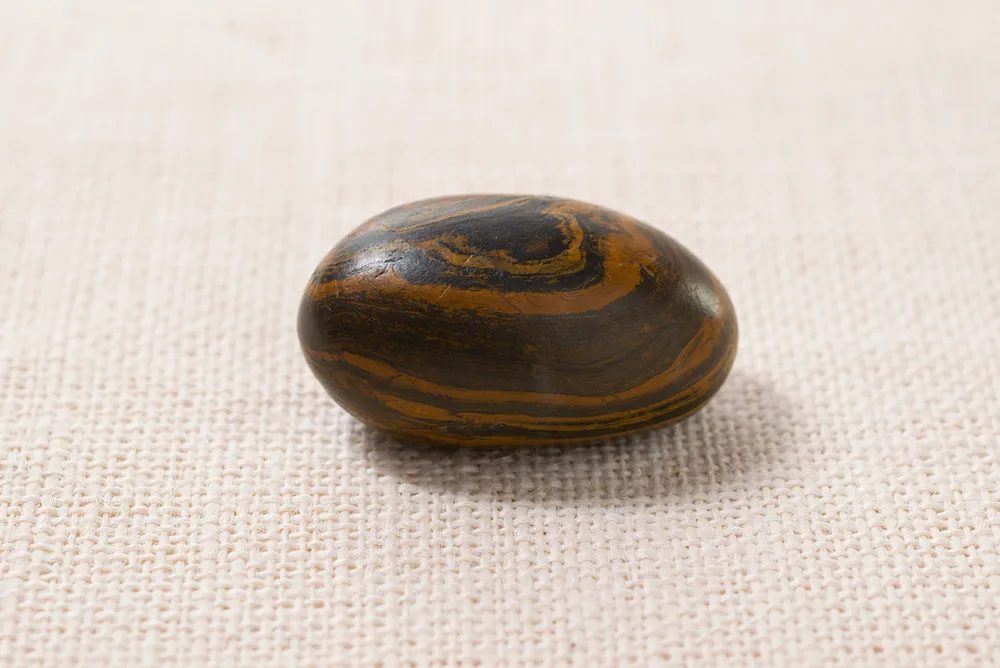
The world the stone came from
If you grew up in the Church, you probably know the picture. Joseph at a table, head bowed over an open volume the title calls the gold plates. A scribe at the edge of the picture, pen moving. It looks like a man reading a book and putting it into English.
The Church’s own account is different, and it begins in the 1820s, in a world where people used stones to look for lost objects. The Church’s own Gospel Topics Essay on this (one of a series the Church published to explain hard parts of its history) says it plainly: “As a young man during the 1820s, Joseph Smith, like others in his day, used a seer stone to look for lost objects and buried treasure.” Its historians say something close in the Ensign: “the villagers of Palmyra and Manchester, New York, where the Smiths lived, sought out Joseph to find lost objects before he moved to Pennsylvania in late 1827.” People sought him out. And the essay tells you where one of the stones came from: “Joseph Smith probably possessed more than one seer stone; he appears to have found one of the stones while digging for a well around 1822.”
The essay says he appears to have found one of his stones in the ground around 1822, and that he used a seer stone to look for lost objects and buried treasure. It also says he used a seer stone (or the interpreters) in the translation. It does not say these were the same stone. The Church publishes this in its essay, in its magazine, and in a photograph. The painting never showed you the stone or the hat.
What the Church and the witnesses now say
The Church of Jesus Christ of Latter-day Saints, Gospel Topics Essay, “Book of Mormon Translation” (2013)
Joseph placed either the interpreters or the seer stone in a hat, pressed his face into the hat to block out extraneous light, and read aloud the English words that appeared on the instrument.
Not “studied the plates.” Not “compared characters.” The claim is that English words appeared on the instrument, the interpreters or the stone, in a hat, and Joseph read them aloud.
Read the essay on churchofjesuschrist.orgEmma Smith, Joseph’s wife and scribe, interviewed by her son in February 1879; published in The Saints’ Herald, October 1, 1879, as “Last Testimony of Sister Emma”
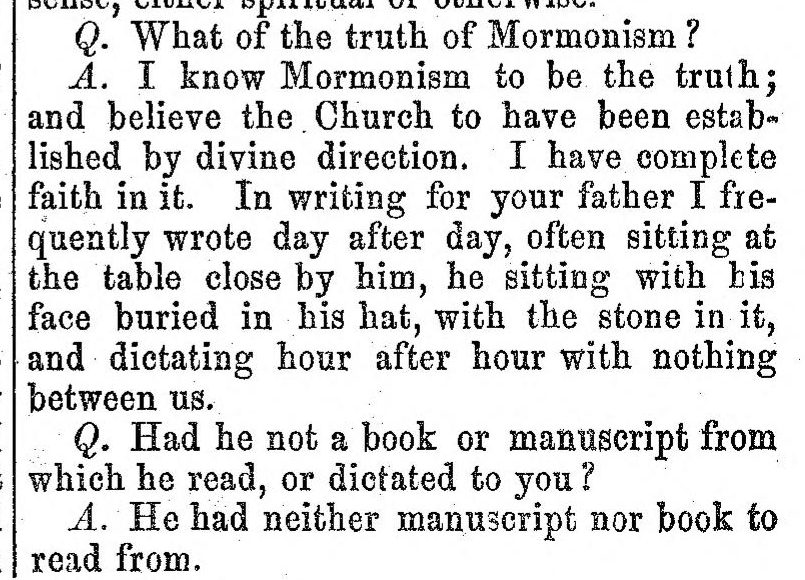
In writing for your father I frequently wrote day after day, often sitting at the table close by him, he sitting with his face buried in his hat, with the stone in it, and dictating hour after hour with nothing between us. Q. Had he not a book or manuscript from which he read, or dictated to you? A. He had neither manuscript nor book to read from.
The scribe who sat at the table says there was no book in front of him. In the Church’s essay she also says the plates often lay on the table, wrapped in a linen cloth. The page itself is shown below.
The Saints’ Herald, vol. 26, on archive.orgDavid Whitmer, An Address to All Believers in Christ (Richmond, Missouri, 1887), p. 12
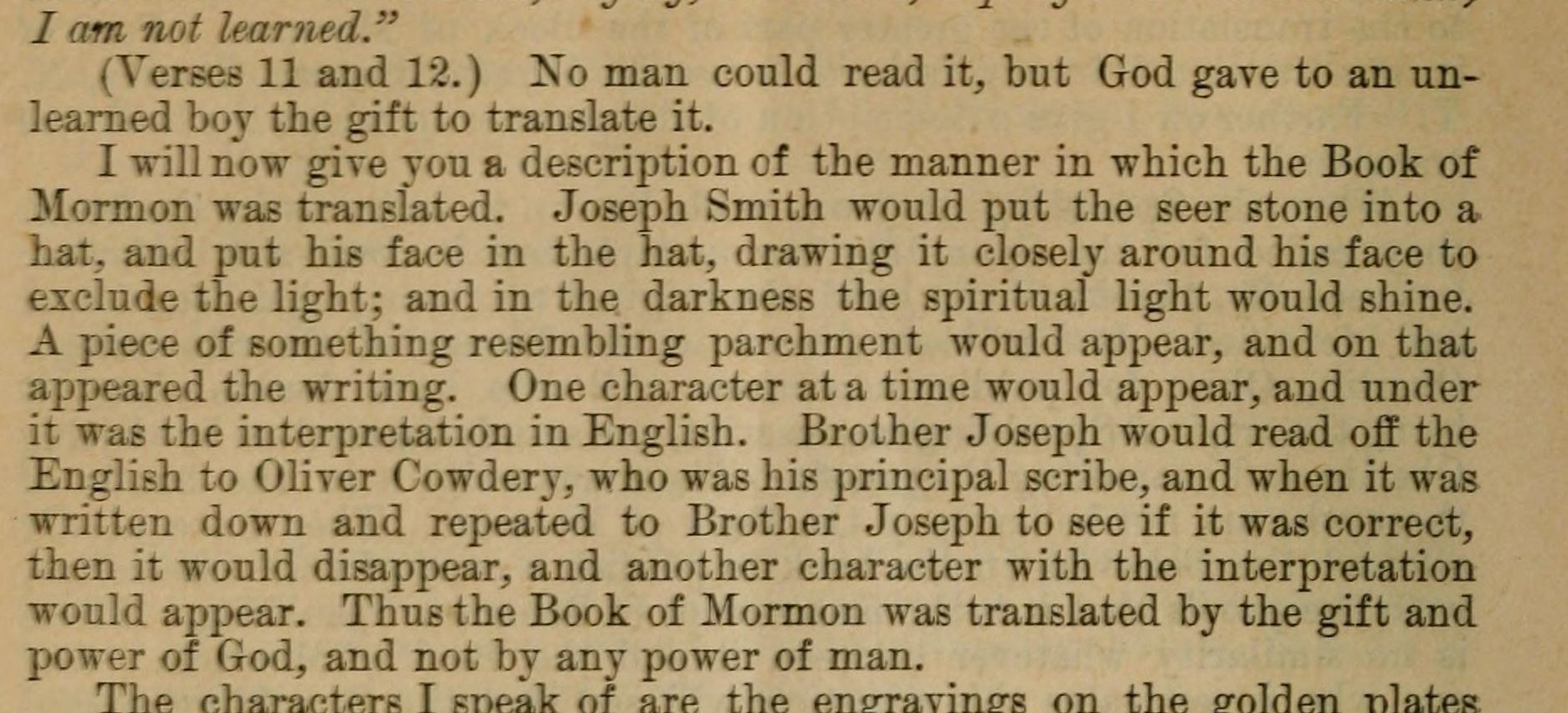
Joseph Smith would put the seer stone into a hat, and put his face in the hat, drawing it closely around his face to exclude the light; and in the darkness the spiritual light would shine. A piece of something resembling parchment would appear, and on that appeared the writing. One character at a time would appear, and under it was the interpretation in English.
Whitmer, one of the Three Witnesses, describes characters and their English appearing inside the hat. He says the characters were “the engravings on the golden plates,” so for him the plates were the source of the writing.
The 1887 pamphlet on archive.orgThe painting you were taught from leaves out what the Church now says.
Here are the two pictures, side by side.
From a stone in the ground to a stone in a Church photograph
Every date below is in the Church’s own sources or in a BYU journal.
Sources: Church essay; Ensign Oct 2015; BYU Studies; Saints’ Herald 1879; Whitmer 1887
The exhibits
Church sources first, then the witnesses and the court record. Every quote is verbatim and linked.
The Church of Jesus Christ, Gospel Topics Essay, “Book of Mormon Translation”
2013
What it establishes: The Church itself says Joseph used a seer stone for treasure seeking, and also says a seer stone was an instrument in the translation.
Read the essay on churchofjesuschrist.orgSame essay
2013
What it establishes: The method, in the Church’s words: a stone, a hat, and English words appearing on it.
Same essayEnsign, October 2015, “Joseph the Seer” by Richard E. Turley Jr., Robin S. Jensen, and Mark Ashurst-McGee
October 2015
What it establishes: Published in the Church’s own magazine, alongside a photograph of a seer stone.
Read the article on churchofjesuschrist.orgSame article
October 2015
What it establishes: According to witnesses, the plates were covered with a cloth during translation.
Same articleJoseph Smith Papers, Introduction to Revelations and Translations, Volume 5
Church Historian’s Press
What it establishes: The editors of the Joseph Smith Papers, noting that Joseph appears to have stopped separating himself from his scribes, say no account reports the plates being visible to the scribe during translation.
Read the introductionEmma Smith, as quoted in the Church’s Gospel Topics Essay
1879
What it establishes: The strongest point for the believing reading: the scribe who says Joseph read from no book also says the plates were in the room, on the table, covered.
Read the essay on churchofjesuschrist.orgEmma Smith, The Saints’ Herald, October 1, 1879, pp. 289–290 (quoted in the Church’s essay)
1879
What it establishes: The person who wrote down the words, answering a direct question about whether Joseph read from anything.
The page on archive.orgWhat the painting showed, and what the witnesses described
Below are the two, one after the other. First, the witnesses’ own printed pages. Then a painting the Church has distributed, in its own media library, of the same event.
| What to look at | What the painting shows | What the witnesses and the Church essay say |
|---|---|---|
| Where his eyes are | Down at an open volume on the table. | “Face buried in his hat.” (Emma) “Pressed his face into the hat to block out extraneous light.” (Essay) |
| The plates | An open volume on the table; the title calls it the gold plates. | “Shielded from view, such as by being covered with a linen cloth.” (Ensign) Emma: the plates “often lay on the table without any attempt at concealment, wrapped in a small linen table cloth.” (Essay) “No accounts” of the plates visible to the scribe. (Joseph Smith Papers) |
| The instrument | None visible. | A seer stone in a hat. (Essay, Emma, Whitmer) |
| What he read | Not shown; the title points to the plates. | English words that “appeared on the instrument.” (Essay) “Neither manuscript nor book to read from.” (Emma) |
| Where the words came from | Not shown; the title points to the plates. | “A piece of something resembling parchment would appear.” (Whitmer) He says the characters were “the engravings on the golden plates.” |
A common line is that Joseph Smith was convicted of fraud in 1826. That is disputed. Gordon A. Madsen (BYU Studies, 1990) concludes: “The evidence thus far available about the 1826 trial before Justice Neely leads to the inescapable conclusion that Joseph Smith was acquitted.” Wesley Walters (Westminster Theological Journal, 1974) argued he was probably found guilty; in Madsen’s description of Walters’s reconstruction, the evidence appeared sufficient to show he was guilty as charged, and he was then held for trial and either allowed to escape or left the county. The Pearsall notes do end with the line “And thereupon the Court finds the defendant guilty.” Madsen calls that line “an afterthought supplied by whoever subsequently handled the notes” that “is not a reflection of what occurred at the trial,” and writes that Walters “assumes a number of unsupported or unwarranted facts and procedures.” What is not disputed is narrower: on March 20, 1826, he was brought before Justice Albert Neely in South Bainbridge, New York, on a “disorderly person” charge, and the justice’s bill calls him “the Glass Looker.” On Madsen’s reading he was not convicted; on Walters’s he probably was. This page does not settle it, and does not call him a convicted con man either way.
What is true on the other side
Start with the strongest point a believer has, and it comes from the scribe this page leans on. Emma says the plates “often lay on the table without any attempt at concealment, wrapped in a small linen table cloth,” and Whitmer says the characters he saw were “the engravings on the golden plates.” On those accounts the plates were present and were the source of the writing, and the stone was the instrument. The essay also notes that some grammatical constructions in the original manuscript “are more characteristic of Near Eastern languages than English,” suggesting that the base language of the translation was not English.
The Church did not hide any of this. It published the essay, put the photograph in its own magazine, and put the stone on its history website. In the accounts quoted here, Emma and Whitmer describe the stone without suggesting trickery. Emma told her son that “The Book of Mormon is of divine authenticity,” and that she had “not the slightest doubt of it.” Whitmer closed his description with “Thus the Book of Mormon was translated by the gift and power of God, and not by any power of man.” A believer can say all of this is exactly what a miracle looks like. That is a coherent position.
The common rebuttals
“The method does not matter. It was a miracle either way.”
If you believe it was a miracle, that is your faith, and this page does not argue with it. But the question here is different: is the picture you were shown the true one? It is not. The picture in the painting is a man bent over plates at a table. The witnesses describe a man with his face in a hat, and the Church’s essay now says so too.
“Seer stones were normal in the 1820s. Everyone had one.”
Historically accurate, and this page grants it. The essay does not say the method was unusual in its time; it says Joseph, “like others in his day,” used a seer stone to look for lost objects and buried treasure. The Book of Mormon’s method uses the same kind of instrument.
“The plates were still the source. The stone just helped him read them.”
Some members answer that the plates were the source and the stone was only the tool. The accounts support part of that: Emma says the plates lay on the table in a cloth, and Whitmer says the characters were the plate engravings. But none of them shows Joseph reading from the plates while the text was dictated: Emma says he had “neither manuscript nor book to read from,” and the Joseph Smith Papers editors say no account reports the plates visible to the scribe. So the Church’s sources describe the stone and the hat plainly. What they never describe is Joseph reading from the plates.
The Church now says the words appeared on an instrument in a hat, and the plates were covered.
That is the Church’s own account. It is not the painting.
What this means
Put the pieces next to each other. A seer stone, one of at least two Joseph appears to have had, found in the ground around 1822. Joseph used a seer stone in those years to look for lost objects and buried treasure. Then, in 1828 and 1829, either the interpreters or a seer stone in a hat, and the English words read aloud from it. The plates, by the Church’s own account, covered with a cloth, and on Emma’s word often lying on the table, with no account reporting that the scribe could see them while the text was being dictated. And on the Church’s own pages, a painting titled “Translating the Gold Plates” of a young man bent over an open volume at a table.
The instrument the Church now describes is the kind of stone he used to look for treasure.
A believer can still say God used the stone, and that the plates were the source of the writing. But the picture you were taught, a man studying characters on a page and putting them into English, is not what the Church’s own accounts describe. They describe English words appearing on a stone in a hat. So what did the plates do, and what does the Church mean by “translated.”?