Beyond religion
Why Smart People Keep Believing
Four documented habits of every human mind can make a feeling of certainty without the claim being true. Church life is the kind of setting where they work, so the feeling cannot be the proof.
The point in one sentence
The feeling of being certain is not proof, because it can be produced without the claim being true: a claim you hear again and again starts to feel true, what you have already given makes you want it to be true, people judge evidence by whether it agrees with them, and a search that can only say yes is not a search. These are documented features of every human mind. Church life, with testimony borne again and again, years and money invested, and members told how to ask and what the answer will feel like, is the kind of setting where they operate. And people raised in other faiths, through the same kind of routine, feel the same certainty about opposite claims.
Four habits of every human mind
Each one has been studied in ordinary people, mostly on everyday questions. None requires a lie, and none requires you to be foolish.
Studies cited below. The author of this site has all four habits too.
The world it came from
If you grew up in the Church, you were probably taught to say the words before you were old enough to weigh them. A hymn, a Primary lesson, a talk in sacrament meeting, a testimony shared from the pulpit: the same few sentences, said by people you loved, again and again. Later came a mission, or a friend’s mission, a temple marriage, a tenth of every paycheck, a calling every few years. Nobody tricked you. It was simply what a good life looked like, and you lived it with your whole heart.
Everyone feels this, not just members. Psychologists have spent seventy years studying how any person, in any group, ends up certain. They did not set out to study Latter-day Saints. They studied college students, online volunteers, survey respondents, and members of a small flying-saucer group in 1954 (the Seekers, covered below). What they found, in different ways, is this: the feeling of being sure is something the mind produces, and it can be produced without the claim being true.
One of the best-known papers is Ziva Kunda’s 1990 article in Psychological Bulletin, “The case for motivated reasoning.” Her point, in short, was that when we want a conclusion, our reasoning keeps working, but it works toward that conclusion. We feel like fair judges. Kunda also found that we are limited by what we can justify to ourselves, so the case has to look reasonable.
What the Church says about how to know
The Church’s own leaders describe the method plainly. Start with the scripture the whole method rests on.
Moroni 10:4-5, Book of Mormon
And when ye shall receive these things, I would exhort you that ye would ask God, the Eternal Father, in the name of Christ, if these things are not true; and if ye shall ask with a sincere heart, with real intent, having faith in Christ, he will manifest the truth of it unto you, by the power of the Holy Ghost. And by the power of the Holy Ghost ye may know the truth of all things.
This is the Church’s actual method, and it is not “repeat it until it feels true.” It is to ask God, sincerely, whether it is true. Members say the answer came when they asked, and some say it came against what they expected or wanted. That is a claim about an experience, and it is held sincerely.
Read Moroni 10 on churchofjesuschrist.orgBoyd K. Packer, “The Candle of the Lord,” Ensign, January 1983
Oh, if I could teach you this one principle. A testimony is to be found in the bearing of it! Somewhere in your quest for spiritual knowledge, there is that ‘leap of faith,’ as the philosophers call it. … It is quite another to have the Spirit confirm to you in your bosom that what you have testified is true.
Elder Packer was answering a question missionaries often ask: how can I bear testimony before I have one? His answer is that the conviction comes in the bearing of it. He adds that the Spirit then confirms to you that what you testified is true. A member would say the confirmation is the witness. The page asks only whether saying it first also makes it familiar.
Read the talk on churchofjesuschrist.orgDallin H. Oaks, “Truth and the Plan,” general conference, October 2018
The methods of science lead us to what we call scientific truth. But ‘scientific truth’ is not the whole of life. … When we seek the truth about religion, we should use spiritual methods appropriate for that search: prayer, the witness of the Holy Ghost, and study of the scriptures and the words of modern prophets.
President Oaks first says science finds scientific truth, then gives the Church’s method for religious truth: prayer, the witness of the Holy Ghost, and study of scripture and the words of modern prophets. The scriptures and prophets are also the sources that teach the Church’s claims, which is the point this page raises.
Read the talk on churchofjesuschrist.orgDieter F. Uchtdorf, “Come, Join with Us,” general conference, October 2013
Please, first doubt your doubts before you doubt your faith.
The counsel is about order: examine your doubts before you let them shake your faith. The same talk says it is natural to have questions, and that few members have not wrestled with serious ones.
Read the talk on churchofjesuschrist.orgNone of this is a trick. It is how a mind works.
And a feeling that any mind can produce, in any faith, cannot be the thing that shows which faith is true.
From the lab to the pew
The studies on this page, and the Church practices they describe.
Sources on this page: the main studies are linked in the exhibits below.
The exhibits
What follows is the Church’s own description of what it asks of members, then the studies, with what each one actually found. These studies used trivia statements, survey questions and political data. None of them measured members of a church or asked what produced anyone’s testimony. They show how the mind makes a feeling of truth. What bears on a testimony is the next step: people in many faiths feel the same certainty about claims that cannot all be true. Where a source could only be checked through a summary, the page says so.
The Church of Jesus Christ of Latter-day Saints, Gospel Topics, “Tithing”
churchofjesuschrist.org
What it establishes: The Church asks members to give a tenth of their income. Over a working life, that is a large and steady investment, which is what sunk cost studies are about.
Read the topic pageHasher, Goldstein & Toppino, “Frequency and the conference of referential validity,” Journal of Verbal Learning and Verbal Behavior 16(1), 107-112
1977
What it establishes: This is the illusory truth effect: a statement you have heard before feels truer. Hearing it again made it feel truer, with no new evidence at all.
The paper (DOI)Fazio, Brashier, Payne & Marsh, “Knowledge does not protect against illusory truth,” Journal of Experimental Psychology: General 144(5), 993-1002
2015
What it establishes: “Knowledge neglect” means not using what you know. People sometimes rated a repeated false statement (for example, that a sari is a short plaid skirt worn by Scots) as truer even when they knew the right answer. The authors explain it as ease: a statement you have heard before is easy to process, and easy feels true.
The paper (DOI)Henderson, Simons & Barr, “The Trajectory of Truth: A Longitudinal Study of the Illusory Truth Effect,” Journal of Cognition
2021
What it establishes: “Probative” means useful as proof. This is a Registered Report (the plan was published before the data came in) that tested whether the effect fades with time. It does fade, and it is still there after a month. The 567 people analysed were UK adults rating trivia statements, not beliefs they care about. The authors say it is not clear the result will carry over to topics where people hold strong prior beliefs. Figures from this paper are shown below.
Read the open-access paperKahan and colleagues, “Motivated numeracy and enlightened self-government,” Behavioural Public Policy 1, 54-86
2017
What it establishes: “Numeracy” means skill with numbers. People read the same table of numbers two ways: as the results of a skin-rash treatment, and as the results of a gun-control law. On the rash, math skill helped. On gun control, the people best with numbers split the most along their politics. This is a different kind of question than faith, but the same pattern.
The paper (DOI)Vranic, Hromatko & Tonkovic, “‘I Did My Own Research’: Overconfidence, (Dis)trust in Science, and Endorsement of Conspiracy Theories,” Frontiers in Psychology
2022
What it establishes: Feeling sure of your own reasoning is not the same as being good at it. This study ties that gap to conspiracy belief. It does not show what any one person’s research looked like.
Read the open-access paperThe visual breakdown: how a testimony gets built
Here are the six steps. No step requires dishonesty. Steps 2 and 5 are Church leaders’ own words. Steps 3 and 4 describe what the studies found about repetition. The last step is this page’s picture of how they fit together.
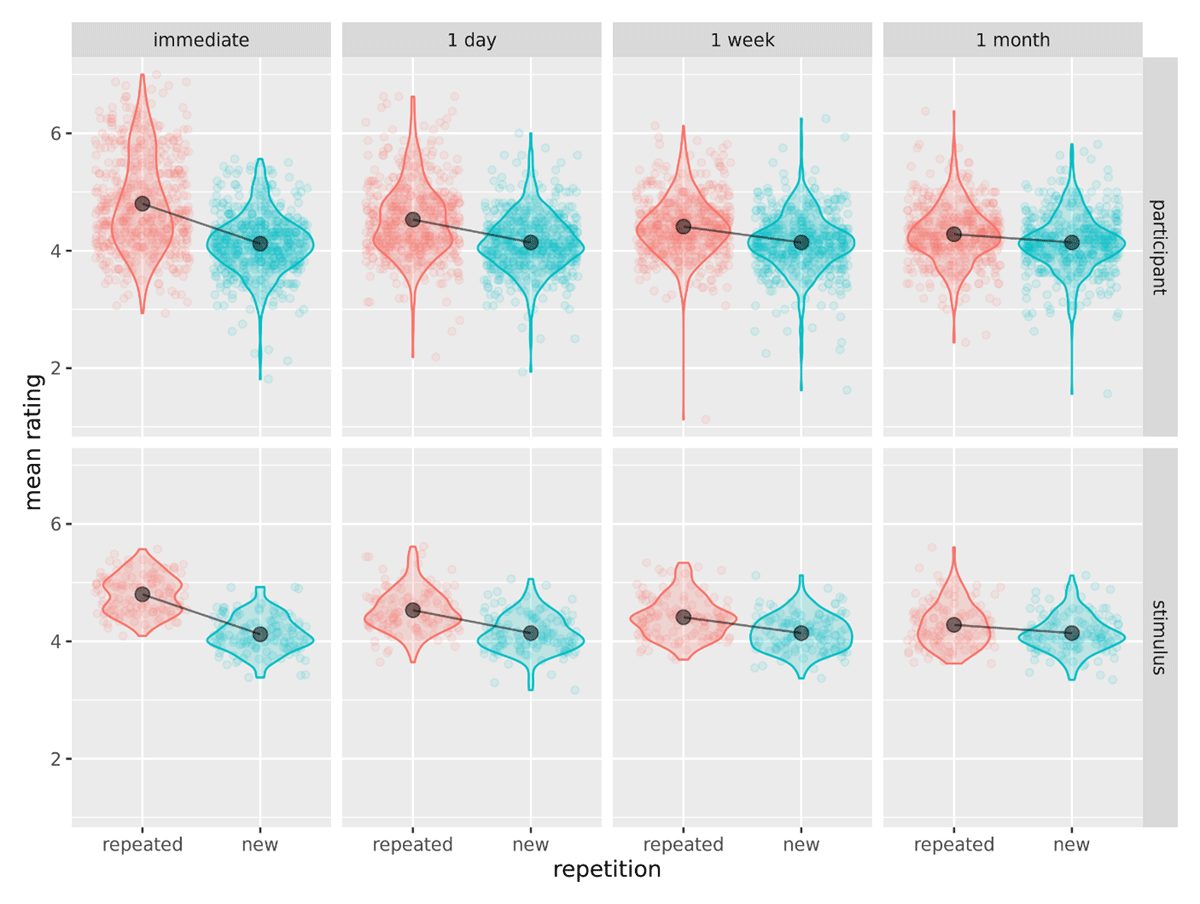
How big is the repetition effect, honestly?
Repeated minus new, in rating points. The bar at the top is the full width of the 1-to-7 scale (6 points), so every bar is on true scale.
Source: Henderson, Simons & Barr (2021), Table 5. A real effect, and not a large one. It shrinks as time passes. The study did not test repeated exposure over years.
Where each habit shows up in church life
| Habit | What the study found | Where it shows up |
|---|---|---|
| Repetition feels like truth | Statements heard again are rated truer (Hasher 1977), sometimes even by people who know the right answer (Fazio 2015). | Testimony meetings, lessons, hymns and conference: the same claims, in trusted voices, for a lifetime. Elder Packer’s counsel to say the words so the conviction can follow. |
| What we paid, we defend | Money, effort or time already spent pulls people to keep going (sunk cost, Arkes and Blumer 1985). People who go through something hard to join a group tend to value the group more (Aronson and Mills 1959). | A tenth of income (Gospel Topics: Tithing), and for many members a mission, a temple marriage, children raised in the Church, and a place in the ward. |
| We judge evidence by whether it agrees with us | Reasoning serves the conclusion we want (Kunda 1990). People best with numbers split the most along political lines on one charged question, gun control (Kahan 2017). | People who know the scriptures well can give the strongest defense of what they believe. A strong defense is not the same as a test. |
| “Research” finds what it started with | People read more of the arguments that fit what they already believe, even when asked to be even-handed (Taber and Lodge 2006; Lord, Ross and Lepper 1979). A weak link between overconfidence in your own reasoning and believing conspiracy theories (Vranic 2022). | President Oaks names prayer, the Holy Ghost, scripture and modern prophets as the method for religious truth. The last two are sources that already teach the Church’s claims. |
When a prediction fails: the famous study, and what is left of it
You may have met this one in a psychology class. In 1954 a Chicago woman named Dorothy Martin told a small group, the Seekers, that a flood would strike on December 21 and flying saucers would rescue them. Psychologist Leon Festinger and two colleagues, Henry Riecken and Stanley Schachter, joined the group to watch. In their 1956 book When Prophecy Fails they said that when the day passed with no flood, the believers did not give up. They grew more sure and began telling the public. It became the textbook case of doubling down.
That account has now been checked against the archives. In November 2025 Thomas Kelly published “Debunking ‘When Prophecy Fails’” in the Journal of the History of the Behavioral Sciences. Using newly unsealed documents, he argues “the book’s central claims are false, and that the authors knew they were false.” He reports that the group was already spreading its message before the failure and quickly dropped its beliefs afterward. He also reports that the researchers invented psychic messages and that Riecken posed as a spiritual authority. The observers made up close to a third of the group, so they were shaping what they claimed to watch. This is one new paper by one scholar. Still, the old study cannot be leaned on as proof.
What survives is smaller, and it does not need the Seekers. After October 22, 1844, when Christ did not return as the Millerites expected, reactions split. Wikipedia’s account says many “simply gave up their beliefs and attempted to rebuild their lives.” Others reinterpreted. Hiram Edson came to believe, in the words of Wikipedia’s summary, that the sanctuary in Daniel 8:14 “was not the earth or the church, but the sanctuary in heaven,” an idea the Seventh-day Adventist Church grew from. So a failed prediction does not reliably make people hold on harder. Some leave, and some explain the miss and stay.
A study cannot make a belief true, and a flawed study cannot make it false. The evidence has to come from the documents, which is the rest of this site.
What is true on the other side
Here is the believing answer at full strength.
- The Church’s method is to ask, not to repeat. Moroni 10:4 invites a person to ask God “if these things are not true,” with “a sincere heart, with real intent.” Members say the answer came when they asked, and some say it came against what they expected or wanted. That is a claim about an experience, and it is held sincerely.
- These habits explain staying better than starting. Some members joined as adults, after missionary lessons instead of years of hearing it, and before they had paid anything. What they felt then is not explained by repetition or by cost.
- Many people hear the same things for the same years and leave. If these habits alone decided it, they would not.
- Members are not forbidden to read other views. In a 1989 article, Elder Oaks wrote, “Members of the Church are free to participate or to listen to any alternate voices they choose.” He also asks members to consider each case carefully and with prayer. President Uchtdorf said in 2013, “It’s natural to have questions.” “Alternate Voices,” Ensign, May 1989.
- Acting on a belief can build it. Courage grows by acting brave. Many members say their faith grew by living it, and the sacrifices were real and brought real good into their lives.
- Repetition is not proof of falsehood. True things get repeated all the time, and the effect is modest.
- Leaving costs a great deal. Family strain, lost community, sometimes marriages. Weighing that is sensible, not biased. A person who says “even if I could not prove it, my life inside it is good” is making an honest choice.
Two of those points deserve a direct answer. Converts did not grow up with the repetition. But they do go through the missionary lessons, they are invited to pray as Moroni 10:4 describes, so the same kind of routine begins quickly, and a convert is also hearing the claims from people they have come to trust. And people who leave after the same routine show that the routine does not guarantee belief. A fair reader should grant that. It fits what the studies say: the effects are modest, and other forces, such as new information, can outweigh them. This page does not say these habits decide anything. It says the feeling of certainty cannot be the proof.
And it cuts every direction. Skeptics have these habits about their politics. Scientists have them about their theories. Someone who has built an identity on having left has sunk costs in that, too. The author of this site is doing it somewhere on these pages right now. Nobody is exempt, and that is why none of this should be used as a club.
Here is what none of those points can do. They explain why the feeling is real and why it is good. They do not make the feeling evidence. A member and a Muslim and a Hindu can all say the first points above, in the same words, about their own certainty.
The same standard, pointed outward
The studies work on anyone, which includes the conspiracy theorist, and it is fair to say so. Someone who searches until they find sources that agree with them can feel, from the inside, like someone who investigated. Lord, Ross and Lepper (1979) and Taber and Lodge (2006) describe that pattern. The Vranic study looked at something close to that: feeling sure of your own reasoning is not the same as being good at it.
That does not mean distrusting institutions is foolish. They have earned plenty: tobacco companies hid what they knew, and their internal memos are now public. Checking for yourself is healthy. Real checking looks like this:
Apply that to a testimony. Ask what result would count against it. If a good feeling counts for it and a bad feeling counts as a test of your faith, then no result can count against it, and a belief that nothing could count against has not been checked. It has been protected.
The common rebuttals
“My testimony did not come from repetition. It came from the Spirit.”
Nothing here says you did not feel something. You did, and the feeling was real. A member would say it came when they asked God, and that it is more than familiarity. Here is the question this page asks: people of many faiths report the same kind of certainty, from prayer, about claims that cannot all be true. If the feeling can arrive with a false claim, it cannot be what shows which claim is true. These studies show one way the mind can produce a sense of truth. They do not show what produced yours. The testimony page goes through that question.
“Plenty of doctors, scientists and professors are members. You cannot call them fools.”
Nobody does. That is the point of the studies. In Kahan’s study, people best with numbers read the same table most in line with their politics. Skill with numbers did not make them more neutral; it made them better at reaching the answer they preferred. Fazio found that knowing the right answer did not always protect people from the repetition effect. Being careful in most of life does not switch these habits off, which is what the studies above found. The page on how to change a mind says why this is also why arguments rarely work, and what does.
“I gave up so much for this. It would not have been worth it if it were not true.”
What you gave was real, and so was the good it did. That was true of the years whether or not the claim is. Studies on sunk cost find that people keep going with something because of what they have already put in. A different set of studies, on effort justification, finds that people who go through something hard to join a group tend to value the group more (Aronson and Mills, 1959). Neither tells you whether the claim is true. They tell you why leaving feels like admitting the cost was wasted. One question can help: if you were meeting this claim today, with nothing invested, would you accept it? The answer does not depend on what you have already given.
If the feeling would be there either way, it cannot tell you which way it is.
Repetition, what we have paid, what we want to be true, and a search that can only find yes can each produce certainty, true or false. People in every faith report it.
Minds do change
None of this means a mind is stuck. The popular fear that facts only make people dig in did not hold up. Across “five experiments in which we enrolled more than 10,100 subjects and tested 52 issues of potential backfire,” Wood and Porter “found no corrections capable of triggering backfire” (Political Behavior, 2019). In 2024 a study in Science found that “many conspiracy theory believers can revise their views if presented with sufficiently compelling evidence,” and the change “remained 2 months later” (Costello, Pennycook and Rand). Neither study was about religion. What they show is general: when the evidence is strong and set out plainly, people do move. That is what the rest of this site is for.
What this means
A child hears the words in a loving room and learns to say them. A man is told the conviction is found in the saying. A feeling arrives, and it is credited to the Spirit. A tenth of every check, and for many a mission, a temple marriage, callings year after year: each is a cost already paid. The method for testing religious truth is to ask God, and to rely on the witness, the scriptures and the prophets who teach the Church’s claims. Every habit above can be found in that picture. Every habit above has been studied in ordinary people, mostly on everyday questions. None of the studies measured members of any church.
The certainty is real. These habits can make a person feel just as certain whether or not the claim is true, so the feeling cannot be the proof.
That is why a member’s certainty, however sincere, is not evidence, and it is why the evidence has to come from somewhere else: from the documents, the dates, and the Church’s own essays, which is what the rest of this site is. So the question the studies leave is not “am I foolish?” The question is this: if the Church were not true, what would forty years as a faithful member feel like? Would it feel any different from your own life in it?