The God question
The Classic Proofs of God
Kalam, fine-tuning, the ontological argument, morality, and the Wager. The two that aim at a particular God end at a God the Church’s scriptures do not describe.
The point in one sentence
The Kalam argument ends at a God who is beginningless, immaterial, and the maker of all matter, made “from nothing” (the Latin is ex nihilo). The ontological argument ends at a God who never lacked any greatness, in any possible world. The Church’s God, as its own scriptures describe him, has “a body of flesh and bones as tangible as man’s” and organized matter that was already there. So even if those two arguments worked, they would prove the God of the creeds, not the God of D&C 130:22. The other three (fine-tuning, morality, the Wager) name no particular God at all. None of the five proves the Church’s God.
The world these arguments came from
You have probably heard the simplest form of these arguments in a talk or a Sunday School lesson: the world is too orderly to be an accident, so someone must have made it. The versions philosophers use are older and sharper, and the best-known versions were worked out by Christians for the God they already worshiped. (The Kalam started with medieval Muslim thinkers; Craig credits al-Ghazali.)
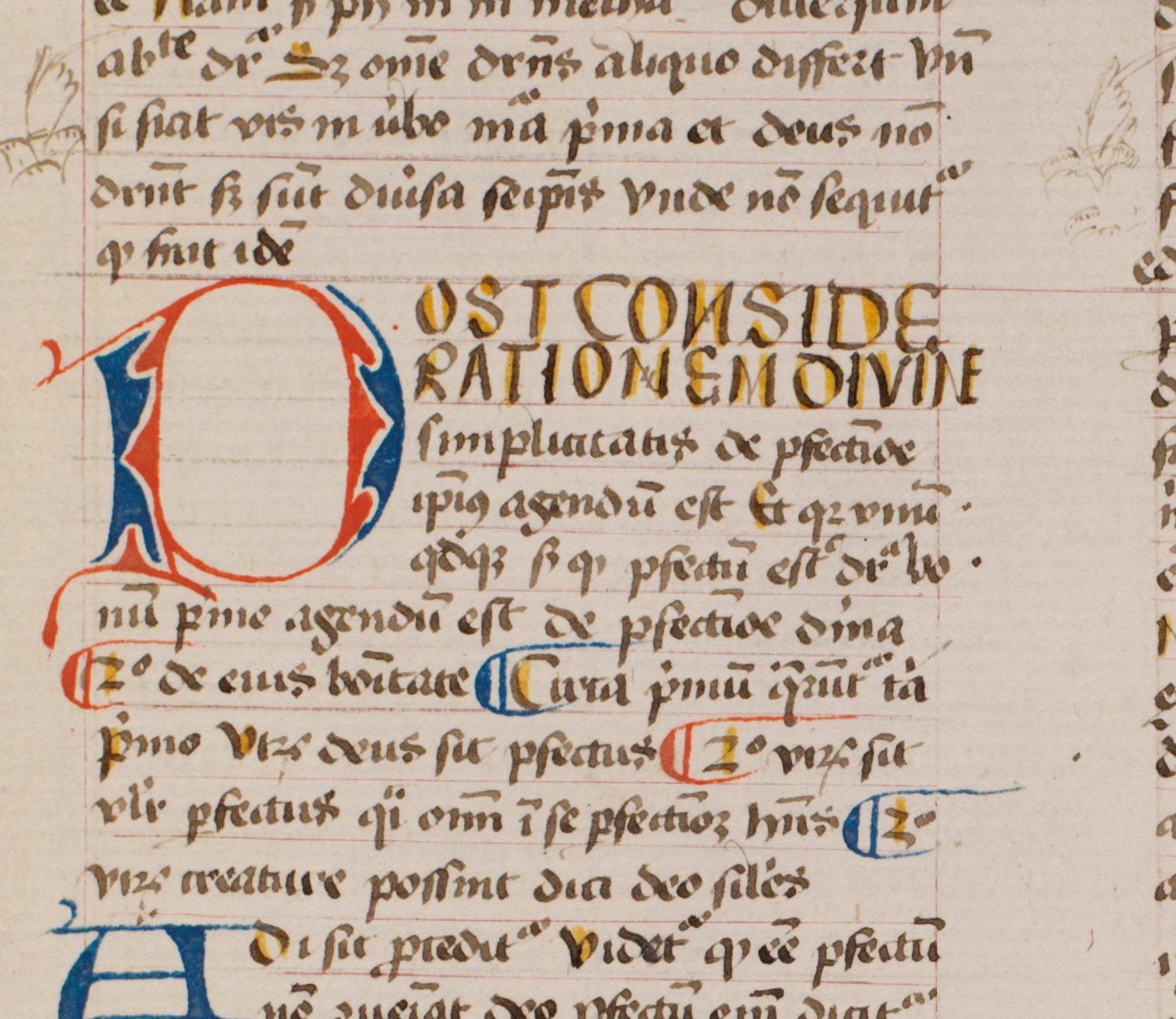
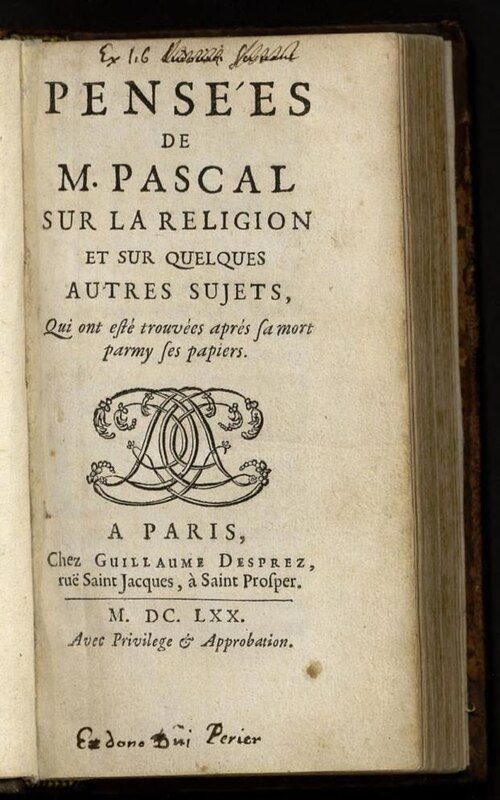
Anselm of Canterbury (1033–1109) wrote the first of them, the ontological argument, in 1077–78. He defined God as “that than which a greater cannot be thought.” Thomas Aquinas (about 1225–1274) laid out five arguments in the Summa Theologiae, written 1267–73, the “Five Ways,” and the first three are, in the Stanford Encyclopedia’s words, “cosmological arguments, based on the impossibility of an infinite series of causes.” (That is a different kind of chain from the Kalam’s, which is about a series stretching back in time.) Blaise Pascal died in 1662 leaving notes for a defense of Christianity; they were published in 1670 as the Pensées, and his wager is in them.
Anselm and Aquinas were writing about the God their church already confessed. In 1215 the Fourth Lateran Council declared that God is “eternal and immense, omnipotent, unchangeable,” the “Creator of all things invisible and visible, spiritual and corporeal,” who “from the beginning of time and by His omnipotent power made from nothing creatures both spiritual and corporeal, angelic, namely, and mundane, and then human” (translation on the Fordham Sourcebook). The Presbyterian Westminster Confession of Faith says the same thing in English: “to create, or make of nothing, the world, and all things therein.”
The five arguments, at full strength
Each one is stated here the way its best modern defender states it, with the standard reply. Where an argument has real force, that is said plainly. The Church’s own teaching, in scripture, comes after.
1. The Kalam cosmological argument (William Lane Craig)
You may have heard it this way: everything has a cause, so the universe has a cause. The name Kalam comes from medieval Islamic theology, as Craig’s article explains. Craig, its best-known modern defender, states it in three lines on his site: “1. Whatever begins to exist has a cause of its beginning. 2. The universe began to exist. 3. Therefore, the universe has a cause of its beginning.” He then argues what that cause must be like: “It must transcend space and time, since it created space and time. Therefore, it must be immaterial and non-physical. It must be unimaginably powerful, since it created all matter and energy.”
Its strongest support is physics, not philosophy. In 2012 Audrey Mithani and Alexander Vilenkin examined the main models of an eternal universe and concluded that each one still needs a beginning somewhere in the past. That is a real result and it is the best card the argument has.
The standard replies. First, the Borde-Guth-Vilenkin theorem, which people often cite, says less than it is made to say. Its own abstract says only that inflating models are “incomplete in null and timelike past directions” and so “require physics other than inflation to describe the past boundary.” It marks where one theory stops, not where time started. Second, the rule “whatever begins has a cause” is learned from things inside the universe, and the Stanford Encyclopedia lists the objection that “we cannot extrapolate from the way the world works to the world as a whole.” Third, a believer says God is exempt because he never began; a skeptic can say the same of the universe’s starting state, and the argument has no way to choose.
The turn for Latter-day Saints. The Kalam’s second line says the universe, all of it, began. Doctrine and Covenants 93:33 says “The elements are eternal.” Craig’s own cause is one that “created all matter and energy” and is “immaterial and non-physical,” so on his account nothing material was there for it to work with. The Church teaches a God with a physical body who worked with matter that never began. A Latter-day Saint can still use a smaller version: this world had a beginning and a personal cause. But then the Kalam’s physics is no longer doing what Craig built it to do, which is to show that everything, matter included, began.
2. Fine-tuning (Robin Collins)
The argument: the basic numbers of physics sit inside a very narrow range that allows life. Robin Collins is a well-known modern defender, and the Stanford Encyclopedia cites his 2009 chapter in its treatment of the argument. In outline: life-friendly conditions are much more likely if someone designed the universe than if no one did.
The standard replies. One is observer selection: we can only ever find ourselves in a universe that allows observers, so seeing one is not surprising. Another is the multiverse: if there are many universes, some will have the right numbers. The third is that no one knows how to assign odds to the possible values of the constants in the first place; the Stanford Encyclopedia calls it “unclear how to assign prior probabilities over the possible values of fundamental parameters.” (For the version about living things, see Evolution vs. Literal Genesis.)
The turn for Latter-day Saints. This one does not clash with the Church. D&C 88:42 says God “hath given a law unto all things,” and D&C 130:20 speaks of a law “decreed in heaven before the foundations of this world.” A Latter-day Saint can say the Church’s God is the kind of designer fine-tuning points to. What the argument cannot do is choose between a God who organized material that was already there (Abraham 4:1) and a God who set the rules from nothing, because it does not say. It picks no particular God, which is why it cannot rescue the Church’s God from the other two.
3. The ontological argument (Anselm; Alvin Plantinga’s modern version)
In plain words: if you can picture a perfect being, then a perfect being must really exist, because being real is part of being perfect. Anselm’s idea: if God is “that than which a greater cannot be thought,” then God must exist in reality, because something that exists is greater than something that does not. Alvin Plantinga, in The Nature of Necessity (1974), rebuilt it in modern logic. The being it reaches is one who, in the Stanford Encyclopedia’s words, “exists necessarily and is essentially omnipotent, omniscient, and morally perfect.” (“Possible worlds” just means ways things could have been.) Plantinga argued that it is at least possible that such a being exists. If it is possible, then it exists in every world, including ours.
The standard replies. Kant said the argument treats existence as a property of a thing, as if it were a trait to be added to the list. Gaunilo, who answered Anselm, built the same argument for “that island than which no greater island can be conceived,” to show the pattern proves too much. And for Plantinga’s version the Stanford Encyclopedia describes the reverse parody: the same logic seems to run the other way, so that “it is possible that God does not exist” would prove he does not exist at all, and everything hangs on the first step, which is the very thing in dispute. Even its defenders disagree about whether it reaches a personal God at all.
The turn for Latter-day Saints. The conclusion is a being who is all-powerful, all-knowing and all-good in every way things could have been, so he cannot have lacked anything, ever, and he depends on nothing. The Church’s own essay says Joseph Smith taught that God “was once as one of us.” Lorenzo Snow’s couplet puts it as “As man now is, God once was.” A being who was once like us did once lack what this argument says its God always has. The Church adds that “little has been revealed” about this and that the sermon text “is not canonized” (accepted as official scripture), so this clash rests on a teaching the Church holds loosely. The clash with the Kalam is on firmer ground, because it rests on scripture (D&C 93:33; D&C 130:22).
4. The moral argument
The argument: right and wrong are real and not just opinion, and real morality needs a source beyond human opinion. That source is God. Its most careful defender in the Stanford Encyclopedia is Robert Adams, who holds that “God is essentially good and that his commands are necessarily aimed at the good.”
The standard replies. The Euthyphro dilemma (named for a dialogue of Plato’s): is something good because God commands it, or does God command it because it is good? As the Stanford Encyclopedia states the two sides: if the second, “the quality of rightness must hold antecedently to and thus independently of God’s commands”; if the first, “God’s commands appear arbitrary.” Adams’s answer (God’s nature is good, so his commands are not arbitrary) is a fair one, though it moves the question to why that nature is the good one. And Erik Wielenberg defends what he calls “godless normative realism”: moral facts are real without God.
The turn for Latter-day Saints. This is the one argument with no direct clash: the Church does teach a perfectly good God. But it proves a good source of morality, which is not the same as the Church’s God over any other good one, and D&C 93:29 says “Intelligence, or the light of truth, was not created or made, neither indeed can be.” The verse does not mention morality, and the Church has not said how it bears on this question. If moral truth is part of that uncreated light, it was never God’s to make. That would be the first side of the Euthyphro dilemma, not Adams’s answer.
5. Pascal’s Wager
Pascal’s note in the Pensées begins: “Let us weigh the gain and the loss in wagering that God is.” If God exists, believing wins an infinite reward; if not, you lose little. So bet on God. You may have heard it as: you have nothing to lose by believing. It is the only one of the five that does not claim God exists. It claims believing is the smart play.
The standard replies. Many gods: the wager assumes two options, but there are many gods to bet on, some of whom punish the wrong belief. Diderot said “An Imam could reason just as well this way.” And belief is not a switch you flip, which Pascal knew; he told doubters to act as believers do until belief followed. Whether that works is the question.
The turn for Latter-day Saints. Pascal wrote for a Catholic reader, and the God he asks you to bet on is the God of the Catholic creeds, the creeds Joseph Smith said the Lord called an abomination (Joseph Smith–History 1:19). Bet on that God and you have bet against D&C 130:22. The Wager runs on an infinite reward, and the Church has one too: exaltation in the highest degree of the celestial kingdom, which a man cannot obtain without entering the new and everlasting covenant of marriage (D&C 131:1–4). So the same reasoning can be turned to the Church’s side. That is the point: the Wager does not favor any one church. It cannot tell you which God to bet on, and the Church does not use it.
Five proofs, one question
Does each one, if it worked, end at the God of D&C 130? Every row can be checked against the sources below.
| The argument | What it would prove if it worked | Does it end at the Church’s God? |
|---|---|---|
| Kalam | A cause that “created all matter and energy,” and is “immaterial and non-physical” (Craig) | No. D&C 93:33 says “The elements are eternal,” and D&C 130:22 gives God a body. |
| Ontological | A being who is all-powerful, all-knowing and all-good in every way things could have been (Plantinga) | No. A God who “was once as one of us” (the Church’s essay) once lacked it. The Church holds that teaching loosely. |
| Fine-tuning | Someone who set the constants of physics (Collins) | No clash, but it picks no particular God. |
| Moral | A good source of morality (Adams) | No clash, but it picks no particular God. (D&C 93:29 puts “the light of truth” outside God’s making.) |
| Pascal’s Wager | That betting on God is the smart play | It picks no God. Pascal bet on the God of the creeds; the Church’s own version of the prize is in D&C 131:1–4. |
Sources: Craig, reasonablefaith.org; Stanford Encyclopedia of Philosophy; Doctrine and Covenants 76, 93, 130; Joseph Smith Papers; Church essay “Becoming Like God”
What the Church teaches about God
The Church’s God, in the scriptures’ own words: These are the lines you may have memorized in seminary.
Doctrine and Covenants 130:22, canonized scripture
The Father has a body of flesh and bones as tangible as man’s; the Son also; but the Holy Ghost has not a body of flesh and bones, but is a personage of Spirit.
The Father has a body, and it is a physical one. Not a symbolic one, and not one that appears only when he visits.
D&C 130 on churchofjesuschrist.orgDoctrine and Covenants 93:33, canonized scripture
For man is spirit. The elements are eternal, and spirit and element, inseparably connected, receive a fulness of joy;
The elements, the stuff the world is made of, are eternal. They were not made. Verse 29 adds that “Intelligence, or the light of truth, was not created or made, neither indeed can be.”
D&C 93 on churchofjesuschrist.orgAbraham 3:24 and 4:1, in the Pearl of Great Price
We will go down, for there is space there, and we will take of these materials, and we will make an earth whereon these may dwell; … And then the Lord said: Let us go down. And they went down at the beginning, and they, that is the Gods, organized and formed the heavens and the earth.
The word is “organized,” not “created from nothing.” (Verses 3:24 and 4:1 are quoted together here, with the text between them left out.) Church scripture also says “created” (Moses 1:33). The Church’s essay reads those words as organizing existing material: “God organized the universe out of existing elements.”
Abraham 4 on churchofjesuschrist.orgThe Church’s God has a body and used materials that were already there.
The Kalam argues for a God who made all matter and has no body.
From the proofs to the verdict
Where the classic God was defined, and where the Church’s God was described.
Sources: Stanford Encyclopedia of Philosophy; Lateran IV (Fordham); Joseph Smith Papers; Church essay “Becoming Like God”
The exhibits
These are the sources for the claim, with the Church’s own words first, and then the classic God in the words of the people who define him.
The Church of Jesus Christ, Gospel Topics essay, “Becoming Like God”
On creation
What it establishes: This is the Church’s own statement that its God did not create from nothing. “Ex nihilo” is Latin for “out of nothing,” and it is the claim the Lateran council and the Westminster Confession make about God.
Read the essay on churchofjesuschrist.orgSame essay, on the limits of what the Church teaches
On the King Follett sermon
What it establishes: This is why the argument above rests on canonized verses (D&C 130:22, D&C 93:33, Abraham 3–4). (“Canonized” means accepted as official scripture.) The teaching that God was once like us is a separate matter: the essay says Joseph Smith taught it, and also that “little has been revealed about the first half of this couplet, and consequently little is taught.”
Same essaySame essay, on Lorenzo Snow’s couplet
The Church’s fifth president
What it establishes: The couplet is the Church’s own, and the Church says plainly how little it says about the first half. The couplet is taught; how God came to be is not.
Same essayJoseph Smith, 7 April 1844, as reported by Wilford Woodruff (Joseph Smith Papers)
The King Follett sermon
What it establishes: Woodruff’s own spelling, from two pages (135 and 136) of his account, with text between them left out. The “Learned Dr” is the view Joseph is arguing against: he says the Lord made the world out of nothing, and Joseph tells his listeners to answer that God made it out of something. “Beaureau” is how Woodruff wrote the Hebrew word Joseph was explaining. The Church’s essay says the sermon’s exact wording is uncertain, so this is offered for what one listener wrote down, not as scripture.
Woodruff’s account, Joseph Smith PapersWilliam Lane Craig, “The Kalam Cosmological Argument,” reasonablefaith.org
The conclusion the argument reaches
What it establishes: This is where the best-known defender of the Kalam says it ends. The list includes “immaterial,” and D&C 130:22 says the Father has a body of flesh and bones.
Read the articleThe Westminster Confession of Faith, chapter II, section 1 (Presbyterian)
One historic statement of the classic God
What it establishes: The line the Church’s own scripture contradicts directly: D&C 130:22 says the Father has a body. Joseph Smith said the Lord told him in the First Vision that “all their creeds were an abomination in his sight” (Joseph Smith–History 1:19).
Westminster ConfessionThe same thing, side by side
Side by side. The left side is what the classic arguments conclude, in the words of their defenders and the creeds they came from. The right side is what the Church teaches, in scripture.
- A cause that “created all matter and energy” (Craig)
- “Immaterial and non-physical” (Craig)
- “Beginningless, uncaused” (Craig)
- Made creatures “from nothing” (Lateran IV, 1215)
- “Without body, parts, or passions” (Westminster Confession)
- God “organized and formed” the world from “these materials” (Abraham 3:24, 4:1)
- “A body of flesh and bones as tangible as man’s” (D&C 130:22)
- “The elements are eternal” (D&C 93:33); “As man now is, God once was” (Snow, taught but not canonized)
- “God organized the universe out of existing elements” (Church essay)
- “Infinite and eternal, from everlasting to everlasting the same unchangeable God” (D&C 20:17)
Check any proof yourself
A test you can run on any argument for God, in four steps.
What is true on the other side
These arguments are not stupid, and the people who defend them are not frauds. Craig, Collins and Plantinga are serious scholars who have given their careers to this. Mithani and Vilenkin’s paper is a real result. Fine-tuning really is contested. A Latter-day Saint who reads these arguments with interest is doing nothing foolish.
The Church also teaches things the classic God shares. D&C 20:17 calls him “infinite and eternal, from everlasting to everlasting the same unchangeable God, the framer of heaven and earth.” The Book of Mormon says it too: “he is unchangeable from all eternity to all eternity” (Moroni 8:18). Latter-day Saints are theists, and these proofs are aimed at the same question they care about.
A Latter-day Saint can also say the Church has its own reasons to hold what it holds. God organizing matter that was already there fits D&C 93:33 and Abraham 3:24, and it needs no argument about what happened before time began. Church scripture does say “created” (Moses 1:33), and the Church reads that as organizing. This page found no Latter-day Saint thinker who accepts the classic arguments as they are written, and it does not claim one exists. What it found is that Latter-day Saint theology has its own reasons not to rely on them: God organized matter, so the Kalam’s conclusion is not the Latter-day Saint God.
Many philosophers do not accept these arguments. In a PhilPapers survey of 931 philosophy faculty, 72.8% accepted or leaned toward atheism, 14.6% toward theism, and 12.6% gave another answer. That count includes every kind of philosopher, not only the ones who study the philosophy of religion, and a head count is not an argument. It is shown only to put the field in proportion, on a true scale.
Professional philosophers on God
Accept or lean toward each view. The top bar is everyone surveyed, so each bar below it is on true scale.
PhilPapers survey, target faculty, 931 respondents (philpapers.org); the question is “God: theism or atheism?”; “something else” is the 117 respondents who gave another answer
The common rebuttals
“The proofs show there is a God. The details come by revelation.”
If the details come by revelation, then what holds up the Church’s God is revelation, and the proofs are doing nothing. If the proofs are doing the work, then they are doing it for a different God, because the two that name a God end at one who made matter from nothing or who never lacked anything, and the Church teaches neither. There is no version where the proofs help the Church’s God and also say what they actually say. (For what revelation can and cannot settle, see Believing Without Evidence.)
“Our God is eternal too. D&C 20:17 says ‘from everlasting to everlasting the same unchangeable God,’ and Moroni 8:18 says ‘unchangeable from all eternity to all eternity.’”
Those verses are real, and the Church believes them. They answer one thing, whether God is eternal. They do not answer the Kalam, which needs everything else to have begun, and D&C 93:33 says the elements are eternal. They do not answer the body, which is in D&C 130:22. And they do not answer the ontological argument, where God lacks nothing in any possible world, while the Church’s essay says Joseph Smith taught God “was once as one of us.” In that very sermon, the Joseph Smith Papers’ note on Thomas Bullock’s account quotes the Times and Seasons version: “I am going to tell you how God came to be God. We have imagined that God was God from all eternity.” He was stating the common view in order to answer it. The Church says little is revealed about the first half of the couplet. Whatever the answer is, it is not what the proofs say.
“Our world, as organized, did have a beginning. So the Kalam still works for us.”
That is the believer’s best use of the Kalam, and it works for a smaller claim than Craig’s. Craig’s physics (Mithani and Vilenkin) is about the beginning of space, time and matter. The Church says matter had no beginning and that God did not begin. So the Kalam’s own second line, “the universe began to exist,” is the line D&C 93:33 denies. Craig also writes that this cause “must be itself uncaused because we’ve seen that an infinite series of causes is impossible.” Keep the Church’s view and you keep it by setting aside the physics the Kalam stands on.
If either of the two proofs that name a God worked, the God it proved would not be the God of D&C 130.
The other three do not name a God at all.
What this means
Craig, the best-known defender of the Kalam, says the cause of everything is “immaterial and non-physical” and “created all matter and energy.” The Church’s essay says “God organized the universe out of existing elements.” The ontological argument reaches a being who never lacked anything, and the Church’s couplet says “God once was” like us, a teaching the Church says little about. The Westminster Confession says God is “without body,” and D&C 130:22 says the Father has a body of flesh and bones. Fine-tuning and morality name no particular God. The Wager was written to bet on the God of the creeds.
The proofs were built to defend the God of the creeds. The Church teaches that the God who appeared to Joseph Smith had a body, which the creeds say God does not have.
That leaves a believer two honest choices, and neither is comfortable. Keep the Kalam, and you have kept a God who is immaterial and made all matter. Keep the ontological argument, and you have kept a God who never lacked anything. Keep the Church’s God, and you keep him by what you have been taught and what you have felt (what a spiritual feeling is and is not is covered in The Brain, the Soul, and the Spirit, and the problem of a good God and a suffering world is in The Case Against the God You Were Taught). So what, then, is holding up the God you pray to?