The people
The Persecution Story
The persecution was real and severe. The Church’s own histories also record what some Saints did.
The point in one sentence
The Saints were driven from their homes and killed in Missouri and Illinois, and that is not in dispute. The Church’s own histories also record that some Latter-day Saints raided, burned and intimidated in Missouri in 1838, and that in 1857 a militia of Latter-day Saints carried out the Mountain Meadows massacre of about 120 emigrants. A story of the Saints as only victims is not the story the Church itself publishes, and being persecuted does not show that a church is true.
If you grew up in the Church, you were probably taught the persecution story as a story of suffering: the extermination order, Haun’s Mill, the deaths of Joseph and Hyrum at Carthage. The Church’s own pages confirm all of it. The same pages also record a second part, and this page puts the two side by side.
The world the Saints were driven out of
In the Church’s own essay on the subject: “In the first two decades after the Church was organized, Latter-day Saints were often the victims of violence.” The same essay lists what that meant: “Church leaders, including Joseph Smith, were tarred and feathered, beaten, and unjustly imprisoned.” “Vigilantes and mobs destroyed homes and stole property.” And: “Some Latter-day Saint women were raped or otherwise sexually assaulted during the Missouri persecutions.” The Church’s history page on opposition adds that in Jackson County, Missouri, “a committee of citizens met and drafted documents as the basis for organized violence against the Saints.” The essay says mobs drove them from Jackson County in 1833.
In 1838 a mob destroyed the Latter-day Saint settlement at De Witt, forcing the Saints to flee. The Church’s history page on the war says that when they appealed to Governor Boggs for help, he told them the Saints and the Missourians “must fight their own battles.”
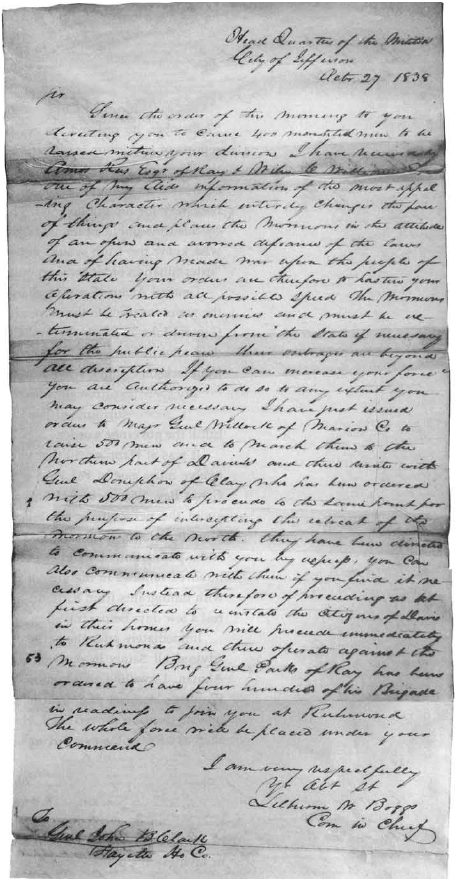
Then came the order. On October 27, Governor Boggs signed the order in the image above. The Church’s history page adds that at the time “extermination” could include forced removal and that Boggs’s intentions “remain uncertain.” The order was nonetheless an order to drive the Saints from the state, and the state itself later said it violated their rights. The Church’s history page on it records that Missouri’s governor, Christopher Bond, officially rescinded it in 1976, arguing that it “clearly contravened the rights to life, liberty, property and religious freedom” and expressing “deep regret for the injustice and undue suffering” it caused the Latter-day Saints. Missouri’s governor expressed regret on behalf of the state 138 years later and said the order violated constitutional rights.
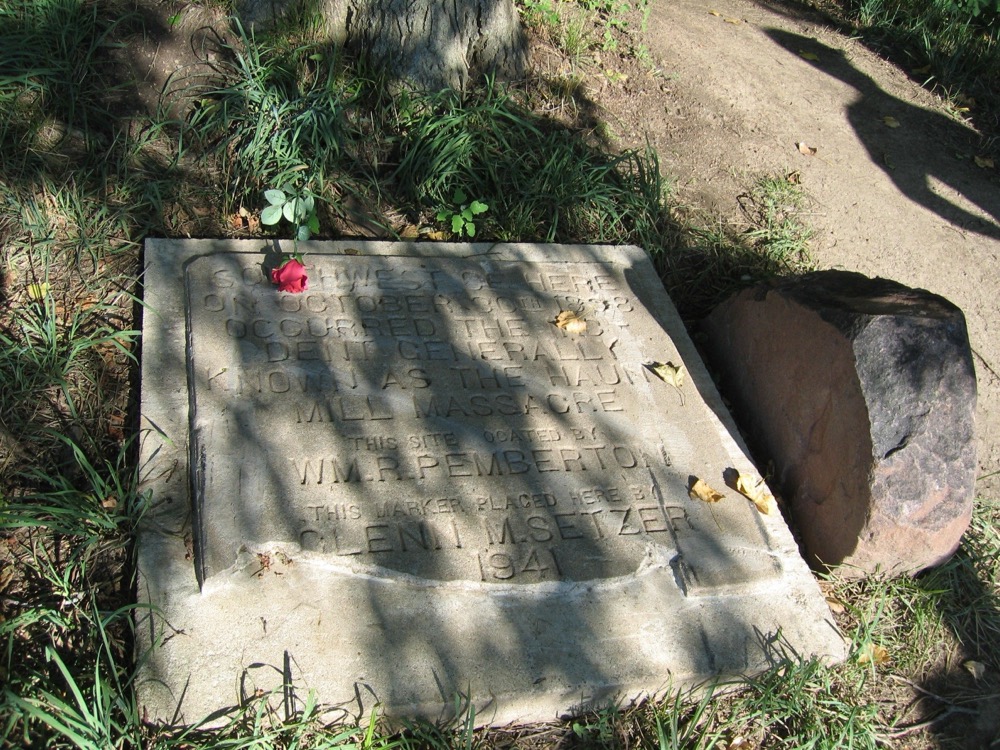
Three days after the order, on October 30, a company of rogue militiamen attacked the settlement at Haun’s Mill (the Church’s pages spell it “Hawn’s Mill”). The Church’s Extermination Order page says vigilantes, not the state militia, carried out the massacre, and that no evidence suggests they knew of the order. The Church’s history page: “Seventeen Latter-day Saints were killed and another 12 to 15 were wounded.” The essay gives the ages: “at least 17 men and boys, ranging in age from 9 to 78, were slaughtered in the Hawn’s Mill Massacre”.
On October 31, General Samuel D. Lucas besieged Far West, arresting Joseph Smith and ordering executions; General Alexander Doniphan prevented the executions (Church history page on the war). The Church’s Extermination Order page says Lucas also demanded that the Saints sign over their property and leave. The Saints then left the state. The essay: mobs drove them “from the state of Missouri in 1839.” Five years later, in Illinois, Joseph and Hyrum Smith were murdered by a mob at Carthage (the full story is on the Joseph page). Everything in this section is stated as the Church’s own pages state it.
What the Church says about it
Gospel Topics essay, “Peace and Violence among 19th-Century Latter-day Saints”
In the first two decades after the Church was organized, Latter-day Saints were often the victims of violence.
The Church’s essay states the persecution plainly, in its opening paragraphs. This page agrees with it.
The essay on churchofjesuschrist.orgThe same essay, on what some Saints did
In the face of this extended persecution, some of the Saints, beginning in 1838, responded on some occasions with defensive … and at times, retaliatory … actions of their own.
The essay’s own words are “defensive” and “at times, retaliatory.” (The essay sets off “and at times, retaliatory” with punctuation that this site does not print; the ellipses mark where it falls.) The same paragraph calls these “isolated acts of violence committed by some Latter-day Saints” that “can generally be seen as a subset of the broader phenomenon of frontier violence in 19th-century America.”
The same essayThe Church’s own publications record both the violence against the Saints and violence by some of them.
1833 to 1857, from the Church’s own pages
Highlighted entries are what the Saints suffered. Plain entries are other events the same pages record, including actions by some Saints.
Sources: Church History Topics on the Mormon-Missouri War of 1838, the Danites, the Extermination Order, Hawn’s Mill Massacre, Mountain Meadows Massacre and the Nauvoo Expositor; the Gospel Topics essay; the 2007 Ensign article. The Crooked River date (October 25) comes from Wikipedia and the June 27 Carthage date from the Joseph page, not from the Church pages cited here.
The exhibits
Each quote below is from the Church’s own pages, as published.
Church History Topics, “Mormon-Missouri War of 1838”
Sidney Rigdon, July 4, 1838
What it establishes: Both sentences are in the Church’s paragraph, so both belong here. Rigdon’s language was threatening, and the Church’s page says he also vowed the Saints would not be the aggressors. Rigdon used the word “extermination” on July 4; the governor’s order used “exterminated” on October 27. The Church’s pages do not say one caused the other.
The Church history pageSame page, the next sentences
Summer 1838
What it establishes: The Church says the Danites pledged to defend the Saints and that the rumors alarmed neighbors. Its separate Danites page adds: “Danites intimidated Church dissenters and other Missourians; for instance, they warned some dissenters to leave Caldwell County.” It also describes their objective as “to defend the community against dissident and excommunicated Latter-day Saints as well as other Missourians.”
The Danites pageChurch History Topics, “Danites”
October 1838
What it establishes: The same page says the Danites existed for five months, from June through October 1838, and that “Historians generally concur that Joseph Smith approved of the Danites but that he probably was not briefed on all their plans and likely did not sanction the full range of their activities.” It also says: “While vigilantes who opposed the Church targeted and sometimes killed noncombatant Latter-day Saints, Danites primarily confiscated or destroyed property they feared could be used by their opponents.” Both are the Church’s own.
The Danites pageChurch History Topics, “Mormon-Missouri War of 1838”
October 1838
What it establishes: The Church’s own sequence places the raids and Crooked River before the order, and says the order came “in the wake of” them. The same sentence says Boggs had earlier backed the Saints’ antagonists. The preceding paragraph on the same page says a mob had destroyed the Saints’ settlement at De Witt and that “the Saints decided to fight back” after reports of mobs burning homes. The Church’s Extermination Order page adds that the local press exaggerated Saint violence and that Crooked River began when a militia company collided with a Latter-day Saint rescue party; that page puts the dead at four, three of them Church members. Neither the raids nor the mobs cancel the other.
The Church history pageChurch History Topics, “Hawn’s Mill Massacre”
October 30, 1838
What it establishes: “Some evidence suggests” and “perhaps” are the Church’s own hedges. This is an open historical question, not a settled justification, and the same page says the killing included shooting boys “execution style” and men who tried to surrender. The page also says that some of those attacked, who had only recently arrived from Ohio, “had already been harassed and disarmed by mob members along the way.” Neither this page nor any other Church page treats the Saints at Haun’s Mill as responsible for the raids.
The Haun’s Mill pageChurch History Topics, “Opposition to the Early Church”
On voting
What it establishes: This is the Church’s own account of why opposition arose, not a justification for the violence. The same paragraph says many Americans were suspicious of how Joseph Smith and later Brigham Young combined political and religious authority, and that in Illinois an “Anti-Mormon Party” formed in 1841 to counter Latter-day Saint voters.
The Church history pageChurch History Topics, “Mountain Meadows Massacre”
September 1857
What it establishes: The Church’s words, including “perhaps.” The omitted sentence says only 17 small children were spared. The same page quotes President Henry B. Eyring on the 150th anniversary: “What was done here long ago by members of our Church represents a terrible and inexcusable departure from Christian teaching and conduct.” It also says that during the “reformation” Church leaders at times “preached with fiery rhetoric, warning against the evils of sin and those who dissented from or opposed the Church,” which led to “increased strain between the Latter-day Saints and their relative few neighbors in Utah.”
The Church history pageEnsign, September 2007, “The Mountain Meadows Massacre” (Richard E. Turley Jr., Ronald W. Walker and Glen M. Leonard)
The fear behind it
What it establishes: The Church’s authors present the Saints’ fear, after being “violently driven from Missouri and Illinois,” as part of the context for 1857, alongside the army’s approach. The Gospel Topics essay states the limit of that kind of explanation: “While historical context can help shed light on these acts of violence, it does not excuse them.” The Ensign article also says that in 1874 nine men were indicted and “only Lee was tried, convicted, and executed for the crime.”
The Ensign articleThe conflict on the map
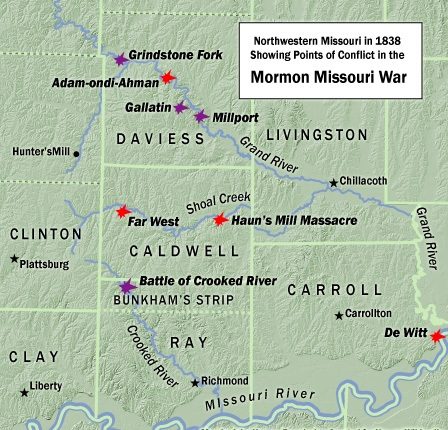
The two columns, row by row
Each row is one episode or period. The left column is what the Saints suffered, as the Church’s own pages record it. The right column is what those pages also record about the Saints in the same period. The columns are not cause and effect; the Church’s pages say where a link is suggested and how firmly. Everything in both columns is from the Church’s own pages.
| Episode | What the Saints suffered | What the Church’s own histories also record |
|---|---|---|
| Jackson County, 1833 | Mobs drive them out; “a committee of citizens met and drafted documents as the basis for organized violence against the Saints.” Opposition page. | The same page says the Saints’ “practice of gathering also led to political opposition: in the young United States, politicians often worried minority groups could swing an election by voting as a bloc, which the early Saints often did.” It does not tie this to Jackson County specifically. |
| Missouri, summer 1838 | “The residents of Carroll County voted for the Saints to leave the county.” In Daviess County, “voters prevented Latter-day Saints from entering the polls, a fight broke out.” War of 1838 page. | Rigdon’s July 4 “war of extermination” oration; the Danites form; they “intimidated Church dissenters and other Missourians.” Danites page. |
| October 1838 | A mob destroys the settlement at De Witt; the Extermination Order; General Lucas besieges Far West; Haun’s Mill, 17 killed and 12 to 15 wounded. Haun’s Mill page. | Mid-October raids by Latter-day Saints that burned homes and stores in Gallatin and Millport (the War of 1838 page); the Crooked River fight, in which the Church’s pages give different death tolls (see the timeline). The Haun’s Mill page says “Some evidence suggests that the attackers were unaware of the order, and that the massacre was an act of vigilante violence, perhaps in retaliation for Latter-day Saint raids in Daviess County.” The Church’s pages do not place responsibility for the massacre on the Saints who were killed. |
| Expulsion, 1839 | Mobs drive them “from the state of Missouri in 1839.” Gospel Topics essay. | The essay says that “In the face of this extended persecution, some of the Saints, beginning in 1838, responded on some occasions with” actions it calls “defensive” and “at times, retaliatory.” |
| Nauvoo, June 1844 | Joseph and Hyrum Smith are murdered when “a mob stormed Carthage Jail.” Expositor page. (Full story: Joseph.) | On June 10, 1844 Joseph Smith, acting with the city council’s authorization, directed a marshal to destroy the press of the Nauvoo Expositor. The Church’s page: “Scholars have concluded that the Nauvoo City Council acted legally to destroy copies of the newspaper but may have exceeded its authority by destroying the press itself.” |
| Utah, 1857 | No violence against the Saints in Utah in 1857; the Ensign article says they feared an army of “roughly 1,500 United States troops” and “had been violently driven from Missouri and Illinois in the prior two decades.” Ensign, 2007. | Mountain Meadows: on September 11, 1857, some 50 to 60 local militiamen, aided by American Indian allies, massacred about 120 emigrants (Ensign); the Church’s history page says the militia was “composed entirely of Latter-day Saints” and the Ensign says “Lee entered the emigrant wagon fort under a white flag and somehow convinced the besieged emigrants to accept desperate terms.” |
The common rebuttals
“The Saints were the victims. Talking about the other side is blaming the victims.”
The Church does not take that position. Its essay opens by saying both are its subject: “This essay explores both violence committed against the Latter-day Saints and violence committed by them.” Naming what happened on one side takes nothing from the other. Explaining a thing is not excusing it, and the essay says so itself: “While historical context can help shed light on these acts of violence, it does not excuse them.”
“The persecution shows this is the Lord’s work. True prophets have always been persecuted.”
Persecution fits a movement being right, but it does not show that. Many movements that contradict each other have been persecuted. Quakers were hanged in colonial Massachusetts: Mary Dyer, one of four Quakers executed there between 1659 and 1661 and known as the Boston martyrs, was hanged in Boston on June 1, 1660. If persecution validated a faith, every persecuted faith would be validated at once, including ones that contradict each other. Suffering shows that people were wronged. It does not show that what they believed was true.
“The Danites and Rigdon were just defending themselves against mobs.”
That is the Church’s framing for some of it. The Church’s pages describe the Saints’ response in 1838 as “defensive” and also, in the essay’s words, “at times, retaliatory.” The Danites page says Danites “intimidated Church dissenters and other Missourians” and that Latter-day Saint vigilantes raided two towns, “burning homes and stealing goods”; the War of 1838 page names the towns as Gallatin and Millport. The Church’s pages say Rigdon’s July 4 oration spoke of “a war of extermination” if mobs gathered and also vowed the Saints “would not be the aggressors.” The essay places these events within what it calls the 19th-century American tradition of “extralegal vigilantism,” and notes that the later Nauvoo Legion “avoided offensive or retaliatory action.”
The Church’s own pages record both the persecution and the raids.
The persecution is real. The raids are real. Neither one erases the other, and the Church’s own pages say both.
What this means
An order that a governor of Missouri later said “clearly contravened the rights to life, liberty, property and religious freedom.” Seventeen dead at Haun’s Mill, at least, ranging in age from 9 to 78. A people driven from Jackson County, from Missouri, and from Nauvoo, Illinois. All of it is in the Church’s own pages.
The Church’s pages also record Rigdon’s “war of extermination,” the burned homes at Gallatin and Millport, the Danites, and Mountain Meadows.
A story that leaves out the raids and Mountain Meadows is not the story the Church’s own pages tell. And suffering, however real, is not evidence that a church is true: other faiths that contradict each other have been persecuted too. The persecution was real, and so was the violence by some Saints. Both are documented in the Church’s own pages.