The Bible underneath it
Who Wrote the Bible, and Who Chose It
No Gospel signs its name, three famous passages are missing from the earliest copies, and the first list of today’s 27 New Testament books is a letter from 367 AD.
The point in one sentence
Open your Bible to the end of Mark. Verses 9 to 20 were not in the oldest copies. Two other passages you may know by heart were not either. The Gospels never name who wrote them. And no list matching your 27 New Testament books exists before a bishop’s letter in 367.
If you grew up on the King James, you may have memorized Mark 16:16, John 8:7, or the verse about the Father, the Word, and the Holy Ghost. Here is what the oldest copies show about each.
The world the Gospels came from
Start with the believing case, because it is a real one. Tradition names the writers of the four Gospels: Matthew the tax collector, Mark the interpreter of Peter, Luke the companion of Paul, John the beloved disciple. Early church writers say so in plain words. The Gospels themselves point to eyewitnesses. And the scholar Richard Bauckham, in Jesus and the Eyewitnesses (Eerdmans, 2006), argued that the Gospels are grounded in eyewitness testimony rather than in anonymous community tradition, a book that won a 2007 Christianity Today award in biblical studies, though reception among scholars was mixed. None of that is a fringe position.
Here is what the documents themselves look like. The earliest Christian writings that survive are letters, not biographies. Scholars date the earliest of Paul’s undisputed letters, 1 Thessalonians, to about 49 to 51 AD, roughly twenty years after the crucifixion. The Gospels come later: Mark around 70 AD, Matthew and Luke around 80 to 90, John around 90 to 100, by the dating given in Wikipedia’s Mark article, its Luke article, and its authorship article. Bart Ehrman puts the general point this way: “New Testament scholars are virtually unified in thinking that the Gospels of the New Testament began to appear after 70 CE. The major exceptions are conservative evangelicals who often date them earlier.” (Ehrman’s blog)
They are also anonymous. The same sources are blunt about it: “The gospels (and Acts) are anonymous, in that none of them provide the name of the author within their text.” That is not by itself a mark against them. Ancient biographies often went unsigned, so that alone proves nothing. What it means is simple: the Gospels do not tell you who wrote them. The names are not in the writing itself. They appear in the headings on the copies and in second-century writers, the earliest of whom is Papias (around 110 to 130 AD).
Then there is the copying. We do not have the original manuscripts. Wikipedia puts it as “The original manuscripts of the New Testament books are not known to have survived.” There are thousands of Greek New Testament manuscripts, and the oldest fragment, Papyrus 52, is a small scrap of John that “may be as early as the first half of the 2nd century.” The earliest complete New Testament is Codex Sinaiticus, which its own site describes as “written in the middle of the fourth century.”
What the tradition said, and what the Gospels say about themselves
The names come from three kinds of testimony. First, two church writers of the second century, quoted below. Second, the Gospels’ own statements about where their accounts came from. Third, a pair of texts, Luke’s opening and the last chapter of John, that each side reads differently.
Papias of Hierapolis, as quoted by Eusebius, Church History 3.39 (Papias is dated roughly 110 to 130 AD; Eusebius wrote in the 300s)
“Mark, having become the interpreter of Peter, wrote down accurately, though not in order, whatsoever he remembered of the things said or done by Christ.” … “Matthew wrote the oracles in the Hebrew language, and every one interpreted them as he was able.”
The earliest naming of Mark and Matthew. Papias says how he got his information: “If, then, any one came, who had been a follower of the elders, I questioned him in regard to the words of the elders,” asking what Andrew, Peter, Philip, Thomas, James, John, or Matthew had said. He was asking secondhand. Eusebius himself, who preserved Papias, wrote that he “appears to have been of very limited understanding.” Two things to read carefully: the Mark line is a report of what an elder said about Mark’s method, and the Matthew line describes a work in Hebrew, while the Matthew we have is in Greek, and by the majority scholarly view it draws on Mark. Schaff’s translation, Nicene and Post-Nicene Fathers.
Eusebius, Church History 3.39, on CCELIrenaeus of Lyons, Against Heresies 3.1.1 (written around 180 AD)
“Matthew also issued a written Gospel among the Hebrews in their own dialect, while Peter and Paul were preaching at Rome, and laying the foundations of the Church. After their departure, Mark, the disciple and interpreter of Peter, did also hand down to us in writing what had been preached by Peter. Luke also, the companion of Paul, recorded in a book the Gospel preached by him. Afterwards, John, the disciple of the Lord, who also had leaned upon His breast, did himself publish a Gospel during his residence at Ephesus in Asia.”
He names all four Gospels and their authors in one passage, and draws a line from each to an apostle or an apostle’s companion. That line is the heart of the traditional case. He is writing about a century after Mark. Roberts and Rambaut translation.
Irenaeus, Against Heresies 3.1, on New AdventThe opening of Luke (KJV, Luke 1:1 to 4)
“Forasmuch as many have taken in hand to set forth in order a declaration of those things which are most surely believed among us, Even as they delivered them unto us, which from the beginning were eyewitnesses, and ministers of the word; It seemed good to me also, having had perfect understanding of all things from the very first, to write unto thee in order, most excellent Theophilus, That thou mightest know the certainty of those things, wherein thou hast been instructed.”
Both readings are available here. Believers read a careful historian who researched his account and knew the eyewitnesses. Ehrman reads the same four verses as the author placing himself one generation removed: the eyewitnesses “delivered them unto us,” and he does not claim to be one. Luke says eyewitnesses “delivered” the account “unto us.” He writes as someone who received it from them. Note also that “many have taken in hand” says other accounts existed before his.
Luke 1:1 to 4 in the KJVThe close of John (KJV, John 21:24), with John 19:35
“This is the disciple which testifieth of these things, and wrote these things: and we know that his testimony is true.” … “And he that saw it bare record, and his record is true: and he knoweth that he saith true, that ye might believe.”
The Gospel points to an eyewitness, the “disciple,” and vouches for him. It never gives his name, and the “we know” is someone else speaking about him. Scholars read this as the beloved disciple being the authority behind the book, written up by another hand, or as the author naming himself indirectly. The traditional identification with John the apostle is Irenaeus’s, from the quote above.
John 21:24 in the KJVNo Gospel names its author. The first writer we have who does is Papias, forty or more years after Mark.
Nobody can say the Gospels name their authors. The names come from Papias and Irenaeus, who report what they were told.
Thirty to 370 AD
Dates are the scholarly approximations used in the sources linked on this page. Jesus died around 30 AD.
Sources: Wikipedia articles on the Gospels, Pauline epistles, Mark 16, and the development of the biblical canon; codexsinaiticus.org
The same timeline, to scale
Years after the crucifixion. The bars are on one scale, so the distance between event and the first full Bible is as long as it really is.
Approximate. Dates for the Gospels are the mainstream scholarly ranges; conservative evangelicals often date them earlier (Ehrman).
The exhibits
First the Church’s own words about the Bible, then the footnotes printed in modern Bibles. Every quote below was read on the linked page.
Articles of Faith 1:8, Pearl of Great Price (bold added)
Canonized, printed in your scriptures today
What it establishes: The Church itself puts a condition on the Bible. As the rest of this page shows, the questions here are not mostly about translation. They are about which words were in the Greek to begin with, and which books count.
Articles of Faith on churchofjesuschrist.orgNIV, Mark 16, printed in the text between verses 8 and 9
Modern translation
What it establishes: A bracketed note set into the text of a Bible millions of people read. The King James prints the same twelve verses with no bracket and no footnote.
Mark 16 in the NIVESV, Mark 16, bracketed note, and its footnote at verse 9
Modern translation
What it establishes: The footnote also reports that some manuscripts carry a different, short ending after verse 8. There were several endings in circulation, not one.
Mark 16 in the ESVNIV, John 7:53 to 8:11 (the woman caught in adultery)
Modern translation
What it establishes: The story is not only missing from the earliest copies. Where it does appear, it floats: different manuscripts put it in different places, including inside Luke.
John 7:53 to 8:11 in the NIVESV, John 7:53 to 8:11, bracketed note and footnote
Modern translation
What it establishes: Two independent translation teams, the NIV and the ESV, say the same thing in nearly the same words.
John 7:53 to 8:11 in the ESVNIV, footnote to 1 John 5:7 to 8
Modern translation
What it establishes: The ESV text also reads “the Spirit and the water and the blood.” The ESV page checked shows no footnote about the missing words. So here the difference between the King James and the modern Bible is not a bracket but a verse that simply is not there.
1 John 5:6 to 8 in the NIVBible quotations on this site are King James, because that is the Bible the Church publishes. Here a modern translation is cited too, because the notes exist only there. The Church’s online edition of the King James carries study footnotes on these verses. The ones listed for Mark 16:9 to 20, for John 8, and for 1 John 5:7 to 8 are cross-references and Topical Guide entries (plus Joseph Smith Translation notes at Mark 16:3 to 6 and John 8:11). None of them flags that the passage is missing from the earliest manuscripts.
Check it yourself: three passages
You need nothing but two Bibles. Open the King James and a modern translation to these three places and read what each prints.
Three passages the King James prints without a mark
What the King James says, what the oldest manuscripts show, and what a modern Bible’s note tells you.
| Passage | The King James prints | The earliest manuscripts | A modern Bible’s note |
|---|---|---|---|
| Mark 16:9–20 | “He that believeth and is baptized shall be saved; but he that believeth not shall be damned” (v. 16) and “They shall take up serpents; and if they drink any deadly thing, it shall not hurt them” (v. 18). No note. | Codex Sinaiticus and Codex Vaticanus, both fourth century, end the Gospel at 16:8. Vaticanus then leaves a whole empty column before Luke begins (some read that as the scribe knowing of a longer ending he did not have; either way the verses are not in it). Eusebius, writing in the 300s, is reported to say accurate copies end there. Irenaeus, around 184, already cites verse 19. | NIV: “The earliest manuscripts and some other ancient witnesses do not have verses 9–20.” ESV: “Some of the earliest manuscripts do not include 16:9–20.” |
| John 7:53 to 8:11 | The woman taken in adultery: “He that is without sin among you, let him first cast a stone at her” (8:7) and “Neither do I condemn thee: go, and sin no more” (8:11). No note. | Missing from the two oldest copies of John (both about the year 200) and from the two oldest nearly complete Bibles (Sinaiticus and Vaticanus, from the 300s). Vaticanus has marks at the end of John 7:52 that some argue show its scribe knew the passage. The first surviving Greek manuscript to include it is Codex Bezae, from the 400s or 500s. | NIV: “The earliest manuscripts and many other ancient witnesses do not have John 7:53–8:11.” ESV: “The earliest manuscripts do not include 7:53–8:11.” |
| 1 John 5:7–8 | “For there are three that bear record in heaven, the Father, the Word, and the Holy Ghost: and these three are one.” (v. 7) No note. | No Greek manuscript before the fourteenth century has the words. Nestle-Aland knows of eight Greek manuscripts with them in all. The earliest Latin copies that have them are from the 400s to 600s. | NIV: “not found in any Greek manuscript before the fourteenth century.” ESV: the words are absent from the text, with no note found on the page checked. |
Sources: KJV, NIV, ESV on biblegateway.com; Wikipedia, Mark 16, Pericope Adulterae, Comma Johanneum
Most scholars today hold that Mark ended at 16:8 and that verses 9 to 20 were added later (Wikipedia, Mark 16: “In the second part of the 20th century the view prevailed that verse 8 was the original ending, as intended by the author.”).
The third passage has a documented path into the King James. Erasmus omitted the words from his first two editions of the Greek New Testament because the words were not in his Greek manuscripts. Here is what happened next.
“The Bible has been changed” is too loose to be useful, and it overstates. Wikipedia’s article on biblical manuscripts gives an estimate of 400,000 variations among the New Testament manuscripts and says most are accidental scribal errors such as spelling, skipped words, and doubled lines. A smaller number look deliberate. And Mark 16:9 to 20 is not a medieval insertion. Justin Martyr (155 to 157) is the earliest clear witness to it, and Irenaeus cites verse 19 around 184. It is old, even if the oldest manuscripts lack it. Three passages in the King James were not in the earliest manuscripts, and the King James does not tell you. Modern Bibles do.
Who decided what counts
The canon is just the official list of books in the Bible. Every book is a separate question, and for the New Testament the answer is not one decision but a long process. By around 200 AD the Muratorian fragment (an early list, found in a damaged copy) already shows “a set of Christian writings somewhat similar to what is now the New Testament, which included four gospels” and argued against objections to them. That is the believing side’s strongest point, and it is true: the core was settled early and broadly. What took centuries was the edge.
That early list leaves out Hebrews, James, 1 and 2 Peter, and 3 John, and includes the Wisdom of Solomon and the Apocalypse of Peter. About 325, Eusebius sorts James, Jude, 2 Peter, and 2 and 3 John as “disputed.”
Athanasius of Alexandria, Festal Letter 39, an Easter letter from a bishop of Egypt, 367 AD
“These are, the four Gospels, according to Matthew, Mark, Luke, and John. Afterwards, the Acts of the Apostles and Epistles (called Catholic), seven, viz. of James, one; of Peter, two; of John, three; after these, one of Jude. In addition, there are fourteen Epistles of Paul… And besides, the Revelation of John.” … “These are fountains of salvation, that they who thirst may be satisfied with the living words they contain. In these alone is proclaimed the doctrine of godliness. Let no man add to these, neither let him take ought from these.”
The earliest surviving list that matches today’s 27 books exactly. It is a bishop’s letter announcing the date of Easter, not a council’s decree. Nicene and Post-Nicene Fathers translation (R. Payne-Smith).
Athanasius, Letter 39, on New AdventHis Old Testament list is not the one your Protestant Bible uses either. He counts “twenty-two books,” gives Jeremiah as “Jeremiah with Baruch, Lamentations, and the epistle,” and puts Esther outside the canon:
Athanasius, Festal Letter 39, on books outside the canon
“… there are other books besides these not indeed included in the Canon, but appointed by the Fathers to be read by those who newly join us, and who wish for instruction in the word of godliness. The Wisdom of Solomon, and the Wisdom of Sirach, and Esther, and Judith, and Tobit, and that which is called the Teaching of the Apostles, and the Shepherd.”
Esther is in every Protestant, Catholic, and Orthodox Old Testament today. Athanasius files it with the books for beginners, next to the Teaching of the Apostles and the Shepherd. The man who gave us the New Testament list had a different Old Testament.
Same letterThe oldest complete New Testament has the same quirk. Codex Sinaiticus ends with two books that are not in today’s New Testament: the Epistle of Barnabas and the Shepherd of Hermas (codexsinaiticus.org).
The disagreement is current, not just history
The three largest Christian traditions still keep different Bibles.
| Tradition | Old Testament | Where it differs |
|---|---|---|
| Protestant | 39 books (66 in all) | Does not include the extra Old Testament books Catholics keep (like Wisdom and Tobit); Luther moved seven of them into a separate “Apocrypha” section. |
| Catholic | 46 books (73 in all) | Council of Trent, 8 April 1546, approved the canon including those extra books. |
| Eastern and Oriental Orthodox | Broader, and not identical to each other | Wikipedia: these churches “may have differences in their lists of accepted books.” Some books are classed as worthy of reading rather than fully canonical. |
Sources: Wikipedia, Biblical canon; Development of the Christian biblical canon
The New Testament margins were contested too. The Syriac Peshitta, a standard early Bible of the Syriac church, was “originally excluding certain disputed books (2 Peter, 2 John, 3 John, Jude, Revelation).” In 1522 Martin Luther placed Hebrews, James, Jude, and Revelation separately at the back of his New Testament, unnumbered, and of James he wrote that it is “a perfect straw-epistle compared with them, for it has in it nothing of an evangelic kind.” (Luther’s canon)
A common story says the Council of Nicaea in 325 voted on which books go in the Bible. The record does not support it. The history of the canon says: “There is no evidence among the canons of the First Council of Nicaea of any determination on the canon.” Athanasius’s list is a bishop’s letter written forty years later, and the North African councils of 393 and 397 are later still. The real history is slower and messier than a single vote, and that is the stronger point.
The Latter-day Saint question
Article of Faith 8 says the Bible is the word of God “as far as it is translated correctly.” Latter-day Saint scripture also says the Bible lost parts. The Book of Mormon says men “have taken away from the gospel of the Lamb many parts which are plain and most precious” (1 Nephi 13:26). So the Church’s own scripture teaches that the Bible was changed by men.
These three passages go the other way. They are not missing from your Bible. They were added to it, after the earliest copies. The King James translators did not mistranslate them. They translated the Greek text they had, the Textus Receptus (the printed Greek New Testament that began with Erasmus), and it already contained them. Article of Faith 8 asks whether the Bible was translated correctly. The problem here comes before translation.
The other tool Latter-day Saints have is the Joseph Smith Translation (JST), Joseph Smith’s inspired revision of the Bible, the subject of its own page. A believer can answer that the JST was given to restore lost truths, not to rule on every manuscript question. That is fair. The Church’s own introduction to the JST says the Lord “inspired the Prophet Joseph Smith to restore truths to the King James Bible text that had become lost or changed since the original words were written.” So what does it do with these three passages?
| Passage | What the JST does | Where to check |
|---|---|---|
| Mark 16:9–20 | The Church’s printed JST for Mark 16 gives only verses 3 to 6 (the angels at the tomb). Joseph’s revision manuscript, though, writes Mark 16 out through verse 20, including verses 9 to 20. He did not cut them or flag them. | JST Mark 16 on churchofjesuschrist.org; New Testament Revision 2, pp. 44 and 45 (second numbering), Joseph Smith Papers |
| John 7:53 to 8:11 | Keeps the passage and adds a line. The footnote to John 8:11 in the Church’s edition reads: “And the woman glorified God from that hour, and believed on his name.” Nothing marks the passage as doubtful. | Footnote to John 8:11, Church’s online scriptures |
| 1 John 5:7 | No change. The Church’s published JST for 1 John has no chapter 5, and Joseph’s revision manuscript, which lists the verses he revised, shows only verses 13 and 18 for 1 John 5. The verse stands as in the King James. | JST 1 John on churchofjesuschrist.org; New Testament Revision 2, p. 148 (second numbering), Joseph Smith Papers |
That is what the JST does not do. It does not say Mark ended at verse 8. It does not say the woman taken in adultery is a later story. It does not remove the words about the Father, the Word, and the Holy Ghost. Joseph Smith revised about 2,100 verses of the New Testament. In his manuscript he works inside the story of the woman caught in adultery (he edits John 8:3, 9 and 10, and the Church’s footnote shows an added line at 8:11). He writes out Mark 16:9 to 20. His list for 1 John 5 has only verses 13 and 18. He left all three passages in.
The same question reaches the Old Testament. For the books of Moses see Who Wrote the Torah.
What is true on the other side
Four things belong here at full strength.
The tradition is early and it is not nothing. Papias is writing some forty to sixty years after Mark, Irenaeus about a century after, and the four-Gospel core was in circulation by 200. The fact that none signs its name is not evidence against what it says. Ancient biographies often went unsigned.
Most variants are trivial. Most are spelling, skipped words, and doubled lines. A text with thousands of Greek copies gives scholars a lot to compare.
The passages are old, even if not original. The adultery story is old. Eusebius says Papias knew a story of Jesus and a woman accused of many sins (a story like it; whether it is the same text is disputed), and Jerome, about 417, says many Greek and Latin copies had the passage. Augustine, who died in 430, believed some had removed it because of what it might seem to permit, writing (as Wikipedia quotes him) that “Certain persons of little faith… removed from their manuscripts the Lord’s act of forgiveness toward the adulteress.” Many readers hold that it preserves a true memory of Jesus. The manuscripts cannot settle that. They settle one thing: it was not in the earliest copies of John, and it appears in different places in later ones.
The Trinity does not depend on 1 John 5:7. Matthew 28:19 names the three together: “baptizing them in the name of the Father, and of the Son, and of the Holy Ghost.” Dropping the verse costs that doctrine one verse, not its foundation.
The common rebuttals
“Papias and Irenaeus knew who wrote the Gospels. That is why the names are on them.” They are early witnesses and they should be heard. But look at what each one says. Papias, the earlier, describes a Hebrew work by Matthew and a Mark who wrote down what Peter said, passed along by an unnamed elder. Irenaeus is writing about a century after Mark. Both are reporting a tradition, not reading a signature, and for Matthew the work Papias describes is in Hebrew, while the Matthew we have is in Greek. The authorship the Gospels do not give, the second century supplies. Every name on a Gospel rests on one of those two reports, not on the Gospel.
“If Matthew copied Mark, that just means he respected a good source. Luke says he used sources himself.” Agreed, and Luke 1:1 says so outright: “many have taken in hand.” Using sources is ordinary and honest. Most scholars think Matthew and Luke both started from Mark’s Gospel and added to it. The point is smaller than a charge of copying: if Mark came first, then Matthew, whom tradition makes an apostle, built much of his account on a book by someone tradition says was not. That is the majority view (Wikipedia, Synoptic problem); one older view puts Matthew first. The anonymity and the dates stand either way.
“The variants don’t touch any doctrine. Scholars can reconstruct the original.” For most of the text, yes. For these three, the people who reconstruct it say they are not original, and the Bibles built on that work say so in print. The King James is the one that does not. Nobody is arguing the doctrine collapses. The point is that the Bible you hold is not a single, fixed, unaltered text. Your own scripture says men changed it. These three passages are changes of the opposite kind, additions, and the King James does not tell you.
“The councils didn’t create the canon. They recognized what the churches already used.” For the core, yes, and that is why this page grants it. But at the edges the churches did not agree: the Syriac Bible lacked five books, Luther demoted four, Athanasius counted Esther out and the Teaching of the Apostles and the Shepherd as reading for beginners, and today Protestants, Catholics, and Orthodox keep different Old Testaments. Recognizing is a decision made by people, and they decided differently.
The Bible was copied, added to, and sorted by people over centuries.
The Bibles that tell you so in their footnotes are the modern ones. The King James does not.
What this means
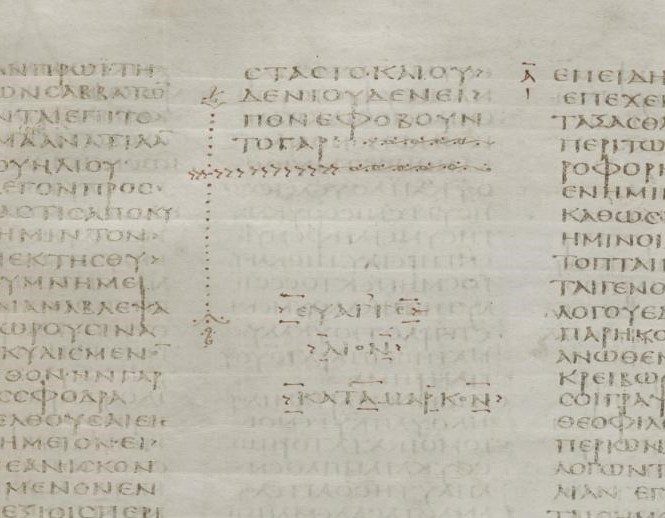
The end of Mark in Codex Sinaiticus, one of the two oldest nearly complete Bibles we have, stops at “for they were afraid,” and the twelve verses your Bible adds are not there. The NIV and the ESV tell you so in print. 1 John 5:7 went into a printed Greek New Testament only after Erasmus was shown a manuscript, and into the King James after that. The four Gospels name no author in their own words, were written one to two generations after Jesus, and the names come from the next century. The first list that matches today’s New Testament is a bishop’s Easter letter from 367, whose Old Testament list, even then, was not yours.
None of the Gospels is signed, none of the originals has survived, and the list of books was set by people, not by one council.
Joseph Smith’s own revision of the Bible, which changed about 2,100 New Testament verses, left all three of these passages in. Article of Faith 8 asks whether the Bible was translated correctly. The problems on this page come before translation: which words were in the Greek, and which books were chosen. People decided both. So who decides how far the Bible is the word of God?