The founding claims
The Bible Joseph Rewrote
Joseph revised an English King James Bible without Hebrew or Greek. A few changes echo ancient readings; the largest additions have no known ancient source.
The point in one sentence
By the Church’s own account Joseph revised an English King James Bible with no Hebrew or Greek, and the largest additions (the Book of Moses and a Genesis 50 prophecy of a seer named Joseph) have no known ancient source, so the Joseph Smith Translation does not show that he recovered what the Bible originally said.
If you grew up in the Church, you were probably taught that Joseph Smith restored “plain and precious” truths that had been lost from the Bible. The Joseph Smith Translation (the JST, his revision of the Bible) is where much of that idea comes from, and its changes appear in the footnotes of the Church’s King James Bible. This page looks at what the Church itself says about how the revision was made.
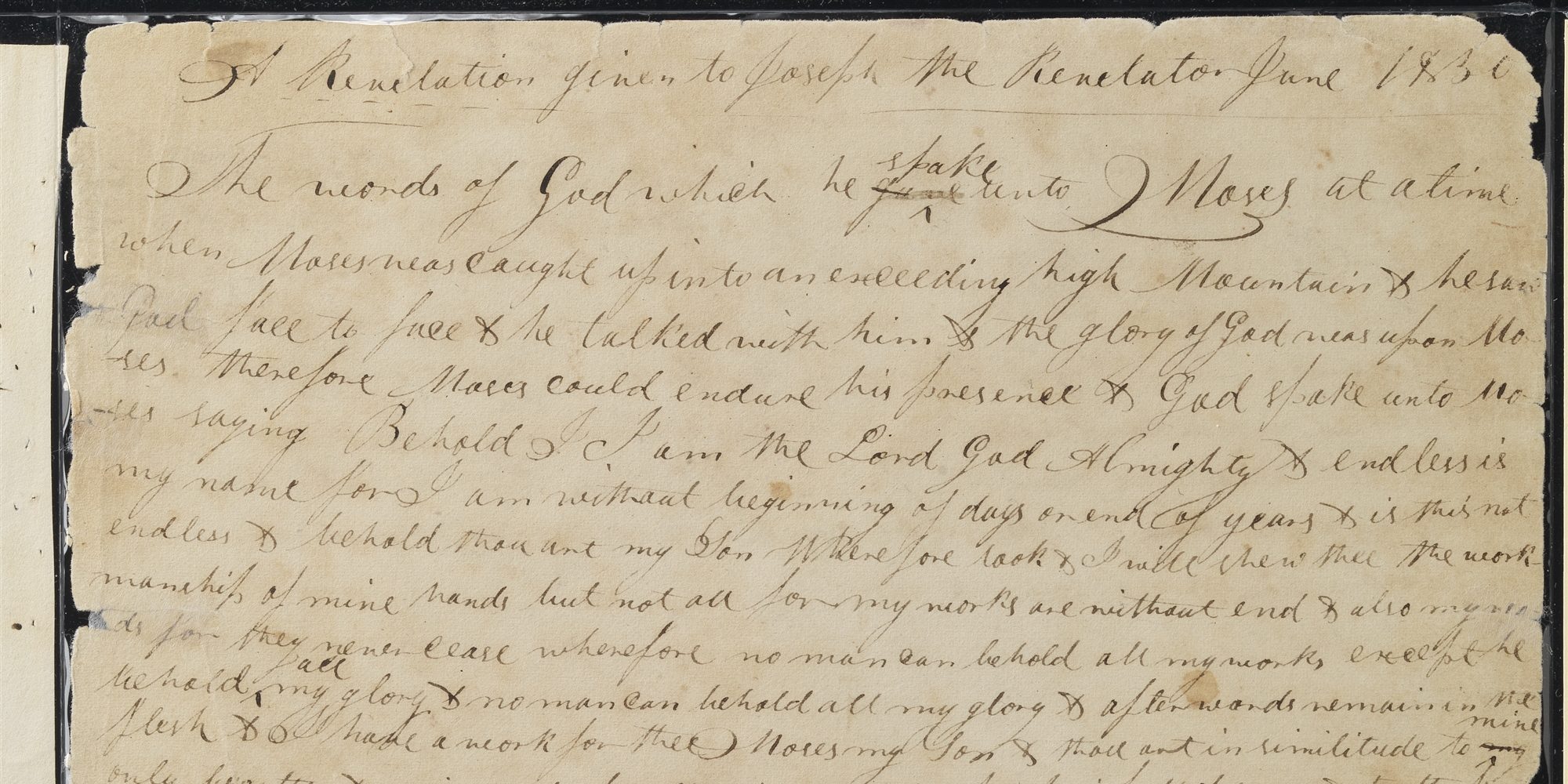
The strongest believing answer comes first. Kent P. Jackson, a retired BYU professor of ancient scripture who has written extensively on the JST, in Understanding Joseph Smith’s Translation of the Bible (2022), says it is misdirected to fault the JST for not matching ancient manuscripts:
Kent P. Jackson, Understanding Joseph Smith’s Translation of the Bible (BYU Religious Studies Center and Deseret Book, 2022), pp. 34-35, as quoted by FAIR
Some may choose to find fault with the Joseph Smith Translation because they do not see correlations between the text on ancient manuscripts. The supposition would be that if the JST revisions were justifiable, they would agree with the earliest existing manuscripts of the biblical books. This reasoning is misdirected in two ways. First, it assumes that extant ancient manuscripts accurately reproduce the original test [sic], and both Joseph Smith and the Book of Mormon teach otherwise. Because the earliest Old and New Testament manuscripts date from long after the original documents were written, we no longer have original manuscripts to compare with Joseph Smith’s revisions. The second problem with faulting the JST because it does not match ancient texts is that to do so assumes that all the revisions Joseph Smith made were intended to restore original text. We have no record of him making that claim, and even in places in which the JST would restore original text it would do so not in Hebrew or Greek but in Modern English and in the scriptural idiom of early nineteenth-century America.
This is the believing answer at full strength: the oldest manuscripts are not the originals, and the JST was never meant to be a manuscript restoration across the board. Jackson also writes, in a 2005 BYU article, “I believe that parts of the Joseph Smith Translation restore original biblical text that had become lost since the time of the Bible’s authors,” and in the same piece: “Even though I believe that the JST restores original text, it is likely that most changes have other explanations.”
FAIR page quoting JacksonIn a 2005 BYU article Jackson lists four kinds of change: restored original text, lost teachings that were never recorded in the Bible, harmonization with other scripture, and clarification for modern readers. There is also textual evidence on the believing side. In 2004 the BYU newspaper reported on research presented by Thomas Wayment, a BYU professor of ancient scripture, noting that “there are roughly 250,000 variants of the New Testament” in ancient languages and quoting him that “there is strong support for some passages agreeing verbatim with ancient texts.” The same report says “there is not variant support for all passages,” and it names no passages. Matthew 6:13 also has real early parallels, covered in the table below.
The world it came from
Joseph was not the only American of his day to reshape the Bible. Thomas Jefferson had finished The Life and Morals of Jesus of Nazareth in 1820, “by cutting and pasting, with a razor and glue, numerous sections from the New Testament,” leaving out the miracles. In 1833, the year the Church says Joseph completed his own revision, Noah Webster published his “Common Version,” for which “He used the King James Version (KJV) as a base and consulted the Hebrew and Greek along with various other versions and commentaries.” Webster, per the same account, “molded the KJV to correct grammar, replaced words that were no longer used, and removed words and phrases that could be seen as offensive.” Jefferson’s version “excludes all miracles by Jesus and most mentions of the supernatural.” Webster started from the King James text and went to the Hebrew and Greek; Joseph, the Church says, did not.
The Book of Mormon, printed in 1830, already says the Bible had lost things: 1 Nephi 13:28 says “there are many plain and precious things taken away from the book, which is the book of the Lamb of God.” The Church’s history page dates the start to the summer of 1830: “Joseph and Oliver received by revelation an account of visions experienced by Moses but not found in the Bible.” It says Joseph “completed his work on the entire project by July 1833.”
What Joseph and the Church said
The Church of Jesus Christ, introduction to “Selections from the Joseph Smith Translation of the Bible”
The Lord inspired the Prophet Joseph Smith to restore truths to the King James Bible text that had become lost or changed since the original words were written.
This is the Church’s claim in one sentence: some truths were lost, and revelation put them back. It says truths, and it says restore. It does not say the changes come from a manuscript.
Read it on churchofjesuschrist.orgSame introduction, the next point
Joseph’s translation was more revelation than literal translation from one language into another.
So the Church itself puts the work in a different category from translating a document.
Same pageThe Church, Church History Topics, “Joseph Smith Translation of the Bible”
While working on his revision of the Bible, Joseph Smith did not employ Hebrew and Greek sources, lexicons, or a knowledge of biblical languages to render a new English text. Rather, he used a copy of the King James Bible as the starting point for his translation, dictating inspired changes and additions to scribes.
The source text was English. The Church says so directly.
Read it on churchofjesuschrist.orgDoctrine and Covenants 73:3-4, January 10, 1832, and 124:89, January 19, 1841
“it is expedient to translate again... and after that it is expedient to continue the work of translation until it be finished.” Nine years later, to William Law: “publish the new translation of my holy word unto the inhabitants of the earth.”
Canonized revelations mention the work at least twice: in 1832 Joseph and Sidney Rigdon are told to continue it, and in 1841 William Law is told to help publish it.
D&C 124 on churchofjesuschrist.orgTake all of that seriously. What is left?
Even a believing BYU scholar says most changes are not restorations. The ones that might be cannot be tested against any manuscript. What is left is Joseph’s word that he was inspired. Jackson and Wayment point to some textual evidence, noted above, but neither claims manuscripts confirm it.
From a dictated page to the manuscripts online
What the Church’s own history page and the Joseph Smith Papers date.
Sources: Joseph Smith Papers; Church History Topics, Joseph Smith Translation of the Bible; D&C 73, 124
The exhibits
What follows is the record in the Church’s own words and those of its BYU scholars, with every source linked.
Church History Topics, “Joseph Smith Translation of the Bible”
Church History Department
What it establishes: The Church places the source in English, and says no Hebrew or Greek sources were used.
Read it on churchofjesuschrist.orgSame page, on publication
Church History Department
What it establishes: The revision the Church prints is a selection, set into the King James text.
Same pageBYU Religious Studies Center, “Precious Truths Restored: Joseph Smith Translation Changes Not Included in Our Bible,” by Thomas E. Sherry and W. Jeffrey Marsh, Religious Educator 5:2, reporting Robert J. Matthews’ count
2004
What it establishes: The same article gives the count: 1,289 verses changed in the Old Testament, 2,096 in the New, plus the added introduction to Genesis (now Moses 1), for 3,410 in all. It gives three reasons for the gap: the manuscripts were held by the Reorganized Church, the 1979 volume was already near its binding limit, and doctrines already found elsewhere in the scriptures did not need duplicating.
Read it at BYU RSCKent P. Jackson, BYU, “New Discoveries in the Joseph Smith Translation of the Bible”
2005
What it establishes: A believing BYU scholar who has spent decades on the manuscripts puts the restoration claim at some changes, not most. His other explanations include harmonizing a verse with truth found elsewhere in scripture and, he writes, clarifying the text for modern readers.
Read it at BYU RSCDavid A. LeFevre, BYU RSC, “The Sermon on the Mount in the Joseph Smith Translation”
2010
What it establishes: The Book of Mormon’s version of the Sermon on the Mount and the JST’s version differ in most of the verses the JST changed in Matthew 5-7. LeFevre adds that “Other changes to the Beatitudes in Matthew generally match the well-known version in 3 Nephi,” and concludes that Joseph “did not feel bound by the 3 Nephi version but felt free to translate the New Testament texts as the Spirit led him.”
Read it at BYU RSCBYU Universe, “New Testament variants similar to text of JST,” reporting Thomas Wayment’s House of Learning lecture
Feb 12, 2004
What it establishes: The evidence on the believing side. The same report says “there is not variant support for all passages,” that the changes “do not correlate with any one text, but have different supports in each manuscript,” and it names no passages.
Read it at BYU UniverseHow much was changed
Matthews’ count of verses the manuscript changes (1,289 + 2,096 = 3,385, plus 25 added Genesis-introduction verses = 3,410), and how much of it the LDS edition prints.
Each dot is about 100 of the 3,410 changed verses. The article says the LDS edition contains notes to about one-third of them and counts approximately 1,200 verses printed: about 800 in footnotes and the appendix, 356 in Moses, 55 in Joseph Smith-Matthew.
Source: BYU Religious Studies Center, Precious Truths Restored. The 1,200 figure and its breakdown are the article’s.
The visual breakdown: set it beside the standard Hebrew and Greek
The Church does not say Joseph used manuscripts, and Jackson argues that faulting the JST for not matching them is misdirected. You can still look. Below are five widely discussed JST changes, each printed in the Church’s own scriptures, set beside the standard printed Hebrew or Greek text. They are examples, not a survey, and this is not a manuscript-by-manuscript comparison.
| Passage | King James | Joseph Smith Translation | Standard Hebrew or Greek text |
|---|---|---|---|
| Genesis 6:6 | “And it repented the Lord that he had made man on the earth, and it grieved him at his heart.” | Moses 8:25: “And it repented Noah, and his heart was pained that the Lord had made man on the earth, and it grieved him at the heart.” | וַיִּנָּחֶם יְהוָה “And regretted YHWH.” The one who regrets is the Lord. |
| Exodus 33:20 | “Thou canst not see my face: for there shall no man see me, and live.” | JST: “...there shall no man among them see me at this time, and live, for they are exceeding sinful. And no sinful man hath at any time, neither shall there be any sinful man at any time, that shall see my face and live.” | לֹֽא־יִרְאַ֥נִי הָאָדָ֖ם וָחָֽי “not / shall see me / the man / and live.” No word for “sinful.” |
| Matthew 4:1 | “Then was Jesus led up of the Spirit into the wilderness to be tempted of the devil.” | “Then Jesus was led up of the Spirit, into the wilderness, to be with God.” | “πειρασθῆναι ὑπὸ τοῦ διαβόλου” “to be tempted by the devil.” |
| Matthew 6:13 | “And lead us not into temptation, but deliver us from evil.” | JST 6:14: “And suffer us not to be led into temptation, but deliver us from evil.” | “καὶ μὴ εἰσενέγκῃς ἡμᾶς εἰς πειρασμόν” Verb glossed “lead.” Early writers paraphrase it as “do not allow us to be led”: per Latter-day Saint scholar Kevin Barney, Marcion (second century) wrote “Do not allow us to be led into temptation” for the parallel in Luke 11:4, and Augustine wrote “Many when praying speak as follows: Let us not be led into temptation.” Barney still concludes the Greek, which has the active verb, “is in all probability the original text.” |
| John 1:18 | “No man hath seen God at any time, the only begotten Son, which is in the bosom of the Father, he hath declared him.” | JST John 1:19: “And no man hath seen God at any time, except he hath borne record of the Son; for except it is through him no man can be saved.” | “Θεὸν οὐδεὶς ἑώρακεν πώποτε μονογενὴς Θεὸς ὁ ὢν εἰς τὸν κόλπον τοῦ Πατρός” “No one has ever yet seen God.” No exception clause in the Greek printed on Bible Hub. The oldest Greek witnesses (the papyri P66 and P75, and Vaticanus and Sinaiticus) read “only-begotten God” here, not “Son”; the King James “Son” follows the reading found in Alexandrinus, the Textus Receptus and the Peshitta. |
In the standard Hebrew and Greek texts, none of the five rows has wording that corresponds to the JST. (Matthew 6:13 has an early parallel in Marcion and Augustine, noted in the table.) Each JST version also answers a difficulty a reader might feel: a God who regrets, a God who cannot be seen yet is seen, a Spirit who leads Jesus to be tempted, a God who leads into temptation. That is close to the kind of change Jackson calls harmonization with truth found elsewhere in scripture, and it is a good thing for a commentary to do.
The best-known one: Genesis 50
The King James Genesis 50 has 26 verses and ends with Joseph’s death at 110. The JST version has 38. Inserted before the death is a long prophecy by Joseph of Egypt that a “choice seer” named Joseph will rise in the last days, named after his father. The Church’s seminary manual reads it exactly that way: “Shortly before his death, Joseph of Egypt prophesied that in the latter days the Lord would raise up Joseph Smith to do His work.” Here is the manuscript.
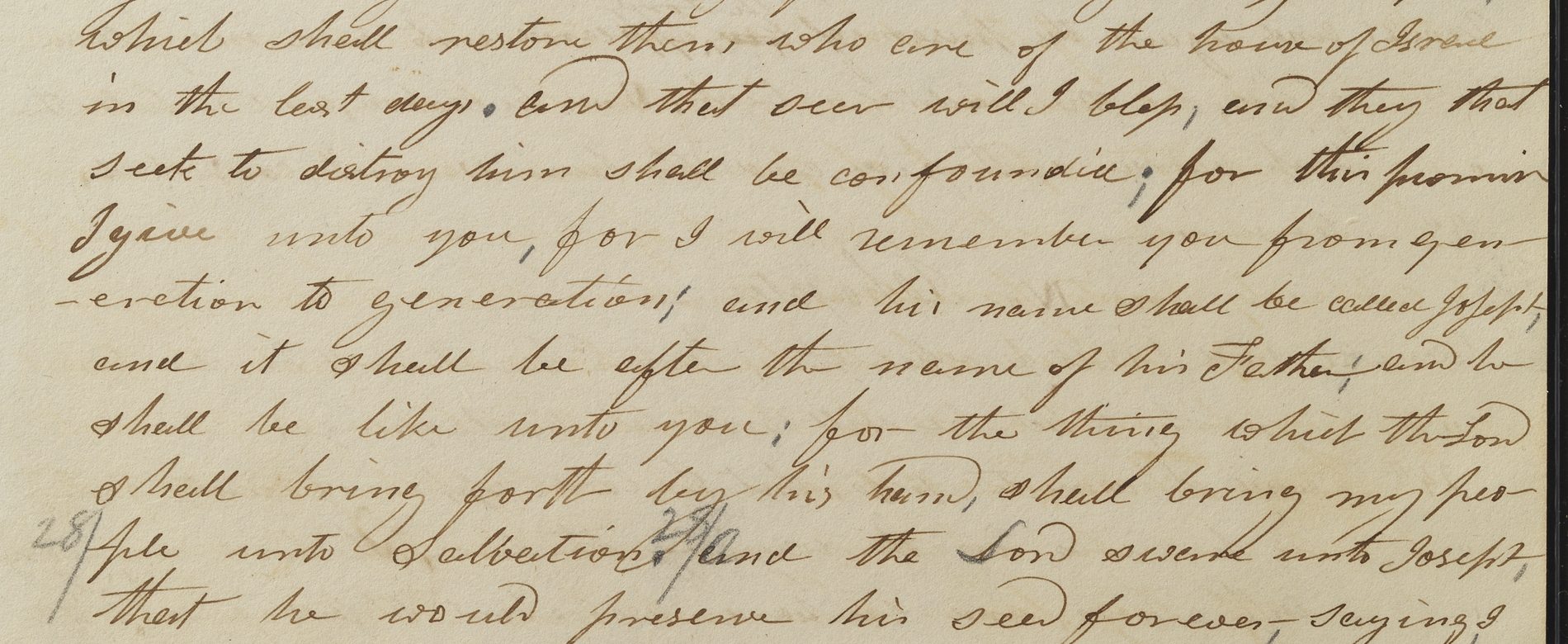
The Book of Mormon, printed in 1830, already had a version of this prophecy. In 2 Nephi 3, Lehi quotes Joseph of Egypt to his own son Joseph. Set the two next to each other:
| JST Genesis 50 | 2 Nephi 3 (Book of Mormon) | |
|---|---|---|
| The seer | 26: “A seer shall the Lord my God raise up, who shall be a choice seer unto the fruit of my loins.” | 6: “A seer shall the Lord my God raise up, who shall be a choice seer unto the fruit of my loins.” |
| His work | 27: “...and he shall be esteemed highly among the fruit of thy loins; and unto him will I give commandment that he shall do a work for the fruit of thy loins, his brethren.” | 7: “...and he shall be esteemed highly among the fruit of thy loins. And unto him will I give commandment that he shall do a work for the fruit of thy loins, his brethren, which shall be of great worth unto them...” |
| His name | 33: “his name shall be called Joseph, and it shall be after the name of his father; and he shall be like unto you; for the thing which the Lord shall bring forth by his hand shall bring my people unto salvation.” | 15: “And his name shall be called after me; and it shall be after the name of his father. And he shall be like unto me; for the thing, which the Lord shall bring forth by his hand, by the power of the Lord shall bring my people unto salvation.” |
| Moses | 34-35: “I will raise up Moses, and a rod shall be in his hand... And I will make a spokesman for him, and his name shall be called Aaron.” | 17: “I will raise up a Moses; and I will give power unto him in a rod... and I will make a spokesman for him.” |
How a believer reads this: it is one ancient prophecy preserved in two places. The Book of Mormon says of Joseph of Egypt, “he truly prophesied concerning all his seed. And the prophecies which he wrote, there are not many greater” (2 Nephi 4:2), and says Lehi’s brass plates held “the five books of Moses” (1 Nephi 5:11). On that reading, Joseph restored a verse the Bible lost and the Book of Mormon kept (2 Nephi 4:2 adds that Joseph’s prophecies “are written upon the plates of brass”). That reading is coherent, and nothing in these two texts can disprove it.
Here is what can be checked from outside. The King James chapter ends at Joseph’s death in verse 26, and none of the sources cited here points to a Hebrew or Greek manuscript with the added verses. The two places the prophecy is found are two books produced through Joseph, one already in print when the other was dictated. Much of the JST wording matches 2 Nephi 3, some of it word for word, and the JST adds details 2 Nephi 3 does not have: the name “Joseph” in so many words, Aaron by name (verse 35), and the Red Sea (“he shall smite the waters of the Red Sea with his rod,” verse 34). No ancient source is named for the Genesis 50 verses. The only source on the page that has them is 2 Nephi 3.
What is true on the other side
Some JST changes solve real problems, and they do so cleanly. Genesis 6:6 has the Lord regretting; Moses 8:25 moves the regret to Noah. Exodus 33:11 has the Lord speaking to Moses “face to face, as a man speaketh unto his friend,” while verse 20 says “there shall no man see me, and live”; the JST rewrites verse 20 so that it is “sinful” men who cannot see God, and the contradiction is gone. Genesis 6:2 has “the sons of God” taking “the daughters of men”; Moses 8:14 has “the sons of men” seeing “that those daughters were fair,” after Moses 8:13 says Noah’s family “were called the sons of God.” A believer can fairly say these are thoughtful, and that inspired commentary is worth having.
Jackson also makes a specific claim that deserves a plain statement. He writes that he has “found wording on the first Old Testament manuscript that I believe can only be explained as a very literal translation from a Hebrew original,” so odd in English that editors “after Joseph Smith’s time took it out, so it is not in the Book of Moses today.” The example itself is in a separate BYU Studies article (Jackson cites his own “Behold I,” BYU Studies, Fall 2005) that is not evaluated here. It is Jackson’s opinion, offered by a scholar who knows the manuscripts well, and it stands as his argument.
One more claim is disputed among Latter-day Saint scholars. Thomas Wayment and Haley Wilson-Lemmon reported, in Wayment’s words, “200 to 300... parallels where Joseph Smith has the exact same change to a verse that Adam Clarke does,” Clarke being a Methodist Bible commentator; Wayment says there are none in Genesis 1 to 24, and that from Matthew on it is “very clear.” Kent Jackson answers that “none of the examples they provide can be traced to Clarke’s commentary, and almost all of them can be explained easily by other means,” and Kevin Barney puts the chance of influence at “de minimis or negligible.” That is a live dispute, and nothing here rests on it.
It is also true that the revision leaves much of the King James Bible’s world alone. Moses 2:7 still has God making the firmament and dividing “the waters which were above the firmament.” And JST Exodus 4:24 supplies a reason for the Lord seeking to kill Moses (“for he had not circumcised his son”) and does not remove it.
The common rebuttals
“It was never meant to be a translation of ancient manuscripts, so comparing it to them proves nothing.”
Agreed, and nothing here says the Church claimed otherwise. The Church says in its own words that Joseph used no Hebrew or Greek. The comparison does not accuse anyone of a claim they did not make. It answers a narrower question: whether anything outside the claim supports it. In these five cases the standard Hebrew and Greek has nothing that matches, and for the one early parallel, Matthew 6:13, Barney concludes the Greek is still the original. That does not prove no original existed; Jackson’s point is that the surviving manuscripts are not the originals. It means that, apart from the scattered readings Wayment and Jackson point to, anyone who accepts the largest additions as restored scripture is accepting them on Joseph’s word alone.
“The manuscripts we have are not the originals. A reading could be older than all of them.”
True. A reading could be older than every surviving copy. But the same sentence protects any claim. It would protect a reading that was invented in 1831 in exactly the same way, and a claim that nothing can count against cannot count in favor either. If the revision is inspired commentary, as Jackson describes most of the changes, then it is something people can value on its merits and it never needed this defense. If it is restoration, this defense is not evidence, because it cannot be tested.
“Genesis 50 predicted Joseph Smith by name, long before he was born.”
Yes, if the text is ancient. But the prophecy appears in only two places, and both are books produced through Joseph, one already printed before the other was dictated. A prophecy found only in Joseph’s own books cannot confirm Joseph. A believer who holds that the Book of Mormon came from ancient plates counts it as ancient, and that is the very thing in question.
“He never finished it, and only part of it is printed.”
Only the second is accurate. A 2 July 1833 letter to Church leaders in Missouri, signed by Sidney Rigdon, Joseph Smith and Frederick G. Williams, says “we this day finished the translating of the Scriptures,” (Joseph Smith Papers) and the Church says he completed the work by July 1833, though he occasionally revisited portions afterward. Only part of it is printed, for the reasons the BYU article gives: access to the manuscripts, space, and not repeating what other scriptures teach. Neither point bears on where the changes came from.
The Church does not hide the JST. It prints selections in its edition of the Bible, publishes the appendix online, and, per the Church’s own history page, published the complete manuscripts in 2004. The interesting question is selection, not concealment.
Joseph did not claim to be working from ancient manuscripts. No Church source quoted here says he did, and Jackson writes that to assume all the revisions were “intended to restore original text” is mistaken: “We have no record of him making that claim.”
Not all 3,410 changes are doctrinal. Jackson writes that more individual corrections “appear to fall into” the category of making the text “more clear and understandable for modern readers” “than into any other.” The count measures activity, not significance.
A Bible revised from an English Bible, and in five widely cited cases the standard Hebrew and Greek text has nothing like the changes.
What stands behind the largest additions, in the sources quoted here, is Joseph’s word that he was inspired.
What this means
Strip it down to what you have just seen. The Church says Joseph revised an English King James Bible without Hebrew or Greek. A BYU scholar who has spent decades on the manuscripts says it is likely that most of the changes have explanations other than restoration, and that faulting the JST for not matching ancient manuscripts is misdirected. A few readings do coincide with ancient ones: Wayment’s 2004 research reported that some JST New Testament readings agree with ancient variants, and Matthew 6:13 has early parallels. In five widely cited changes, nothing in the standard Hebrew and Greek text matches the JST wording. And in Genesis 50, the best-known JST insertion about a seer named Joseph, the manuscript is there on the page: much of its wording matches 2 Nephi 3, some of it word for word, and it adds the name, Aaron and the Red Sea. Apart from the one phrase Jackson reports, no ancient source is named in the sources quoted here for the Book of Moses material or for that prophecy.
The Joseph Smith Translation was made from an English Bible, and its largest additions have no known ancient source. It does not show that Joseph recovered lost Bible text.
The Church calls this a restoration of lost truths. A restoration needs something that was lost and then found. The page shows an English Bible, a few scattered matches with ancient readings, and large additions with no ancient source behind them. Beyond Joseph’s word, nothing in the sources quoted here supports those additions. Inspired commentary can still be worth reading, but it is not the same thing as recovered scripture.