The Bible underneath it
Who Wrote the Torah
The Church’s Bible Dictionary says a later hand wrote the account of Moses’ death, and the Book of Mormon says the plates Lehi carried around 600 BC held all five books of Moses.
The point in one sentence
The Church’s own Bible Dictionary says a later hand wrote part of the first five books, and mainstream scholars place their finished form after the Babylonian exile began, so when 1 Nephi 5:11 says Lehi’s brass plates held “the five books of Moses” about 600 BC, it matches the traditional view of who wrote those books, not what the evidence shows.
The world the five books came from
If you grew up in the Church, you met Moses early. In Primary he was the baby in the basket and the prophet at the Red Sea. You were probably taught that Moses wrote the first five books of the Bible: Genesis, Exodus, Leviticus, Numbers, and Deuteronomy. Many members call them the books of Moses. Jews call the same five books the Torah, which means “law” or “teaching.” For most of the last two thousand years, Jews and Christians read the five books as the work of Moses.
The Talmud, the great collection of Jewish teaching written down in the centuries after Christ, has a passage on who wrote each book of the Bible. One line says that “Joshua wrote his own book and eight verses in the Torah, which describe the death of Moses.” Those eight verses are the end of Deuteronomy. The rabbis saw the problem in a man writing the story of his own death. Rabbi Yehuda said Joshua wrote it. Rabbi Shimon said God dictated it and Moses wrote it “with tears.” (Bava Batra 14b-15a; Menachot 30a.)
A medieval Jewish commentator, Abraham ibn Ezra, stopped at Genesis 12:6. He first suggested a plain reading, that the Canaanites had taken the land from some earlier people. Then he added: “Should this interpretation be incorrect, then there is a secret meaning to the text. Let the one who understands it remain silent.” (Ibn Ezra on Genesis 12:6, Sefaria, Strickman and Silver translation.) Medieval scholars like him began to speak, carefully, about problems like this one. Scholars after him kept noticing the same kinds of lines. Today the Torah is studied in universities the way any ancient book is studied: by reading it closely, and by comparing it with the oldest copies we have. Many believers study it the other way, as the work of Moses.
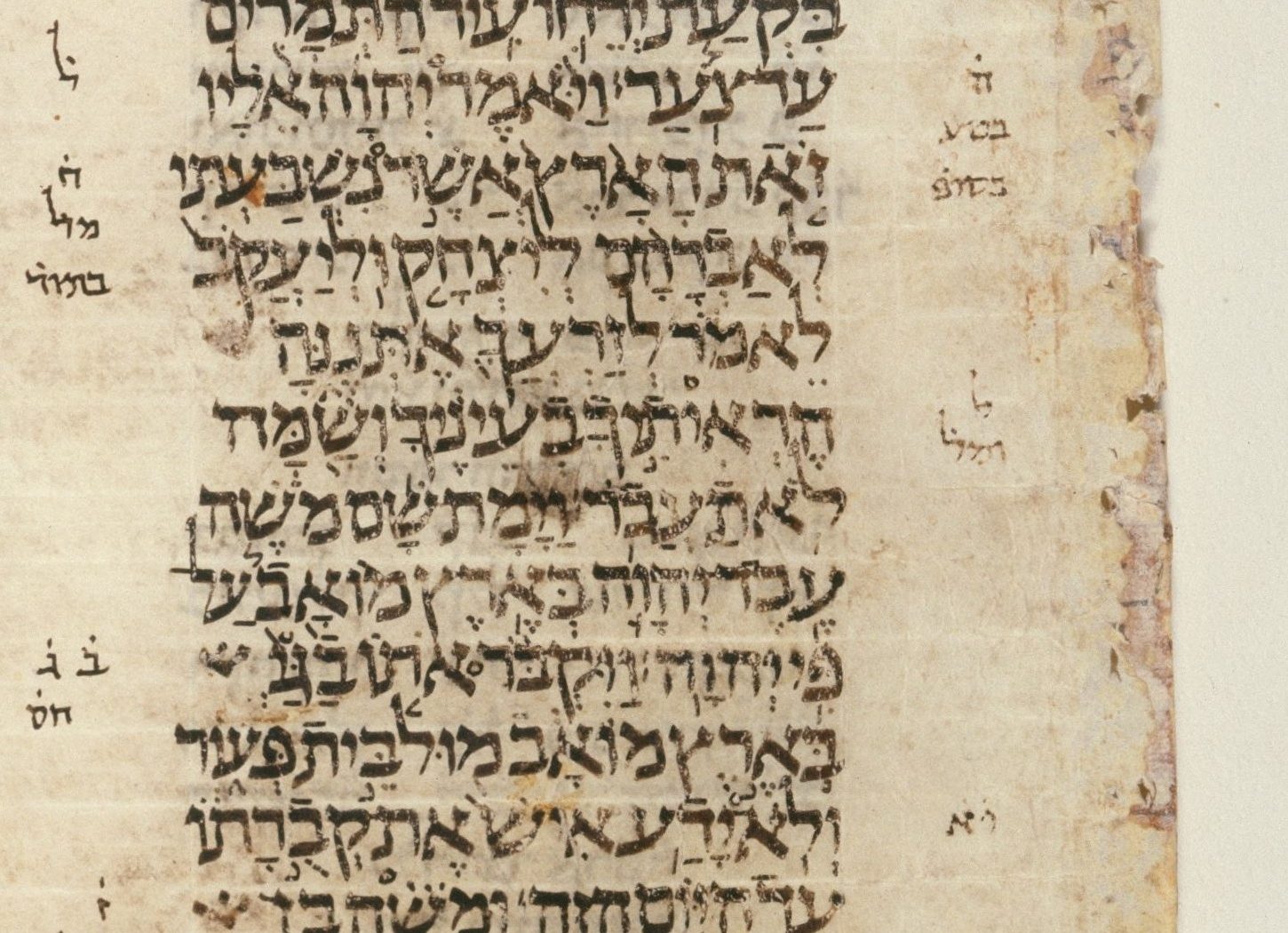
The Leningrad Codex above is a Hebrew Bible copied by hand between AD 1008 and 1011. The Dead Sea Scrolls, found in caves near Qumran between 1946 and 1956, are far older, and among them are fragments of Genesis. They show that Genesis was being copied by hand. They do not say who first wrote it.
What the Church teaches
This is not a side question for Latter-day Saints. The Church’s Bible Dictionary, the reference section printed in the back of the Church’s edition of the King James Bible, says Moses wrote the five books, and it points to two of the Church’s own scriptures as proof.
Bible Dictionary, “Pentateuch” (the Church’s edition of the King James Bible)
The Pentateuch was written by Moses, although it is evident that he used several documentary sources from which he compiled the book of Genesis, besides a divine revelation to him. It is also evident that scribes and copyists have left their traces upon the Pentateuch as we have it today; for example, the explanation of Moses’ supposed death (Deut. 34:5–12) was surely added by a later hand. But latter-day revelation confirms that Moses was the author of the first five books of the Bible: Genesis, Exodus, Leviticus, Numbers, Deuteronomy (1 Ne. 5:10–11; Moses 1:40–41).
This is more careful than what many of us remember being taught. Notice three things the Church’s own dictionary says: Moses used earlier sources, copyists changed the text, and someone else added the account of his death. What it holds on to is the claim that the books are Moses’ work, and that “latter-day revelation” (the Book of Mormon and the Book of Moses) settles it.
Bible Dictionary, “Pentateuch”Bible Dictionary, “Moses”
Latter-day revelation concerning Moses confirms the biblical account of his greatness, his divine calling, and the events of his ministry and reaffirms that he was the author of the five books that bear his name (1 Ne. 5:11; Moses 1:40–41).
The same entry says Moses was a ‘translated being’ who ‘had not died as reported in Deut. 34’ (Alma 45:19). So the Church says the death reported in the last chapter did not happen the way that chapter says. The Pentateuch entry above says who added it: ‘a later hand.’
Bible Dictionary, “Moses”1 Nephi 5:10-13, Book of Mormon, verses run together (Lehi reads the brass plates, which his sons brought from Jerusalem; the chapter heading says “The plates of brass contain writings of Moses and the prophets”)
And after they had given thanks unto the God of Israel, my father, Lehi, took the records which were engraven upon the plates of brass, and he did search them from the beginning. And he beheld that they did contain the five books of Moses, which gave an account of the creation of the world, and also of Adam and Eve, who were our first parents; And also a record of the Jews from the beginning, even down to the commencement of the reign of Zedekiah, king of Judah; And also the prophecies of the holy prophets, from the beginning, even down to the commencement of the reign of Zedekiah; and also many prophecies which have been spoken by the mouth of Jeremiah.
What is being claimed: that around 600 BC (the date the Church prints over the book, “About 600 B.C.”), a set of metal plates in Jerusalem held the five books of Moses, from creation on, alongside the prophets and a record of the Jews down to King Zedekiah.
1 Nephi 5 on churchofjesuschrist.orgMoses 1:40-41, Pearl of Great Price
And now, Moses, my son, I will speak unto thee concerning this earth upon which thou standest; and thou shalt write the things which I shall speak. And in a day when the children of men shall esteem my words as naught and take many of them from the book which thou shalt write, behold, I will raise up another like unto thee; and they shall be had again among the children of men…
Neither 1 Nephi 5:11 nor Moses 1:40-41 uses the word ‘author’ of the five books. The dictionary draws that conclusion from them. This is the Latter-day Saint answer for any gap in the Bible: words were taken out of what Moses wrote, and they have been restored through Joseph Smith. It is a real answer, and it is taken up below.
Moses 1 on churchofjesuschrist.orgOne claim, two scriptures, and a dictionary that already concedes a later hand.
So the question is no longer whether anyone else touched the books. It is how much of them, and when.
From Moses to the brass plates to the scholars
Where the five books stand on the Church’s timeline, and where the text itself points.
Sources: Church scriptures and Bible Dictionary; Bava Batra 14b-15a; Menachot 30a; Wikipedia, “Torah” and “Documentary hypothesis”
The exhibits
First the Church’s own words, then the text of the books, then the outside voices. Every quotation is word for word from the source linked.
Bible Dictionary, “Pentateuch,” the Church’s edition of the King James Bible
Printed in the Church’s scriptures
What it establishes: The Church itself says that eight verses of the books of Moses were not written by Moses. The question left is whether those eight verses are the only ones.
Read the entry on churchofjesuschrist.orgSame entry, on how Genesis was made
Printed in the Church’s scriptures
What it establishes: The Church’s dictionary agrees that Genesis was put together from earlier written sources. That is the idea scholars call a composite text. The only difference left is who did the putting together, and when.
Same entryDeuteronomy 34:5-6, King James Version (the last chapter of the last book)
What it establishes: The book says “he buried him,” not “I buried him.” And “unto this day” is how a writer talks when enough years have passed that the grave has been lost.
Deuteronomy 34 on churchofjesuschrist.orgDeuteronomy 34:10, King James Version
What it establishes: “Since” looks back over the prophets who came after Moses. This sits inside the verses (34:5-12) that the Church’s own dictionary says a later hand added.
Same chapterGenesis 36:31, King James Version
What it establishes: The verse is followed by a list of eight Edomite kings, Bela through Hadar. Its natural reading is that it was written by someone who already knew that Israel had kings. By the Bible’s own account, Israel’s kings come after Moses.
Genesis 36 on churchofjesuschrist.orgGenesis 12:6, King James Version
What it establishes: This is the line Abraham ibn Ezra stopped at. “Then” suggests a writer for whom the Canaanites were no longer there. This is a clue rather than a proof, because believers can read it as a plain note that the land was not empty when Abram came, which was Ibn Ezra’s own first suggestion.
Genesis 12 on churchofjesuschrist.orgTalmud, Bava Batra 14b (via Sefaria, English translation)
A Talmudic teaching, written down in the centuries after Christ
What it establishes: One rabbi in the Talmud gave the end of Deuteronomy to Joshua. Another said Moses wrote it by dictation, weeping (next exhibit). Either way, the rabbis saw that those verses needed an explanation. The Church’s dictionary takes the first view.
Bava Batra 14b on SefariaTalmud, Menachot 30a, Rabbi Shimon (via Sefaria, English translation)
A Talmudic teaching, written down in the centuries after Christ
What it establishes: This is the believing answer at its best: Moses wrote even the account of his own death, as God spoke it, and wept as he did. It keeps Moses as the author of those eight verses. It does not explain Genesis 36:31, and it is not the answer the Church’s dictionary gives.
Menachot 30a on SefariaAbraham ibn Ezra on Genesis 12:6 (via Sefaria, Strickman and Silver translation)
Medieval Jewish commentary
What it establishes: Read the whole thing: he offers the harmless explanation first. Then he hints that if it fails, there is something he will not say out loud.
Ibn Ezra on Genesis 12:6 on SefariaWikipedia, “Torah,” summarizing mainstream biblical scholarship
Accessed Oct 13, 2026
What it establishes: The Persian period is 539 to 333 BC, the time after Babylon fell to Persia and the exile ended. It begins about sixty years after the date the Church prints over 1 Nephi, “About 600 B.C.”
Wikipedia, “Torah”Christine Hayes, Yale RLST 145, Lecture 5 (Open Yale Courses transcript)
Yale University course on the Hebrew Bible
What it establishes: A Yale professor of the Hebrew Bible says most scholars still hold that the Torah is made of different sources, while arguing over the details. Julius Wellhausen was the nineteenth-century scholar whose theory dated the last of those sources, the priestly writing, to the exile (after Babylon took many Judeans away in 586 BC) or later. That is the point this page needs.
Hayes, Lecture 5, Open Yale CoursesThe verses, laid out side by side
This is the part you can check yourself, with a King James Bible in your hands. Each row is a verse. The middle column says what it says. The right column says what a single author living in the time of Moses would have to be doing for it to read that way.
| The verse | What it says | Why it does not read as Moses writing it |
|---|---|---|
| Deuteronomy 34:5-6 | “So Moses the servant of the Lord died there… And he buried him… but no man knoweth of his sepulchre unto this day.” | He cannot narrate his own death and burial, or say that his grave was later lost, unless God dictated it (Rabbi Shimon’s answer, below). The Church’s dictionary says a later hand added it. |
| Deuteronomy 34:10 | “And there arose not a prophet since in Israel like unto Moses…” | “Since” looks back across prophets who came after him. Same eight verses, same later hand. |
| Genesis 36:31 | “…the kings that reigned in the land of Edom, before there reigned any king over the children of Israel.” | Reads as written when Israel already had kings. Believers answer that Moses knew kings were coming (below). Possible, but it is a second explanation, not the reading the verse itself invites. |
| Genesis 12:6 | “And the Canaanite was then in the land.” | Suggests a writer for whom the Canaanites were gone. A clue, not a proof. |
| Genesis 1:11-27 and 2:5-19 | Chapter 1: plants, then animals, then man. Chapter 2: man first, then the garden and trees, then the animals. | Two accounts of the same beginning, told in different orders and different wording, set side by side. Believers read chapter 2 as zooming in on day six; the order is the question. |
| Genesis 6:19-20, 7:2-3 and 7:8-9 | 6:19-20 says “two of every sort” go into the ark. 7:2-3 says clean beasts and fowls go in “by sevens,” and unclean beasts “by two.” 7:8-9 says clean and unclean “went in two and two.” | The weakest row, and it is here so you can judge it. 7:2-3 and 7:8-9 give different numbers for the clean animals. Believers read 6:19-20 as the minimum and 7:8-9 as a short summary. Scholars read it as two flood accounts stitched together. |
Two creation accounts, two different orders
Genesis 1 and Genesis 2, in the King James Version, set next to each other.
- Plants first (1:11-12): “Let the earth bring forth grass, the herb yielding seed, and the fruit tree…”
- Then animals (1:25): “God made the beast of the earth after his kind…”
- Man last (1:27): “So God created man in his own image… male and female created he them.”
- Field plants not yet (2:5): “every plant of the field before it was in the earth… and there was not a man to till the ground.”
- Man first (2:7): “the Lord God formed man of the dust of the ground.”
- Trees after man (2:8-9): “the Lord God planted a garden eastward in Eden; and there he put the man whom he had formed. And out of the ground made the Lord God to grow every tree that is pleasant to the sight.”
- Animals after (2:19): “out of the ground the Lord God formed every beast of the field… and brought them unto Adam.”
Genesis 1 and 2, KJV, churchofjesuschrist.org. Latter-day Saints answer this with a “spiritual creation” first (Moses 3:5); see below.
What the brass plates have to hold
Here is where the question stops being only about the Bible and starts being about the Book of Mormon. Nephi says the plates his sons brought from Jerusalem “did contain the five books of Moses.” The verse does not say these were early drafts, or pieces. The Church’s own dictionary reads that verse as proof that Moses was the author of all five.
The Bible gives a small glimpse of Jerusalem in the years before Lehi left. In the eighteenth year of King Josiah, the high priest Hilkiah told the scribe Shaphan, “I have found the book of the law in the house of the Lord,” and when the king heard it read, he “rent his clothes” (2 Kings 22:8, 11). The Bible does not say how much of the Torah that book held. Nephi says the plates held all five books, from creation on.
Now put that next to what the text and the scholars show. The books describe the death and burial of Moses, which the Church says a later hand wrote. They list Edom’s kings “before there reigned any king over the children of Israel.” A later hand on its own does not settle the question, because the Church could say that hand worked before 600 BC. What settles it is when the books reached the form we have. Mainstream scholars put that during or after the exile, which began in 586 BC. The Book of Mormon puts the finished set in Jerusalem by 600 BC. That is the traditional view of who wrote the books and when, and it is not what the evidence shows.
What is true on the other side
The believing case deserves to be stated at its best. The books do say Moses wrote. Exodus 24:4: “And Moses wrote all the words of the Lord.” Numbers 33:2: “And Moses wrote their goings out according to their journeys by the commandment of the Lord.” Deuteronomy 31:9: “And Moses wrote this law, and delivered it unto the priests the sons of Levi.” Deuteronomy 31:24 says he finished “writing the words of this law in a book.” Jews and Christians read those verses as saying he wrote all five books. None of them says he wrote Genesis, and none says he wrote the account of his own death. And no reasonable reader says Moses cannot have had help: the Church’s own dictionary says he used sources, and that scribes touched the text.
Here is each believing answer, and what it leaves standing.
| The believing answer | What it explains | What it leaves standing |
|---|---|---|
| Moses wrote the books, and later scribes added a little (the Church’s Bible Dictionary). | Deuteronomy 34:5-12, and perhaps other small notes. | It is no longer “Moses wrote the Torah.” It is “Moses wrote most of it,” with the reader left to sort which parts. The Church’s own dictionary says copyists “left their traces” on the text “as we have it today.” |
| Joshua wrote the last eight verses (one rabbi in Bava Batra 14b-15a and Menachot 30a), or Moses wrote them as God dictated, weeping (Rabbi Shimon, Menachot 30a). | The death and burial of Moses, Deuteronomy 34:5-12. | Only those eight verses. Rabbi Shimon’s version keeps Moses as author of them, but it still has Moses write “And Moses died there” and a grave that “no man knoweth” “unto this day.” It does not touch Genesis 36:31, Genesis 12:6, or the two creation accounts. And the Church’s own dictionary does not take Rabbi Shimon’s way out; it says “a later hand.” |
| Moses knew kings were coming. Deuteronomy 17:14-15 has him say “I will set a king over me, like as all the nations that are about me,” and Genesis itself promises that kings will come from Abraham (17:6: “kings shall come out of thee”) and from Jacob (35:11: “kings shall come out of thy loins”). | Genesis 36:31. A writer in Moses’ day knew kings were coming. | Knowing kings were coming is not the same as saying the Edomites reigned “before there reigned any king over the children of Israel.” That is how a writer talks who is looking back from a time when Israel had one. It also needs a separate answer for each verse, and it answers none of the doublets. |
| Moses 1:41: words were “taken from the book which thou shalt write,” and have been restored. Moses 3:5 adds that God created all things “spiritually, before they were naturally upon the face of the earth.” | Why the Bible may be missing things, and why a spiritual creation could come before the one in Genesis 2. | It says words were removed. It does not say Moses wrote the account of his burial, or Genesis 36:31, or that the books were finished by 600 BC. And it explains an order of creation without explaining why one author would tell it twice in different words. |
The common rebuttals
“The Church already says a later hand added the end. That doesn’t make Moses not the author.”
That is true as far as it goes, and it is the right place to start. But look at what the sentence has done. Once part of the five books is allowed to come from a later hand, the claim is no longer that Moses wrote them. It is that Moses wrote most of them, and everyone agrees to stop at a line the text does not draw. Genesis 36:31 is not in Deuteronomy 34. The dictionary’s own words, “documentary sources” and “scribes and copyists,” describe a book made over time, which is what scholars mean by composite. A later hand on its own does not decide the question, because the Church could say that hand worked before 600 BC. What decides it is when the books reached the form we have. Mainstream scholars put that after the exile began, and the Book of Mormon puts the finished set in Jerusalem by 600 BC.
“The documentary hypothesis has been abandoned.”
The four-document version has been heavily revised, and this page does not rest on it. What has not been abandoned is that the Torah is built from earlier sources and took its final form late. The Church’s dictionary itself says “documentary sources.” You do not need J, E, D, and P. You need Deuteronomy 34, Genesis 36:31, and two creation stories.
“The brass plates could have held an earlier copy of the five books.”
They could have, and that is the believing answer that matters most. The strongest form of it uses Nephi’s own words. The plates are a record “from the beginning, even down to the commencement of the reign of Zedekiah” (1 Nephi 5:12), so they were put together late, and they could have been updated along the way, the way the Bible Dictionary says the Bible was. Look at what that gives up. If the plates were updated to include later hands, they are no longer “the five books of Moses” as Moses wrote them, which is what 1 Nephi 5:11 and the dictionary say. The claim becomes “something like them was there.” Nephi does not say that. The Church’s dictionary does not say it either.
“Jesus said Moses wrote of him.”
He did, in John 5:46-47: “For had ye believed Moses, ye would have believed me: for he wrote of me. But if ye believe not his writings, how shall ye believe my words?” This is the strongest single verse on the believing side, and it deserves a straight answer. Speaking to a first-century Jewish audience, Jesus used the name by which they called the Torah, the way a person says “Shakespeare” for the plays. If that is how he spoke, the verse does not tell us who wrote Genesis 36:31. If he meant that Moses personally wrote every word, the books themselves show later additions, as the Church’s dictionary says. Either way, the verses on the page decide the question, not the way people talked about the book.
The book that says Moses wrote it also tells of his burial.
The Church’s own dictionary admits the later hand. The rest of the book shows more.
What this means
Here is what the Church’s own pages show. The Church teaches that Moses wrote Genesis through Deuteronomy, and it points to the Book of Mormon and the Book of Moses as proof. Its own Bible Dictionary admits that Moses used earlier sources, that copyists changed the text, and that the account of his death was “surely added by a later hand.” The Talmud records one rabbi saying Joshua wrote eight verses, and another saying Moses wrote them weeping. The book tells of his burial and says no one knows the grave “unto this day.” It lists Edom’s kings “before there reigned any king over the children of Israel.” It tells the creation twice, in two orders.
The question was never whether other hands touched the five books. The Church already says they did. It is when the books reached the form we have, and mainstream scholars put that after Lehi’s day.
Mainstream scholarship places the final form of the Torah in or after the exile, after the date the Book of Mormon gives for the plates. So 1 Nephi 5:11, and the Church’s Bible Dictionary that cites it as proof, describe the five books of Moses the way tradition says they were written, not the way the evidence shows they came to be. If the books on the plates did not yet exist in the form we have, what else was taught as settled that rests on the same kind of assumption?