The founding claims
The Witnesses
None of the Three ever denied what they signed. Their certainty is the evidence offered, and some of these men were also certain of things the Church does not accept.
The point in one sentence
The Book of Mormon witnesses were sincere, but their certainty cannot show what they saw. By David Whitmer’s own words it was both “in a vision, or in the spirit” and “in the body also,” and some of these men were just as certain of things the Church itself does not accept.
What is true on the other side
None of the Three ever denied what they signed, and that is the strongest thing on the believing side, so it goes first. The Church’s own history page says: “Despite differences with Joseph Smith that led each of the Three Witnesses to part ways individually with the Church (Cowdery and Harris later returned), they continued to affirm their testimony as witnesses throughout their lives.” Two of the three came back, and none of them used the break to say the plates were not real. These were not men who drifted away quietly. Each broke with Joseph Smith, and Joseph wrote of four of them in 1838 in the harshest terms (see the exhibits). Martin Harris, in a January 1871 letter to H. B. Emerson: “no man ever heard me in any way deny the truth of the Book of Mormon, the administration of the angel that showed me the plates.” David Whitmer, in print in 1887: “I will say once more to all mankind, that I have never at any time denied that testimony or any part thereof. I also testify to the world, that neither Oliver Cowdery or Martin Harris ever at any time denied their testimony.” Whitmer also reports that he was present at Cowdery’s death in Richmond, Missouri, on 3 March 1850, and that Cowdery’s last words were: “Brother David, be true to your testimony to the Book of Mormon.” That is Whitmer’s report of the words, not Cowdery’s own writing.
It gets stronger for the Eight Witnesses, the second group of eight men who also signed a statement. Their statement says they “did handle with our hands” the leaves, and that “we have seen and hefted.” John Whitmer, who died in July 1878, is reported by P. Wilhelm Poulson (in a letter dated 31 July 1878, published 6 August 1878, after Whitmer’s death) as answering a request that he reaffirm: “I have never recalled it, and I have nothing to reaffirm.” And Oliver Cowdery, speaking at Kanesville in 1848 after ten years outside the Church, the same year he was readmitted, is recorded in Reuben Miller’s journal saying: “I beheld with my eyes, And handled with my hands the gold plates from which it was translated,” and “I wrote with my own pen the intire book of Mormon (save a few pages) as it fell from the lips of the prophet.”
The witnesses also described the experience in plainly physical terms. Doctrine and Covenants 17:3 says that after faith they would have “seen them with your eyes.” The Three signed that the plates were laid “before our eyes.” Whitmer wrote in 1887 that “we were in the body also, and everything was as natural to us, as it is at any time,” with a bright light at noon day, and in 1884 is reported saying “I saw with these eyes and I heard with these ears.” They also described it in visionary terms: Whitmer in the same 1887 letter, “in a vision, or in the spirit,” and Harris, according to the printer John Gilbert, “with a spiritual eye.” Both kinds of description are in the record.
All of that is true, and this page does not argue with any of it. These men were sincere, and they saw something. The question is what a sincere certainty can prove. Their certainty is the evidence being offered, and some of these men were just as certain of other things the Church itself does not accept.
The world it came from
If you grew up in the Church, you were probably taught that eleven men saw the plates and never denied it. That part is true. Here is the rest of what the record says. By the Church’s account, Joseph Smith received the gold plates in September 1827, and no one else was said to have seen them uncovered. The first 116 pages of the translation were lost in the summer of 1828, an episode the Church preserves in the heading of Doctrine and Covenants 3.
The book itself promises its own witnesses. Second Nephi says the book would be hidden “from the eyes of the world, that the eyes of none shall behold it save it be that three witnesses shall behold it, by the power of God, besides him to whom the book shall be delivered.” Ether says it again: “And unto three shall they be shown by the power of God; wherefore they shall know of a surety that these things are true.” Three witnesses were written into the text before any three people had been chosen. In June 1829, in Fayette, New York, a revelation now part of the Church’s scripture, Doctrine and Covenants 17, was addressed to Oliver Cowdery, David Whitmer, and Martin Harris, “prior to their viewing the engraved plates.” Cowdery had been Joseph’s scribe, and the Whitmer family home in Fayette was the setting.
The Church records what followed: “This experience took place in June 1829 near the home of Peter Whitmer Sr. in Fayette, New York.” Then eight more men, whom the Church describes as “members of the Smith and Whitmer families,” declared that Joseph Smith showed them the plates. Both statements went into the back of the 1830 first edition, on the last printed leaf, and have been printed with the book ever since.
What they signed, and what was promised first
Doctrine and Covenants 17:1-3, given June 1829 to Cowdery, Whitmer, and Harris, before they saw the plates (canonized scripture)
Behold, I say unto you, that you must rely upon my word, which if you do with full purpose of heart, you shall have a view of the plates… And it is by your faith that you shall obtain a view of them, even by that faith which was had by the prophets of old. And after that you have obtained faith, and have seen them with your eyes, you shall testify of them, by the power of God.
The sight was promised in advance and made conditional on faith (v. 2), and the next verse says that after obtaining faith they would have “seen them with your eyes.” Whether that describes ordinary sight or a vision is the question the next two cards raise.
D&C 17 on churchofjesuschrist.orgThe Testimony of Three Witnesses, 1830 first edition, signed Oliver Cowdery, David Whitmer, Martin Harris
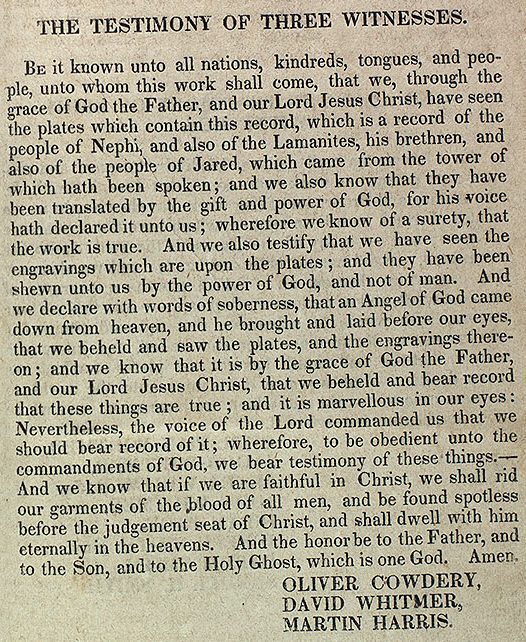
…they have been translated by the gift and power of God, for his voice hath declared it unto us… …an Angel of God came down from heaven, and he brought and laid before our eyes, that we beheld and saw the plates, and the engravings thereon…
Notice what is claimed and what is not. An angel brought the plates, a voice spoke, and they “beheld and saw.” The Three do not say they touched them. The Eight, by contrast, say “handle with our hands.”
Joseph Smith Papers, 1830 editionNobody has to say they were insincere.
The question is what their certainty can prove, when some of these men were just as certain of things the Church does not accept.
From the promise to the verdicts
The witnesses’ own later paths, as the Church itself records them.
Sources: Church History Topics; D&C 28 heading; Ensign, June 1979; D&C Historical Resources; Whitmer, Address to All Believers in Christ (1887)
The exhibits
Church sources first, then the witnesses in their own words. Where a source is late, secondhand, or hostile, the exhibit says so.
The Church of Jesus Christ, Church History Topics, “Witnesses of the Book of Mormon”
Published by the Church
What it establishes: The Church itself reports the excommunications and departures, and that Cowdery and Harris later returned. It also describes the Eight as “members of the Smith and Whitmer families.”
Read the page on churchofjesuschrist.orgDoctrine and Covenants 17:2-3, canonized scripture, given June 1829
Before the viewing
What it establishes: The viewing was promised on condition of faith, in advance, and the next verse says that after faith they would have “seen them with your eyes.” It is described as a “view,” the same word Whitmer later uses for a spiritual one.
Read D&C 17David Whitmer to Anthony Metcalf, Richmond, Missouri, in his own words, dictated to J. J. Snyder
2 April 1887
What it establishes: One of the Three, asked directly, says they were ‘in the spirit’ and saw ‘in a vision, or in the spirit,’ and in the same passage that they were ‘in the body also’ at noonday and it was ‘as natural to us, as it is at any time.’ He never recanted. Metcalf had told him Harris called it ‘being in vision’; Whitmer’s letter says: ‘Martin Harris, you say, called it “being in vision.”’
Whitmer’s letter, printed in Metcalf, Ten Years Before the Mast (1888)Martin Harris, as reported by John A. Clark, a minister hostile to Joseph Smith (thirdhand, from “a gentleman in Palmyra”)
Clark wrote in 1840 (Episcopal Recorder); the conversation he reports is undated
What it establishes: Thirdhand, from an unnamed source, and by a hostile minister. FAIR notes it mixes events from before and after Harris became a witness, so it is not evidence about what the Three saw in June 1829. It is listed because the same vocabulary appears in later accounts. The same sentence says Harris saw them ‘just as distinctly as I see any thing around me.’
FAIR’s page on the statementJohn H. Gilbert, the printer who set the testimony, memorandum written decades later
8 September 1892, recalling the setting of the 1830 type
What it establishes: Recollections recorded 49 to 62 years later, so weigh them accordingly: Gilbert’s earlier version, in a 16 March 1879 letter to James T. Cobb, has Harris answering “no, but with spiritual eyes.” It resembles Whitmer’s “in the spirit” wording. Believing readers point out that Harris used “spiritual” sight and “natural” sight as compatible, citing his 1875 Jensen interview.
FAIR’s page, citing Early Mormon Documents 2:548Doctrine and Covenants 28, section heading, canonized, September 1830
Printed in your scriptures
What it establishes: Hiram Page signed the Eight Witnesses statement. The Church’s own heading says Page’s stone claims deceived several members and that Cowdery was wrongly influenced by them. Page renounced the revelations after the revelation was given.
Read D&C 28David Whitmer, “An Address to All Believers in Christ”
1887
What it establishes: Whitmer ties the two claims together himself: ‘if you believe that God spake to us three witnesses by his own voice, then I tell you that in June, 1838, God spake to me again by his own voice from the heavens.’ The Church publishes the first claim as part of its scripture and did not follow the second; it excommunicated him in April 1838.
The Address, on FAIRThe Church of Jesus Christ, Ensign, June 1979, “Was Martin Harris ever excommunicated from the Church?”
Published by the Church
What it establishes: The Church’s own account. Strang claimed to have found and translated buried metal plates of his own. The same article says: “Through all of his waverings, Martin Harris never denied his testimony of the Book of Mormon, the one thing of which he had a sure knowledge.”
Read the Ensign articleJoseph Smith, Letter to the Church in Caldwell County, Missouri, from Liberty Jail
16 December 1838
What it establishes: Joseph’s own words about four of the eleven witnesses, written from Liberty Jail about six months after Whitmer says God told him to leave. The brackets are the Joseph Smith Papers’ editorial insertions, and the page adds Thomas B. Marsh and Orson Hyde to the list. In the passage quoted, Joseph judges their conduct and says nothing about their testimony; it was written during the 1838 Missouri conflict about men who had turned against him.
Joseph Smith Papers, p. 6“Burnett’s 1838 letter proves Harris admitted he never saw the plates.” Stephen Burnett, a disaffected member, wrote to Lyman Johnson on 15 April 1838 that Harris “never saw the plates with his natural eyes only in vision or imagination,” and that Harris had hefted the plates under cloth “but he never saw them only as he saw a city through a mountain.” This is one disaffected listener’s report of what Harris said in a public meeting, written in anger and not corroborated by anyone else present. A 2024 article from BYU’s Religious Studies Center concludes Burnett “is not a credible source for accurately understanding the experience of the Eight Witnesses,” and the letter contradicts what the Eight themselves consistently said. This site does not rest anything on it.
“Most of the witnesses followed James Strang.” Only Martin Harris is documented following Strang. Harris later helped organize McLellin’s Church of Christ, and Whitmer was briefly in it and founded his own church in 1875. That is a separate point.
The visual breakdown
Here is the second printed page, the one for the Eight, and then the three men of the first page side by side. Check the signatures against the families, and check the table against the Church’s own pages.
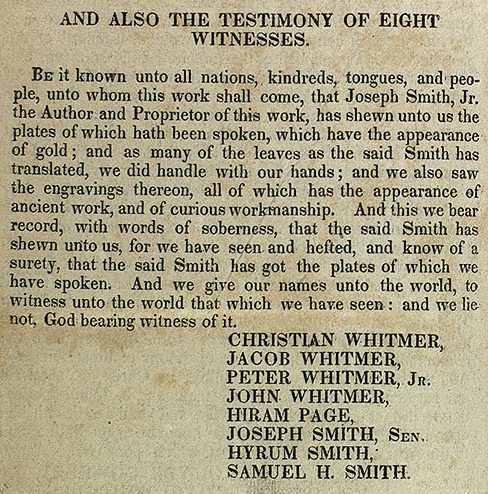
By blood or marriage, ten of the eleven witnesses were tied to the Whitmer or Smith families by 1832. Nine were by 1829: David and four more Whitmers, three Smiths, and Hiram Page, who married Catherine Whitmer in 1825. A tenth, Oliver Cowdery, married Elizabeth Ann Whitmer in 1832. Only Martin Harris has no family tie. Source: Church History Topics; D&C Historical Resources, bios of Page and Cowdery.
| The Three | What he signed in 1830 | What he said later | Other claims or movements the Church rejects | Where he ended up |
|---|---|---|---|---|
| Oliver Cowdery | An Angel of God “brought and laid before our eyes” the plates. | 1848 (Miller journal): “I beheld with my eyes, And handled with my hands the gold plates.” Last words, as Whitmer reports them: “be true to your testimony.” | Was “wrongly influenced” by Hiram Page’s stone revelations in 1830 (D&C 28 heading); Page renounced them after the revelation. | Excommunicated 1838; readmitted at Kanesville, Iowa, in 1848. |
| David Whitmer | The same. | 1884, reported: “I saw with these eyes and I heard with these ears.” 1887: “in a vision, or in the spirit,” and also “in the body.” | “God spake to me again by his own voice from the heavens” in 1838; Joseph “fell into error” (1887). | Left in 1838. Briefly involved in McLellin’s church; founded the Church of Christ (Whitmerite) in 1875. “Never at any time denied.” |
| Martin Harris | The same. | Reported by others, late or secondhand: “a spir[i]tual eye,” “the eye of faith.” 1871 letter: no man ever heard him deny “the administration of the angel.” | Joined James Strang’s church and served its mission to England; “avowed member of the Shakers” (Ensign); helped organize McLellin’s Church of Christ in 1847. | Rebaptized in Utah 17 Sept 1870; died 1875. “Never denied his testimony” (Ensign). |
The common rebuttals
“They never denied it, not once, even when they hated Joseph. A liar would have cracked.”
Agreed on every word, and the page begins with it. But a sincere witness is a different thing from an accurate one, and the question was always what he sincerely saw. Whitmer, asked a direct question in writing by Metcalf, says in 1887 that they were ‘in the spirit,’ saw ‘in a vision, or in the spirit,’ and also that ‘we were in the body also, and everything was as natural to us, as it is at any time.’ The believing reading is that it was a real event; the other reading is that it was a vision. His own words hold both. The revelation that arranged the viewing makes the view conditional on faith (‘by your faith that you shall obtain a view of them’), and then says ‘you…have seen them with your eyes.’ So his own testimony does not say which it was.
“But Cowdery said he ‘handled with my hands the gold plates,’ and Harris said he prayed to see it with natural eyes.”
Cowdery’s words are recorded in Reuben Miller’s journal of 21 October 1848, from a public conference at Kanesville ten years after his excommunication and the same year he was readmitted, and he made no retraction in between. The signed 1830 statement of the Three says “laid before our eyes” and does not mention handling. The Eight are the ones who say “handle with our hands,” and they were mostly Whitmers and Smiths. Harris, in an 1875 interview with Ole Jensen, said that Joseph, Cowdery, Whitmer, and he went into a grove to pray “to obtain a promise that we should behold it with our eyes natural eyes, that we could testify of it to the world.” Those are statements about what was sought and what happened, not a single clean answer. Whitmer says in 1884 ‘I saw with these eyes and I heard with these ears,’ and in 1887 both ‘in a vision, or in the spirit’ and ‘in the body also.’ Taken together, the accounts describe it in both physical and visionary terms, and they do not settle between them.
“Their later mistakes don’t cancel what they saw in 1829.”
True, and the Church’s own pages say they were fallible: the Ensign speaks of Harris’s “waverings,” and the Church records the departures of Cowdery, Harris, and Whitmer. The believing claim is narrow: they were truthful about one event. This page does not say their later errors cancel the event. It says something simpler: when men are sincere and also wrong about other things they were sure of, their certainty alone cannot show what kind of thing they saw. Whitmer says God spoke to him by his own voice in 1838; the Church excommunicated him that April. Page, one of the Eight, said a stone gave him revelations; D&C 28:11 says ‘Satan deceiveth him,’ and Page renounced them. Harris joined Strang, who claimed plates of his own. Being sure is not the same as being right.
Whitmer tied the two claims together himself.
He offered both in the same pamphlet. The Church takes the first as scripture and did not follow the second.
What this means
Lay the record out in order. The book promises three witnesses before three existed. A revelation told them they would see by faith, and then see with their eyes. They signed that an angel brought the plates before their eyes. Whitmer, asked by Anthony Metcalf in 1887 how it happened, wrote that they were in the spirit and saw in a vision, and also that they were in the body and it was as natural as anything. Harris, in accounts that range from hostile to late, used the language of the eye of faith and a spiritual eye, and also said, in 1875, that they prayed to behold it with natural eyes. The Eight, who handled the plates, were Whitmers, Smiths, and Page, who married a Whitmer. Cowdery and Harris returned to the Church, and none of the Three denied the testimony. Everything in the record is consistent with these men being sincere. Several of them also held to other claims the Church does not accept: a stone (Page), a voice from heaven (Whitmer), a second prophet with plates of his own (Harris).
They did not lie. But their certainty is the evidence offered, and the Church itself says some of these men were wrong about other things they were sure of.
You were probably taught that the witnesses are outside proof that the plates were physical. Read in order, their own words do not say that. Whitmer calls the experience both a vision and as natural as anything. If a man’s certainty about an angel counts as evidence for the plates, what does his equal certainty about a voice from heaven, a stone, or a second set of plates tell you about what certainty is worth?