The institution
The Shell Companies
According to the SEC’s findings, which the Church settled without admitting or denying, the Church’s senior leadership approved using separate companies to file its investment reports, to avoid disclosing the amount and nature of its assets.
The point in one sentence
According to the SEC’s findings, which the Church and Ensign Peak accepted in a settlement without admitting or denying them, the Church’s senior leadership approved a plan to avoid disclosing the amount and nature of its assets, and Ensign Peak carried it out for almost twenty years through thirteen LLCs, whose Forms 13F misstated that the LLCs held investment and voting discretion over the securities.
The world it came from
This page is about one thing: how the Church’s investment filings were structured, as described in a federal order. Every statement about the Church below is the SEC’s finding, made in a settled order, or the Church’s own statement. Where the money came from, what it has bought and what the courts did with the tithing lawsuits are on The Money, and are not repeated here.
In 1997 the Church created Ensign Peak Advisors. The SEC order describes it as “an integrated auxiliary of the Church” set up “to manage the Church’s investment securities,” with no shareholders or members. Its board was made up of members of the Presiding Bishopric and its own managing director, and the managing director “is appointed by the Church’s First Presidency and reports to the senior leadership of the Church.” The order defines that phrase for its own use: “senior leadership of the Church” means “the Church’s First Presidency and Presiding Bishopric.” At the start Ensign Peak managed approximately $7 billion of Church assets.
That put it under a federal rule most people have never heard of. Any institutional investment manager with investment discretion over at least $100 million in exchange-traded securities must file a Form 13F every quarter, listing the securities and their value. The order notes that these forms “are available to the public for review.” The SEC’s enforcement director put the principle this way: “The requirement to file timely and accurate information on Forms 13F applies to all institutional investment managers, including non-profit and charitable organizations.”
What the Church says, and what is true in it
The strongest case for the Church comes first, at full strength, because parts of it are simply correct.
The SEC order contains no finding that any money was misused, misspent or diverted. The violation it names is a disclosure violation: failing to file Forms 13F in Ensign Peak’s own name, and misstating information on the forms that were filed. Churches are also generally exempt from filing a Form 990, the public IRS financial return. The IRS instructions for Form 990 say that “A church, an interchurch organization of local units of a church, a convention or association of churches, or an integrated auxiliary of a church” is not required to file it. The Church’s own account of what happened is this:
The Church of Jesus Christ of Latter-day Saints, statement on the SEC settlement
Since 2000, Ensign Peak received and relied upon legal counsel regarding how to comply with its reporting obligations while attempting to maintain the privacy of the portfolio. As a result, Ensign Peak established separate companies (LLCs) that each filed Forms 13F instead of a single aggregated filing. Ensign Peak and the church believe that all securities required to be reported were included in the filings by the separate companies. The Church’s senior leadership received and relied upon legal counsel when it approved of the use of the external companies to make the filings. Ensign Peak handled the mechanics of the filing process. The Church’s senior leadership never prepared or filed the specific reports at issue.
February 21, 2023. The Church’s claim is that it sought privacy, that both Ensign Peak and the senior leadership relied on legal counsel, that leadership did not prepare or file the reports, and that every required security was in fact reported. The order does not discuss legal advice either way, and does not find that any required security was left out of the filings. (It does find, paragraphs 25 and 26, that Ensign Peak’s own staff prepared and filed the forms.) The order also records that the forms were publicly available and that the Church’s internal audits did not recommend specific changes to the structure.
The statement, on the Church NewsroomThe same statement, on the timeline and the close
In June 2019, the SEC first expressed concern about Ensign Peak’s reporting approach. Ensign Peak adjusted its approach and began filing a single aggregated report. Since that time, 13 quarterly reports have been filed in full accordance with SEC requirements. […] We affirm our commitment to comply with the law, regret mistakes made and now consider this matter closed.
The Church states that it has filed correctly since 2019. The order dates the first consolidated filing in Ensign Peak’s name on February 14, 2020, for the quarter ended December 31, 2019.
The full statement, as published by the Deseret NewsThe order does not say the money was misused. It says the Church sought to avoid disclosing the amount and nature of its assets.
Both of those are true at once, and the rest of this page is about the second one.
From the first LLC to the consolidated filing
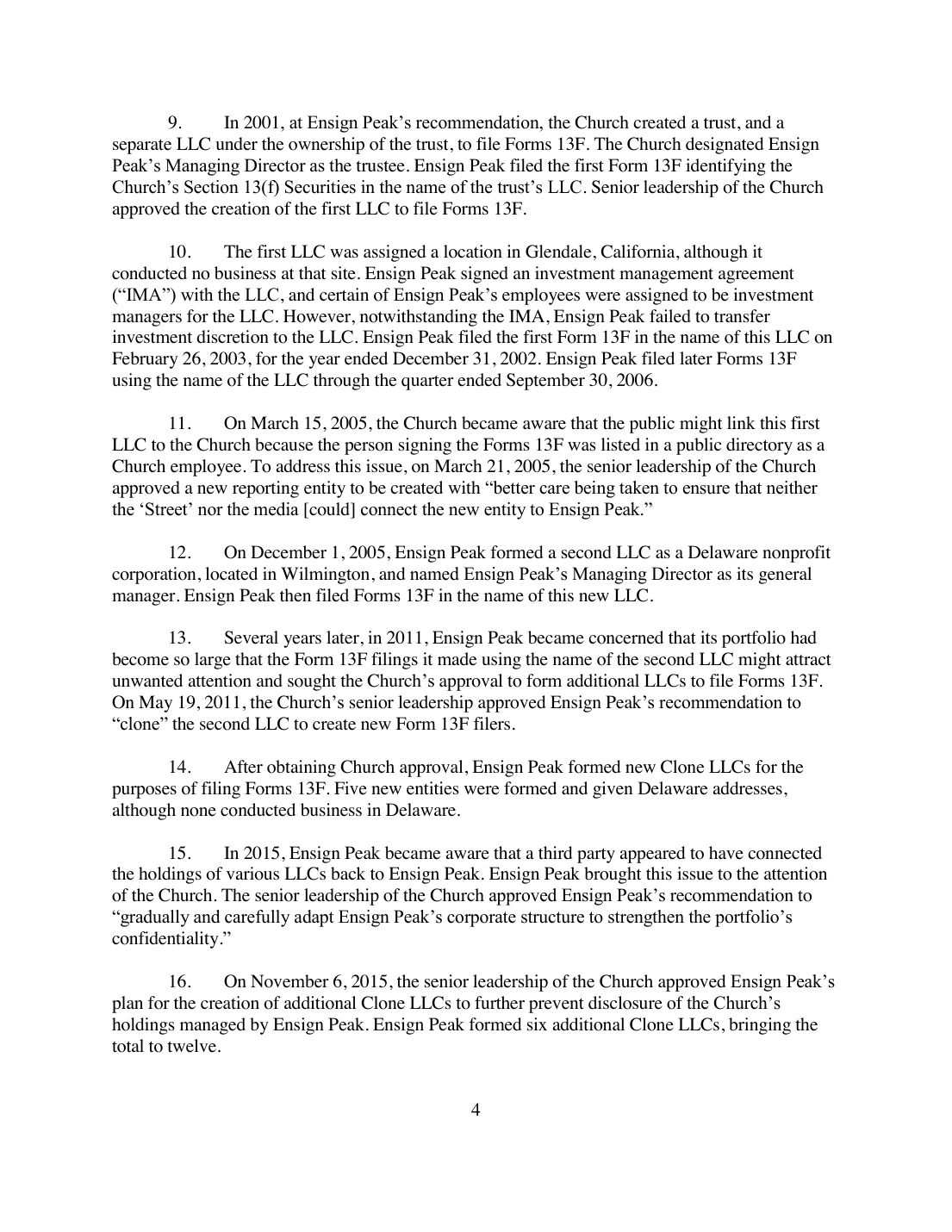
The dates are the order’s. Each approval below is described in the order as given by the Church’s senior leadership.
Sources: SEC order, Release No. 34-96951, Feb 21, 2023, paragraphs 3 to 16, 32 to 35; Church statement, Feb 21, 2023
The exhibits
Everything in this section is quoted from the order itself, or from the SEC’s announcement of it. Emphasis (bold) in the quotes below is added by this page. The order’s footnote says its findings “are made pursuant to Respondents’ Offers of Settlement and are not binding on any other person or entity in this or any other proceeding.” They are the Commission’s findings, made on the basis of the settlement offers. The Church and Ensign Peak consented to the order without admitting or denying them (they did admit the SEC’s jurisdiction).
SEC order, Summary, on the purpose of the LLCs
February 21, 2023
What it establishes: The order says the thirteen companies existed for the sole purpose of filing the forms and preventing public disclosure by Ensign Peak of the Church’s holdings. The forms themselves were public, filed under the LLCs’ names.
The order (PDF)SEC order, Summary, on who knew
February 21, 2023
What it establishes: In this finding the Church is not an uninvolved parent. The order says Ensign Peak developed the approach with the Church’s knowledge and approval, and that the Church sought to avoid disclosure of the amount and nature of its assets. Per the order, Ensign Peak prepared and filed the forms (paragraph 25).
The order (PDF)SEC order, paragraph 8, on the reason
February 21, 2023
What it establishes: The stated reason is the size of the portfolio and what disclosure would lead to. The order does not say what the consequences were feared to be.
The order (PDF)SEC order, paragraph 31, on the approval rule
February 21, 2023
What it establishes: Leaving the structure and filing in Ensign Peak’s own name required unanimous approval from the First Presidency and Presiding Bishopric.
The order (PDF)SEC order, paragraph 22, on the people who signed
February 21, 2023
What it establishes: The order adds that many of them were Church employees, that they performed no function beyond signing the forms, and that Ensign Peak gave them “very limited information” about the LLCs or why they were created.
The order (PDF)SEC order, paragraph 24, on the phone numbers
February 21, 2023
What it establishes: This describes one senior manager and one Business Manager, not the Church’s leadership. It is part of how the structure was run.
The order (PDF)SEC order, paragraph 34, on the 2018 resignations
February 21, 2023
What it establishes: After the structure was publicly reported in May 2018 it continued, with new signers, until the consolidated filing for the last quarter of 2019.
The order (PDF)SEC press release, on the penalties and the enforcement director
February 21, 2023
What it establishes: The release states Ensign Peak agreed to pay a $4 million penalty and the Church a $1 million penalty. The order says the Church “caused” Ensign Peak’s violations.
The SEC announcementThe filing, next to the facts
The single most checkable part of this story is the gap between what an LLC’s Form 13F said and what the order found. The order identifies several statements on the forms that it finds were misstated. Here they are, next to what the order found.
| On the form | What the form said or implied | What the order found |
|---|---|---|
| Who decided what to buy and vote | Each Clone LLC had “sole investment discretion,” “no other managers,” and “sole voting discretion” (paragraph 27). | “Ensign Peak continued to manage the entire portfolio and at all times maintained investment and voting discretion over all the securities listed” (paragraph 27). |
| Where the company was | An address outside Utah, chosen “to create the impression that the Clone LLCs conducted business operations throughout the U.S.” (paragraph 23). | “[N]one of them conducted any business at those locations other than the receipt of mail” (paragraph 23). |
| Where the signer signed | The address on the signature page (paragraph 29). | “[A]ll Business Managers were located in Salt Lake City” (paragraph 29). |
| What the signer attested | That “all information contained herein is true, correct and complete” (paragraph 28). | Ensign Peak gave the signers “only the signature pages of the Forms 13F and not the complete documents” (paragraph 28). |
| What the contracts said | Investment management agreements “assigned discretion and authority to manage the securities portfolio to the LLCs” (paragraph 18). | “[T]he Clone LLCs never exercised investment discretion over the Church’s assets” (paragraph 19). |
How the structure grew
The order’s own sequence of decisions, with the approvals it attributes to the Church’s senior leadership.
Source: SEC order, paragraphs 7 to 16, 32 to 35
The scale, as the order and the SEC state it
Not all of these figures measure the same thing, so read the labels.
Sources: SEC order, paragraphs 5, 33 and 35; SEC press release 2023-35. The 1997 figure is all assets, a significant share of them 13(f) securities, so it is not a like-for-like starting point.
Thirteen LLCs, each created, in the order’s words, for the sole purpose of filing Forms 13F.
What the whistleblower alleged
In November 2019 a former Ensign Peak employee, David Nielsen, filed an IRS whistleblower complaint. As the Deseret News reported on December 17, 2019, it alleged that Ensign Peak held between $99 billion and $101 billion, that it was not meeting IRS requirements for charitable spending, that Ensign Peak delivered $600 million to Beneficial in 2009, and that Ensign Peak improperly sent $1.4 billion from 2010 to 2014 to Property Reserve Inc., which funded City Creek. These are allegations; they are not findings.
The Church’s response to the complaint, December 17, 2019
We take seriously the responsibility to care for the tithes and donations received from members. […] Claims being currently circulated are based on a narrow perspective and limited information. The church complies with all applicable law governing our donations, investments, taxes and reserves.
Quoted in part. The SEC order covers only Forms 13F. It does not mention City Creek, Beneficial Life or the IRS complaint, so none of those allegations is part of what the government found here. They are covered, with the court cases that followed, on The Money.
The statement, as published by the Deseret NewsThe common rebuttals
“Churches don’t have to publish their finances. Wanting privacy is not a crime.”
Both halves are true. The IRS does not require a church to file a Form 990, and wanting privacy is not itself a securities violation. The order does not fault the Church for keeping its finances private. The violations it names are failing to file Forms 13F in Ensign Peak’s own name and filing forms in the names of LLCs that misstated, among other things, who held investment and voting discretion. By the order’s account, the LLCs existed for the sole purpose of filing the forms, the signers were chosen for common names, and the addresses were places where nothing happened except the receipt of mail.
“They were following their lawyers.”
That is the Church’s account: that Ensign Peak, and the Church’s senior leadership when it approved the structure, relied on legal counsel. It may be fully true. The order does not address legal advice either way. It speaks to whether anyone meant to break the law, which the order does not find or discuss. What the order does find is what the structure was for and what the forms said. It also records that two internal Church audits, in 2014 and 2017, highlighted the risk that the SEC might disagree, did not recommend specific changes, and that the approach continued. The Church settled without admitting or denying, and its statement closes: “We affirm our commitment to comply with the law, regret mistakes made and now consider this matter closed.”
“No tithing money was misused. It’s a reserve for the future.”
The order makes no finding of misuse, and this page makes no claim of it. The Church’s December 2019 statement defends the reserve as “a sound doctrinal and financial principle.” The Church regards its reserve as sound stewardship, and the order does not say otherwise. The order raises a separate matter: it finds that the Church’s senior leadership approved the structure because it sought to avoid disclosing the amount and nature of its assets, out of concern for what disclosure would bring. The Church’s stated reason is privacy, on legal advice. The order does not say what the feared consequences were.
The order does not say the money was misused. It says the Church sought to avoid disclosing its size.
What to make of that is left to the reader.
What this means
Here is what the order finds. A Church entity was required to file public forms listing its securities. According to the SEC’s findings, the Church’s senior leadership approved, in 2001, 2005, 2011 and 2015, a series of LLCs to file them instead, out of concern that disclosure in Ensign Peak’s name would bring “negative consequences” given the size of the portfolio. Ensign Peak prepared and filed the forms. The signers were chosen for common names. The LLCs’ addresses were places where nothing happened except the receipt of mail. The forms said each LLC had sole investment and voting discretion, and the order finds Ensign Peak kept it. After a website reported the links in 2018, two of the signers resigned and were replaced, and the filings went on until early 2020. Two internal Church audits had highlighted the risk, without recommending specific changes. The Church and Ensign Peak settled without admitting or denying the findings and agreed to pay penalties of $1 million and $4 million. The Church says it relied on legal counsel, believes every required security was reported, and regrets mistakes made.
Members who seek a temple recommend are asked a list of questions the Church publishes. One of them:
The temple recommend questions, read by President Russell M. Nelson at the October 2019 general conference
Do you strive to be honest in all that you do?
One of the questions on the list. The Church’s announcement says: “These current updates clarify, but do not change, worthiness requirements to enter a temple.” The question is asked of individual members. This page does not claim it is a rule about the institution, only that it states what the Church asks of the people it asks it of.
The questions, on the Church NewsroomMembers seeking a temple recommend are asked whether they strive to be honest in all that they do. According to the SEC’s findings, which the Church settled without admitting or denying, the Church’s senior leadership approved a structure in which Ensign Peak filed Forms 13F in the names of LLCs, to avoid disclosing the amount and nature of the Church’s assets, and those forms misstated who held investment and voting discretion. The Church says its leadership relied on legal counsel and did not prepare or file the reports.
The Church’s account is that it took legal advice, wanted privacy, and has filed correctly since 2019. The order’s findings are about the dates, the approvals, and the structure of the filings. A reader can hold both. Whether the Church had the right to keep its finances private is not in dispute. What each reader may weigh is how to square a standard of honesty that the Church asks of its members with a filing structure that the SEC found was created for the sole purpose of filing the forms and preventing public disclosure by Ensign Peak, and whose forms misstated who held discretion, set against the Church’s statement that it relied on counsel.