The institution
Seventeen Million Members
The Church counts names on a membership record. In the three countries checked here, far fewer people told their census they belong.
The point in one sentence
If you grew up in the Church, you have heard the big number: 17,887,212, reported as “total membership,” and the Church’s own Handbook says membership is a matter of records, not of attendance or belief. In Brazil, Mexico and Chile, a national census asked people directly what religion they belong to. Only about one in five to one in four of the Church’s count said they are Latter-day Saints. The 17.9 million is a count of records, not of people who say they belong, so its size and growth cannot be offered as proof of how many people believe.
The world the number came from
In 1980 the Church reported 4,638,000 members. By the end of 1990 it was 7,760,000, and by the end of 2000, 11,068,861. Of today’s 17,887,212, the Church reports 6,929,770 in the United States. That means about 61 percent of the total is in other countries.
The Church’s own page for Brazil says that “The Portuguese translation of the Book of Mormon, first published in 1940, signaled a new era for the Church in Brazil,” and reports 1,573,360 members there at the end of 2025. Its page for Mexico says that “In 2004 Mexico became the second country (after the United States) with one million Latter-day Saints,” and reports 1,572,287 today. Chile is at 624,203.
This is a real achievement of organization, devotion and sacrifice, and nothing on this page takes that from the missionaries who did it. But it set up a question that has to be asked once the numbers get this large: what, exactly, is being counted?
What the Church and its members say
Start with the believing case at full strength, because it is a strong one. The Church does not say that every name on its rolls is a weekly attendee, and it is not hiding that: its president told its priesthood in 1997 that converts were being neglected and that the Church had to work to retain them. Its own scripture, in a verse members read as describing the latter-day Church, speaks of the church of the Lamb as few in number. Its theology has a specific answer for everyone the numbers leave out. And it can point to something no census contradicts: hundreds of thousands of people are baptized every year.
General Handbook, section 33.6.2, “Members of Record”
“Those who have been baptized and confirmed” · “Those under age 9 who have been blessed but not baptized” · “Those who are not accountable because of intellectual disabilities, regardless of age” · “Unblessed children under age 9” when at least one parent or one grandparent is a member of the Church and both parents give permission.
This is the Church’s own definition of who is a member of record. It is a definition of a record. Nothing in the list depends on attendance, belief, or how a person would answer a census.
Read the General Handbook, chapter 33President Gordon B. Hinckley, priesthood session of general conference, October 1997, “Some Thoughts on Temples, Retention of Converts, and Missionary Service”
“Unfortunately, with this acceleration in conversions, we are neglecting some of these new members.” The next sentence: “I am hopeful that a great effort will go forward throughout the Church, throughout the world, to retain every convert who comes into the Church.”
The Church’s president, to the Church’s priesthood, in 1997: as conversions accelerated, new members were being neglected, and he said so plainly. This is the believing answer in its strongest form: the Church’s leaders know retention is a problem and are working on it.
Read the address on churchofjesuschrist.org1 Nephi 14:12, Book of Mormon
“And it came to pass that I beheld the church of the Lamb of God, and its numbers were few, because of the wickedness and abominations of the whore who sat upon many waters; nevertheless, I beheld that the church of the Lamb, who were the saints of God, were also upon all the face of the earth; and their dominions upon the face of the earth were small, because of the wickedness of the great whore whom I saw.”
Nephi’s vision describes a church whose numbers are few and whose dominions are small. Two verses later, “the power of the Lamb of God” descends on the saints, “and they were armed with righteousness and with the power of God in great glory” (14:14). A member can fairly say that a modest count was predicted. Compare Matthew 7:14, KJV: “Because strait is the gate, and narrow is the way, which leadeth unto life, and few there be that find it.”
1 Nephi 14 on churchofjesuschrist.orgDoctrine and Covenants 1:30
“the only true and living church upon the face of the whole earth, with which I, the Lord, am well pleased…”
This is the claim the numbers are being asked to sit beside: not that the Church is large, but that it is the only true and living church.
D&C 1 on churchofjesuschrist.orgA record is not a headcount.
If numbers matter, the rolls have to be checked against people. If numbers do not matter, then growth is not an argument either. Either way, 17.9 million is a count of records, not of people who say they belong.
What the Church’s own year-end reports show
Reported membership at the close of each year, and the average yearly growth between the points. The rate is my arithmetic from the Church’s totals.
Sources: the Church’s statistical reports for 1980, 1990, 1999 to 2000, 2009 to 2010, 2019, 2024 and 2025; Church country pages for Mexico, Brazil and the United States. Details on the sources page.
The exhibits
What follows is the record: first the Church’s own words and numbers, then the government counts and the surveys. Every figure is dated and linked.
General Handbook, section 33.6.4, on records of members who cannot be located
Current edition
What it establishes: Lost-member records are left out of ward statistics. The Church’s published worldwide totals do not say how, or whether, those records are treated, so this page does not claim they are in or out.
General Handbook, chapter 33The Church of Jesus Christ of Latter-day Saints, 2025 statistical report
As of December 31, 2025
What it establishes: The headline number. The report gives counts of records and of baptisms. I found no sentence in it that defines membership or gives an activity rate, which is why the definition above comes from the Handbook.
2025 statistical reportThe Church’s page for the United States
Last updated 31 Dec 2025
What it establishes: About 39 percent of the rolls are in the United States and about 61 percent elsewhere. That is why the census checks below are abroad and the Pew check is at home.
Church page, United StatesMexico’s national statistics institute (INEGI), 2010 census, Panorama de las religiones en México 2010
Published 2011
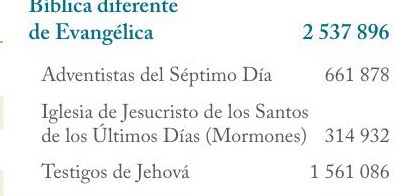
What it establishes: The count of people who told the census they belong. The same table lists 92,924,489 Catholics and 1,561,086 Jehovah’s Witnesses out of a national population of 112,336,538.
INEGI report (PDF)Brazil’s statistics institute (IBGE), 2010 census, table 137 (population by religion)
2010
What it establishes: This table covers all residents, not only adults, so age cannot explain the gap with the Church’s own figure for the same period.
IBGE data (SIDRA table 137)Pew Research Center, Religious Landscape Study, 36,908 U.S. adults surveyed July 17, 2023 to March 4, 2024
Published September 22, 2026
What it establishes: Pew notes that the three earlier surveys were by telephone and the 2023-24 study mainly online and on paper, and says an experimental telephone survey run alongside it indicates the comparisons are safe to make. It is a measure of identification, not attendance or belief, and it covers the United States only.
Read the Pew reportcumorah.com country report for Chile, on the 2002 Chilean census
Report data through 2009
What it establishes: A church-growth research site, cited here for the 2002 figure. The same report notes the census excluded those under age 15.
cumorah.com, ChileThe gap, country by country
The Mexican table above is the real document. Here is the same check for three countries, with the Church’s own count of the period next to what people said to their government. Check any row yourself; the links are on the sources line.
Reported members and census self-identification
Church-reported membership (last year-end before the census, as compiled from the Church Almanac) against people who told the census they are Latter-day Saints.
| Country and census | Church-reported members | Counted by the census | Census count as a share of Church count |
|---|---|---|---|
| Brazil, 2010 | 1,102,674 (year-end 2009) | 226,509 (all ages) | about 21% |
| Mexico, 2010 | 1,158,236 to 1,197,573 (year-end 2009; two compilations differ) | 314,932 (national table) | about 26% to 27% |
| Chile, 2002 | 509,592 (year-end 2000) to 527,972 (2002), per cumorah.com | 103,735 (ages 15 and over only) | about 20% |
Church figures for 2009: the Wikipedia tables for Mexico and Brazil, which cite the Deseret News Church Almanac, and, for the upper Mexico figure, cumorah.com. I did not see the Almanac itself, and the Church’s own country pages carry only current figures. Chile: cumorah.com. Census figures: INEGI and IBGE directly (Chile via cumorah.com).
Census count as a share of the Church-reported count
The first row is the Church-reported count, set at 100 percent. The other rows are what the censuses counted, as a share of it.
Ratios are my arithmetic: 314,932 over 1,158,236 (27.2%) and over 1,197,573 (26.3%); 226,509 over 1,102,674 (20.5%); 103,735 over 509,592 (20.4%) and over 527,972 (19.6%); cumorah.com itself says ‘just under 20%.’
This is not an accusation that anyone padded a number. The Handbook defines who should have a membership record, and a Church president said from the pulpit in 1997 that new converts were being neglected and urged the Church to retain them. Three details also keep the comparison honest. The Church Almanac figures are for the year before the census, so some of the gap is timing. The Church count includes children on record, and Chile’s census counted only people 15 and over, so the age cutoff makes the census share look lower than a like-for-like share would, and the sources do not say by how much. And the newest census figures I could verify are from 2010 and 2002. What does not change is the order of magnitude: in all three countries the census count comes to about a fifth to a little over a quarter of the Church’s count, and in Brazil the census table includes every age.
Raised Latter-day Saint, and still identify as one
Americans in the Pew Religious Landscape Study. The first row is everyone raised in the Church.
Sources: Pew Research Center, Sept 22, 2026 (two reports); Pew, Dec 15, 2025, for the Catholic figure. Pew cautions that results split by age and gender rest on fewer interviews and carry larger margins of error.
What is true on the other side
Three things belong here at full weight, because they are real.
The people who stay are devoted. Pew finds that 71 percent of lifelong Latter-day Saints, and 63 percent of converts, attend religious services in person at least weekly. Whatever the rolls hold, the people who still claim the label are not casual about it.
The Church is not unusual in losing people. In the same study, 57 percent of those raised Catholic and 45 percent of those raised Buddhist still identify that way, against 54 percent for the Church, while Protestants (70 percent), Jews (76), Muslims (77) and Hindus (82) retain more.
Convert baptisms rose in 2025. The Church reported 385,490 convert baptisms in 2025, up from 308,682. At the same time, new children of record fell from 114,550 in 2015 to 91,835 in 2025, about 20 percent. The Church’s reports do not say why.
None of that touches the page’s point, which was never that the Church is dying. It is that the number the Church publishes is not a count of people who say they belong.
The common rebuttals
“The Church never said every name on the rolls is active.”
Correct, and the page agrees: that is the whole point. The Handbook defines a member of record by baptism and confirmation, and by the other categories in section 33.6.2, none of which is attendance or belief. President Hinckley said in 1997 that new members were being neglected as conversions accelerated. So 17,887,212 is a count of membership records, and the Church’s report does not call it anything else. Reading it as 17.9 million people who would tell you they are Latter-day Saints is a different claim. When governments asked, in Brazil and Mexico in 2010 and Chile in 2002, the number of people who said they were Latter-day Saints came to about a fifth to a quarter of the count.
“Census numbers are unreliable. People misreport their religion all the time.”
Self-identification is a real measurement with real limits, and the caveats above stand. The Brazilian table that gives 226,509 also gives the whole resident population of 190,755,799, so age is not the explanation, and the Mexican table lists 314,932 on the same page as 92,924,489 Catholics. Timing and wording can move a figure, but nothing on this page suggests they would account for a gap this size in three countries.
“Every church loses people, and the Church is growing anyway.”
Both are true, and both are on this page: Catholics retain 57 percent, and 385,490 people were baptized in 2025. Neither answers the question. A record is created at baptism, and nothing in the Handbook’s list ties it to continued identification, so the rolls can keep growing while the number of people who identify does not. Growth in the rolls and growth in the people are two different measurements, and the Church publishes only the first.
“The Book of Mormon says the true church would be few. Small numbers are what we should expect.”
That is a fair reading of 1 Nephi 14:12, and the page leaves it standing. Two verses later the same vision has the power of God descending on the saints, which members take as part of the picture. It also cuts the other way. If a small count is what the true church looks like, then a large count is no evidence for it, and the argument from growth has to be dropped. Either way, the headline number cannot be used to show the Church is true.
A name on a record is not a person who says they belong.
In the three countries checked, when their own governments asked, the answer came back at about a fifth to a quarter of the Church’s count.
What this means
Here is what you just saw. The Church’s Handbook defines who should have a membership record, mainly by baptism and confirmation, with no test of attendance or belief. The Church’s published total, 17,887,212, is reported as “total membership” with no further definition; this page reads it as a count of those records. 61 percent of that total is outside the United States. In Mexico’s 2010 census, 314,932 people said they were Latter-day Saints, where the Church’s own count for the period was more than a million. In Brazil’s, 226,509 of a population of 190,755,799, against about 1.1 million on the rolls. In Chile’s 2002 census, 103,735 people aged 15 and over, against about half a million on the rolls. In the United States, 54 percent of the people raised in the Church still identify with it, down from 70 percent in 2007, while 71 percent of lifelong members and 63 percent of converts attend weekly.
The Church’s own scripture speaks of the church of the Lamb as few in number, and the Church’s own handbook defines membership by records, not by attendance or belief. By its own words, the headline number is not a count of people who say they belong.
If a small count is what a true church looks like, then a count of 17.9 million is not an argument. If a large count is supposed to mean something, then it has to be a count of people who say they belong, and when governments counted people, they found about a fifth to a quarter of it. So the 17.9 million is a count of records. It is not evidence of how many people believe, and it is not evidence that the Church is true.